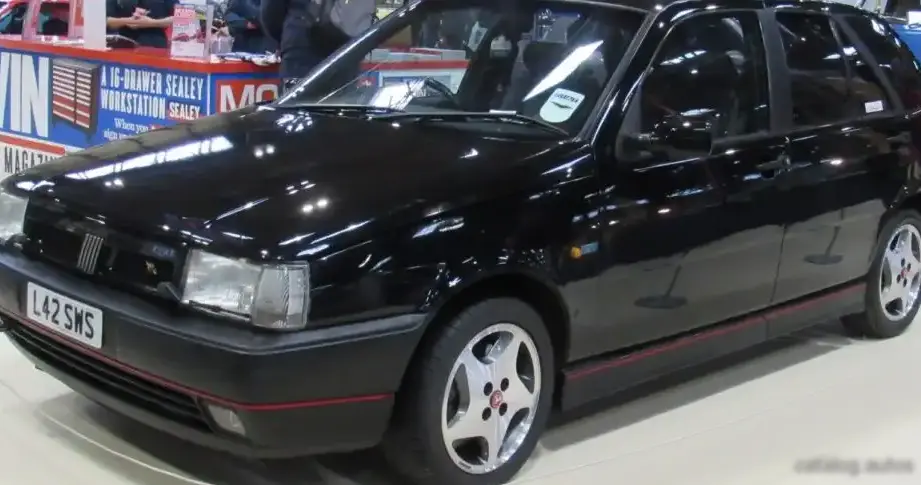
The Fiat Tipo (358) Wagon 1.3 MultiJet 95 HP, introduced with the 2020 facelift, represents an entry-level diesel option within the Tipo station wagon range. Positioned as a fuel-efficient and practical choice, it aimed to provide affordable family transport in European markets. This variant builds upon the foundation of the Tipo platform (shared with the Opel/Vauxhall Astra) and offers a balance between running costs and usability. Production of this specific configuration ran from 2020 onwards, continuing as part of the broader Tipo lineup.
Technical Specifications
| Brand | Fiat |
| Model | Tipo |
| Generation | Tipo (358, facelift 2020) Wagon |
| Type (Engine) | 1.3 MultiJet (95 Hp) |
| Start of production | 2020 |
| Powertrain Architecture | Internal Combustion engine |
| Body type | Station wagon (estate) |
| Seats | 5 |
| Doors | 5 |
| Fuel consumption at Low speed (WLTP) | 5.1-5.2 l/100 km (46.1 – 45.2 US mpg, 55.4 – 54.3 UK mpg, 19.6 – 19.2 km/l) |
| Fuel consumption at Medium speed (WLTP) | 4.2-4.3 l/100 km (56 – 54.7 US mpg, 67.3 – 65.7 UK mpg, 23.8 – 23.3 km/l) |
| Fuel consumption at high speed (WLTP) | 3.7 l/100 km (63.6 US mpg, 76.3 UK mpg, 27 km/l) |
| Fuel consumption at very high speed (WLTP) | 4.7-4.8 l/100 km (50 – 49 US mpg, 60.1 – 58.9 UK mpg, 21.3 – 20.8 km/l) |
| Combined fuel consumption (WLTP) | 4.4 l/100 km (53.5 US mpg, 64.2 UK mpg, 22.7 km/l) |
| CO2 emissions (WLTP) | 114-116 g/km |
| Fuel consumption (economy) – combined (NEDC) | 4.5 l/100 km (52.3 US mpg, 62.8 UK mpg, 22.2 km/l) |
| CO2 emissions (NEDC) | 119 g/km |
| Fuel Type | Diesel |
| Acceleration 0 – 100 km/h | 13.5 sec |
| Acceleration 0 – 62 mph | 13.5 sec |
| Acceleration 0 – 60 mph | 12.8 sec |
| Maximum speed | 180 km/h (111.85 mph) |
| Emission standard | Euro 6d Final |
| Weight-to-power ratio | 13.8 kg/Hp, 72.5 Hp/tonne |
| Weight-to-torque ratio | 6.6 kg/Nm, 152.7 Nm/tonne |
| Power | 95 Hp @ 3750 rpm |
| Power per litre | 76.1 Hp/l |
| Torque | 200 Nm @ 1500 rpm (147.51 lb.-ft. @ 1500 rpm) |
| Engine layout | Front, Transverse |
| Engine Model/Code | 55283775 |
| Engine displacement | 1248 cm3 (76.16 cu. in.) |
| Number of cylinders | 4 |
| Engine configuration | Inline |
| Cylinder Bore | 69.6 mm (2.74 in.) |
| Piston Stroke | 82 mm (3.23 in.) |
| Compression ratio | 16.8:1 |
| Number of valves per cylinder | 4 |
| Fuel injection system | Diesel Commonrail |
| Engine aspiration | Turbocharger, Intercooler |
| Engine oil capacity | 3.9 l (4.12 US qt | 3.43 UK qt) |
| Coolant | 6.1 l (6.45 US qt | 5.37 UK qt) |
| Kerb Weight | 1310 kg (2888.06 lbs.) |
| Max. weight | 1860 kg (4100.6 lbs.) |
| Max load | 550 kg (1212.54 lbs.) |
| Trunk (boot) space – minimum | 550 l (19.42 cu. ft.) |
| Fuel tank capacity | 50 l (13.21 US gal | 11 UK gal) |
| Permitted trailer load with brakes (12%) | 1500 kg (3306.93 lbs.) |
| Permitted trailer load without brakes | 500 kg (1102.31 lbs.) |
| Permitted towbar download | 60 kg (132.28 lbs.) |
| Length | 4571 mm (179.96 in.) |
| Width | 1792 mm (70.55 in.) |
| Height | 1514 mm (59.61 in.) |
| Wheelbase | 2638 mm (103.86 in.) |
| Front track | 1542 mm (60.71 in.) |
| Rear (Back) track | 1543 mm (60.75 in.) |
| Front overhang | 893 mm (35.16 in.) |
| Rear overhang | 1040 mm (40.94 in.) |
| Minimum turning circle (turning diameter) | 10.9 m (35.76 ft.) |
| Drivetrain Architecture | The Internal combustion engine (ICE) drives the front wheels of the vehicle. |
| Drive wheel | Front wheel drive |
| Number of gears and type of gearbox | 5 gears, manual transmission |
| Front suspension | Independent type McPherson |
| Rear suspension | Coil spring, Elastic beam |
| Front brakes | Disc, 281 mm |
| Rear brakes | Disc, 264 mm |
| Assisting systems | ABS (Anti-lock braking system) |
| Steering type | Steering rack and pinion |
| Power steering | Electric Steering |
Powertrain & Engine Architecture
The heart of this Tipo Wagon is the 1.3 MultiJet diesel engine, identifiable by its engine code 55283775. This is a four-cylinder, inline engine displacing 1248 cc. It utilizes a turbocharger with an intercooler to boost power output to 95 horsepower at 3750 rpm and 200 Nm (147.51 lb-ft) of torque at a low 1500 rpm. The engine employs a diesel common rail direct injection system, crucial for efficient combustion and reduced emissions. The high compression ratio of 16.8:1 is typical for diesel engines, contributing to their thermal efficiency. The engine is transversely mounted in the front of the vehicle. The 5-speed manual transmission is the only gearbox option available with this engine, prioritizing fuel economy over outright performance.
Driving Characteristics
The 1.3 MultiJet 95 HP variant of the Tipo Wagon delivers a driving experience focused on practicality and fuel efficiency. Acceleration from 0-100 km/h (0-62 mph) takes approximately 13.5 seconds, and top speed is limited to 180 km/h (111.85 mph). While not particularly quick, the engine provides adequate power for everyday driving and highway cruising. The turbocharger helps to mitigate turbo lag, offering a reasonable amount of torque at lower engine speeds. The 5-speed gearbox is geared for economy, meaning higher engine speeds are required for brisk acceleration. Compared to higher-output versions of the Tipo, such as those with more powerful diesel engines or gasoline options, this variant feels noticeably slower. However, it excels in fuel economy, making it a compelling choice for drivers covering long distances.
Equipment & Trim Levels
The 1.3 MultiJet 95 HP trim typically represents the entry point into the Tipo Wagon range. Standard equipment generally includes air conditioning, power steering, electric front windows, a basic audio system with USB connectivity, and ABS brakes. Safety features such as electronic stability control and multiple airbags are also standard. Interior upholstery is typically cloth, and the dashboard features a functional, if somewhat basic, design. Optional extras could include alloy wheels, a touchscreen infotainment system with navigation, rear parking sensors, and cruise control. The trim level often dictates the availability of these options.
Chassis & Braking
The Tipo Wagon utilizes a McPherson strut independent suspension setup at the front and a coil spring elastic beam axle at the rear. This configuration provides a reasonable balance between ride comfort and handling. The front brakes are ventilated discs measuring 281 mm, while the rear brakes are solid discs measuring 264 mm. ABS (Anti-lock Braking System) is standard. Given the vehicle’s weight (approximately 1310 kg / 2888 lbs), the braking system is adequate for typical driving conditions. Stabilizer bars are fitted to both the front and rear axles to reduce body roll during cornering.
Market Reception & Comparison
The Fiat Tipo Wagon 1.3 MultiJet 95 HP was generally well-received as a practical and affordable family car. Critics praised its fuel efficiency and spacious interior, particularly the generous boot space (550 liters). However, some reviewers noted the engine’s lack of outright performance and the somewhat basic interior trim. Compared to other diesel-powered estate cars in its class, the Tipo offered a competitive price point and a good level of standard equipment. Its fuel economy figures were generally favorable, making it an attractive option for high-mileage drivers. Compared to the petrol variants, the diesel offered significantly better fuel consumption, but at the cost of some refinement.
Legacy
The 1.3 MultiJet engine, in various iterations, has proven to be a relatively reliable powertrain. While diesel engines are inherently more complex than their gasoline counterparts, the MultiJet design has a good track record for durability. Common issues, if any, tend to be related to the diesel particulate filter (DPF), particularly on vehicles used primarily for short journeys. In the used car market, the Tipo Wagon 1.3 MultiJet 95 HP represents a good value proposition for buyers seeking a practical and economical estate car. Its relatively low running costs and spacious interior continue to make it a popular choice, though potential buyers should ensure the DPF has been properly maintained.