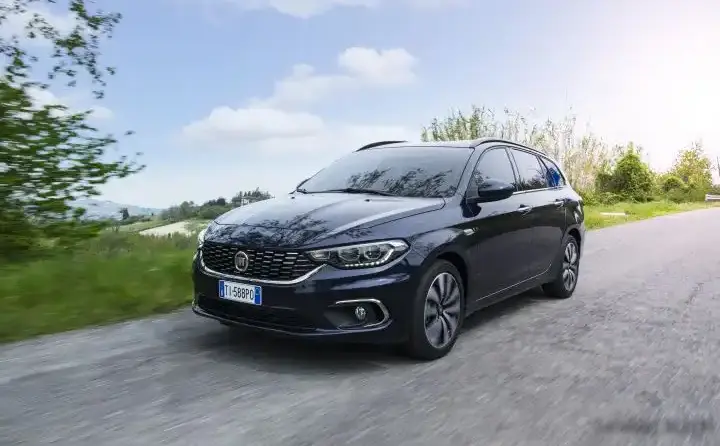
The Fiat Tipo (358) Wagon 1.3, producing 95 horsepower, was a key variant in the Tipo lineup, particularly in European markets, from 2016 to 2018. Positioned as an entry-level offering within the wagon body style, it aimed to provide practical, fuel-efficient transportation for families and individuals. This model represented Fiat’s attempt to recapture a segment of the market where they had previously been less competitive, offering a compelling blend of space, economy, and affordability. It was built on the C-segment platform shared with other Stellantis vehicles, offering a relatively modern and well-equipped package for its price point.
Technical Specifications
| Brand | Fiat |
| Model | Tipo |
| Generation | Tipo (358) Wagon |
| Type (Engine) | 1.3 (95 Hp) |
| Start of production | 2016 |
| End of production | 2018 |
| Powertrain Architecture | Internal Combustion engine |
| Body type | Station wagon (estate) |
| Seats | 5 |
| Doors | 5 |
| Fuel consumption (urban) | 4.5 l/100 km (52.3 US mpg, 62.8 UK mpg, 22.2 km/l) |
| Fuel consumption (extra urban) | 3.3 l/100 km (71.3 US mpg, 85.6 UK mpg, 30.3 km/l) |
| Fuel consumption (combined) | 3.7 l/100 km (63.6 US mpg, 76.3 UK mpg, 27 km/l) |
| CO2 emissions | 99 g/km |
| Fuel Type | Diesel |
| Acceleration 0 – 100 km/h | 12.3 sec |
| Acceleration 0 – 62 mph | 12.3 sec |
| Acceleration 0 – 60 mph | 11.7 sec |
| Maximum speed | 180 km/h (111.85 mph) |
| Emission standard | Euro 6 |
| Weight-to-power ratio | 14.5 kg/Hp, 69.1 Hp/tonne |
| Weight-to-torque ratio | 6.9 kg/Nm, 145.5 Nm/tonne |
| Power | 95 Hp @ 3750 rpm |
| Power per litre | 76.1 Hp/l |
| Torque | 200 Nm @ 1500 rpm (147.51 lb.-ft. @ 1500 rpm) |
| Engine layout | Front, Transverse |
| Engine Model/Code | 55283775 |
| Engine displacement | 1248 cm3 (76.16 cu. in.) |
| Number of cylinders | 4 |
| Engine configuration | Inline |
| Cylinder Bore | 69.6 mm (2.74 in.) |
| Piston Stroke | 82 mm (3.23 in.) |
| Compression ratio | 16.8:1 |
| Number of valves per cylinder | 4 |
| Fuel injection system | Diesel Commonrail |
| Engine aspiration | Turbocharger, Intercooler |
| Engine oil capacity | 3.9 l (4.12 US qt | 3.43 UK qt) |
| Coolant capacity | 6.1 l (6.45 US qt | 5.37 UK qt) |
| Kerb Weight | 1375 kg (3031.36 lbs.) |
| Max. weight | 1875 kg (4133.67 lbs.) |
| Max load | 500 kg (1102.31 lbs.) |
| Trunk (boot) space – minimum | 550 l (19.42 cu. ft.) |
| Fuel tank capacity | 50 l (13.21 US gal | 11 UK gal) |
| Permitted trailer load with brakes (12%) | 1200 kg (2645.55 lbs.) |
| Length | 4571 mm (179.96 in.) |
| Width | 1792 mm (70.55 in.) |
| Height | 1514 mm (59.61 in.) |
| Wheelbase | 2638 mm (103.86 in.) |
| Front track | 1542 mm (60.71 in.) |
| Rear track | 1543 mm (60.75 in.) |
| Front overhang | 893 mm (35.16 in.) |
| Rear overhang | 1040 mm (40.94 in.) |
| Minimum turning circle | 10.93 m (35.86 ft.) |
| Drivetrain Architecture | Front wheel drive |
| Number of gears | 5 |
| Gearbox type | Manual transmission |
| Front suspension | Independent type McPherson |
| Rear suspension | Semi-independent, coil spring |
| Front brakes | Disc |
| Rear brakes | Disc |
| Assisting systems | ABS (Anti-lock braking system) |
| Steering type | Steering rack and pinion |
| Power steering | Electric |
Powertrain & Engine Architecture
The heart of the Tipo Wagon 1.3 was the Fiat MultiJet 1.3-liter turbocharged diesel engine, internally designated as the 55283775. This engine was a member of the Fiat Group’s family of small-displacement diesel engines, known for their fuel efficiency and relatively low emissions. It featured a common rail direct injection system, delivering fuel at extremely high pressure for optimized combustion. The engine employed a fixed-geometry turbocharger with an intercooler to boost power and torque. The 1.3-liter engine produced 95 horsepower at 3750 rpm and 200 Nm (147.51 lb-ft) of torque at 1500 rpm. This torque output, available from relatively low engine speeds, was a key characteristic of the engine, providing good drivability in everyday conditions. The engine was paired with a five-speed manual transmission, which was the only transmission option available for this variant.
Driving Characteristics
The 1.3-liter diesel engine, coupled with the five-speed manual gearbox, provided adequate, though not exhilarating, performance. Acceleration from 0 to 60 mph took around 11.7 seconds, and the top speed was approximately 111.85 mph. The engine’s strength lay in its mid-range torque, making it suitable for highway cruising and overtaking maneuvers. However, it could feel strained when pushed hard, especially when fully loaded. The gear ratios were well-chosen for fuel efficiency, but they didn’t prioritize sporty driving. Compared to higher-output versions of the Tipo, such as those equipped with the 1.6-liter gasoline engine, the 1.3 diesel offered significantly less power but superior fuel economy. The manual transmission provided a more engaging driving experience than an automatic would have, but it required more driver involvement.
Equipment & Trim Levels
The 1.3-liter Tipo Wagon typically came with a reasonable level of standard equipment. This included air conditioning, power windows, central locking, a basic audio system with USB connectivity, and ABS brakes. Safety features such as electronic stability control (ESC) and traction control were also standard. Interior upholstery was typically cloth, and the dashboard featured a functional, if somewhat basic, design. Optional extras included alloy wheels, a touchscreen infotainment system with navigation, rear parking sensors, and cruise control. The trim level was generally considered entry-level, focusing on providing essential features at an affordable price point.
Chassis & Braking
The Tipo Wagon utilized a McPherson strut front suspension and a semi-independent coil spring rear suspension. This setup provided a comfortable ride quality, although it wasn’t particularly sporty. The front brakes were ventilated discs, while the rear brakes were solid discs. The steering was electrically assisted, providing light and easy steering feel. The chassis was designed to prioritize practicality and comfort over outright handling performance. The weight distribution was reasonably balanced, contributing to stable handling characteristics.
Market Reception & Comparison
The Fiat Tipo Wagon 1.3 received generally positive reviews for its fuel efficiency, spacious interior, and competitive price. Critics praised its practicality and affordability, making it a good choice for families and budget-conscious buyers. However, some reviewers noted that the engine lacked refinement and could be noisy under acceleration. Compared to other wagons in its class, such as the Volkswagen Golf Estate or the Skoda Octavia Combi, the Tipo offered a more affordable alternative, but it didn’t quite match their levels of refinement or driving dynamics. Its fuel economy was competitive, and its reliability was generally considered to be good.
Legacy
The Fiat Tipo Wagon 1.3, while not a performance icon, proved to be a reliable and economical workhorse for many owners. The 1.3 MultiJet engine, despite its relatively small displacement, was known for its durability and longevity. In the used car market, these models continue to offer good value for money, particularly for those seeking a practical and fuel-efficient wagon. While not as sought-after as some of the higher-performance variants, the 1.3 diesel Tipo Wagon remains a viable option for buyers looking for a no-frills, affordable, and dependable vehicle.