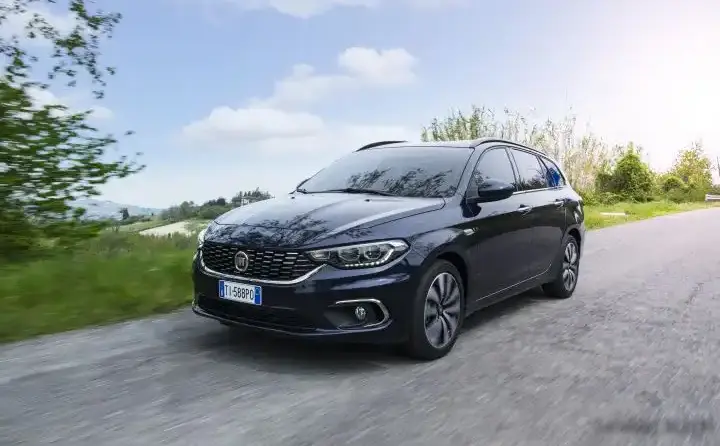
The Fiat Tipo (358) Wagon 1.4 (120 hp) was a front-wheel-drive, five-door station wagon produced by the Italian manufacturer Fiat between 2016 and 2018. Positioned as a mid-range offering within the Tipo wagon lineup, it aimed to provide a balance of practicality, fuel efficiency, and reasonable performance for family buyers. This variant was part of the broader Tipo (358) generation, which represented Fiat’s return to the compact segment after a period of absence, utilizing the Small Wide architecture shared with other Stellantis group vehicles. The 1.4-liter turbocharged engine and six-speed manual transmission combination was a popular choice in European markets, offering a compromise between the base 1.3-liter diesel and the more powerful 1.6-liter gasoline options.
Technical Specifications
| Brand | Fiat |
| Model | Tipo |
| Generation | Tipo (358) Wagon |
| Type (Engine) | 1.4 (120 Hp) |
| Start of production | 2016 |
| End of production | 2018 |
| Powertrain Architecture | Internal Combustion engine |
| Body type | Station wagon (estate) |
| Seats | 5 |
| Doors | 5 |
| Fuel consumption (urban) | 7.7 l/100 km (30.5 US mpg) |
| Fuel consumption (extra urban) | 5 l/100 km (47 US mpg) |
| Fuel consumption (combined) | 6 l/100 km (39.2 US mpg) |
| CO2 emissions | 139 g/km |
| Fuel Type | Petrol (Gasoline) |
| Acceleration 0 – 100 km/h | 9.8 sec |
| Acceleration 0 – 62 mph | 9.8 sec |
| Acceleration 0 – 60 mph | 9.3 sec |
| Maximum speed | 200 km/h (124.27 mph) |
| Emission standard | Euro 6 |
| Weight-to-power ratio | 11.5 kg/Hp |
| Weight-to-torque ratio | 6.4 kg/Nm |
| Power | 120 Hp @ 5000 rpm |
| Torque | 215 Nm @ 2500 rpm (158.58 lb.-ft. @ 2500 rpm) |
| Engine layout | Front, Transverse |
| Engine Model/Code | 940B7000 |
| Engine displacement | 1368 cm3 (83.48 cu. in.) |
| Number of cylinders | 4 |
| Engine configuration | Inline |
| Cylinder Bore | 72 mm (2.83 in.) |
| Piston Stroke | 84 mm (3.31 in.) |
| Compression ratio | 9.8:1 |
| Number of valves per cylinder | 4 |
| Fuel injection system | Multi-port manifold injection |
| Engine aspiration | Turbocharger, Intercooler |
| Engine oil capacity | 3.1 l (3.28 US qt | 2.73 UK qt) |
| Coolant capacity | 5.5 l (5.81 US qt | 4.84 UK qt) |
| Kerb Weight | 1380 kg (3042.38 lbs.) |
| Max. weight | 1880 kg (4144.69 lbs.) |
| Max load | 500 kg (1102.31 lbs.) |
| Trunk (boot) space – minimum | 550 l (19.42 cu. ft.) |
| Fuel tank capacity | 50 l (13.21 US gal | 11 UK gal) |
| Permitted trailer load with brakes (12%) | 1200 kg (2645.55 lbs.) |
| Length | 4571 mm (179.96 in.) |
| Width | 1792 mm (70.55 in.) |
| Height | 1514 mm (59.61 in.) |
| Wheelbase | 2638 mm (103.86 in.) |
| Front track | 1542 mm (60.71 in.) |
| Rear track | 1543 mm (60.75 in.) |
| Front overhang | 893 mm (35.16 in.) |
| Rear overhang | 1040 mm (40.94 in.) |
| Minimum turning circle | 10.93 m (35.86 ft.) |
| Drivetrain Architecture | Front wheel drive |
| Number of gears | 6 |
| Gearbox type | Manual transmission |
| Front suspension | Independent type McPherson |
| Rear suspension | Semi-independent, coil spring |
| Front brakes | Ventilated discs |
| Rear brakes | Disc |
Powertrain & Engine Architecture
The Fiat Tipo 1.4 (120 hp) Wagon was powered by the Fiat Fire family of inline-four cylinder gasoline engines, specifically the 940B7000 unit. This engine featured a 1.4-liter displacement, utilizing a single overhead camshaft (SOHC) design with four valves per cylinder. A key feature was its turbocharging and intercooling system, which significantly boosted power output compared to naturally aspirated versions. The engine employed multi-point fuel injection, delivering fuel directly into the intake ports. The 940B7000 engine was known for its relatively compact size and lightweight construction, contributing to the Tipo’s overall balanced handling. The six-speed manual transmission was a standard offering, providing precise gear changes and contributing to the car’s fuel efficiency. The transmission’s gear ratios were tuned to maximize both acceleration and highway cruising comfort.
Driving Characteristics
The 120 hp 1.4-liter turbocharged engine provided adequate performance for everyday driving. Acceleration from 0 to 60 mph took approximately 9.3 seconds, and the car had a top speed of 124 mph. While not a particularly sporty vehicle, the turbocharger provided a noticeable boost in power during acceleration, making overtaking maneuvers relatively easy. The six-speed manual transmission allowed drivers to keep the engine in its optimal power band. Compared to the base 1.3-liter diesel, the 1.4-liter offered more responsive acceleration, but it lacked the low-end torque of the diesel. Compared to the 1.6-liter gasoline engine, the 1.4-liter offered a better balance of performance and fuel economy. The wagon’s suspension provided a comfortable ride, absorbing bumps and imperfections in the road well. However, the handling was not particularly sharp, and the car exhibited some body roll during cornering.
Equipment & Trim Levels
The 1.4 (120 hp) Tipo Wagon typically came with a reasonable level of standard equipment. This included air conditioning, power windows, central locking, a basic audio system with USB connectivity, and steel wheels with wheel covers. Higher trim levels, often denoted by additional packages, offered features such as alloy wheels, a touchscreen infotainment system with Bluetooth connectivity, rear parking sensors, cruise control, and automatic climate control. Interior upholstery was typically cloth, with options for upgraded materials on higher trims. Safety features included ABS brakes, electronic stability control, and multiple airbags.
Chassis & Braking
The Tipo Wagon utilized a McPherson strut front suspension and a semi-independent coil spring rear suspension. This setup provided a good balance of ride comfort and handling. The front brakes were ventilated discs, while the rear brakes were solid discs. The steering was electrically assisted, providing light and easy steering feel. The chassis was designed to provide a stable and predictable driving experience, prioritizing comfort and practicality over outright sportiness.
Market Reception & Comparison
The Fiat Tipo Wagon 1.4 (120 hp) was generally well-received by automotive critics as a practical and affordable family vehicle. It was praised for its spacious interior, comfortable ride, and reasonable fuel economy. However, some critics noted that the interior materials were somewhat basic and that the handling was not particularly engaging. Compared to rivals such as the Volkswagen Golf Estate and the Ford Focus Estate, the Tipo Wagon offered a more affordable price point but lacked the refinement and brand prestige of those competitors. The 1.4-liter engine was considered a good compromise between performance and fuel efficiency, offering a noticeable improvement over the base diesel engine.
Legacy
The Fiat Tipo (358) Wagon, including the 1.4 (120 hp) variant, represented Fiat’s attempt to regain a foothold in the competitive compact wagon segment. While not a runaway success, it provided a practical and affordable option for families. The 940B7000 engine proved to be relatively reliable, although regular maintenance is crucial. On the used car market, these models are generally available at attractive prices, making them a good value proposition for buyers seeking a spacious and economical wagon. However, potential buyers should be aware of the potential for age-related wear and tear, and a thorough inspection is recommended before purchase.