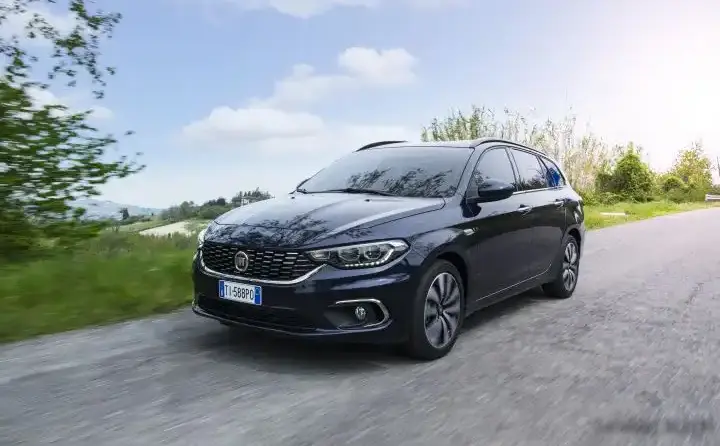
The Fiat Tipo (358) Wagon 1.4 T-Jet, producing 120 horsepower, was a variant of the Tipo station wagon produced between 2018 and 2020. Positioned as a mid-range offering within the Tipo lineup, it aimed to balance fuel efficiency with reasonable performance for family transport. This model represented Fiat’s attempt to offer a practical and affordable estate car in the European market, leveraging a turbocharged engine for improved drivability. The Tipo (358) series, launched in 2016, was a significant return to a nameplate with a strong heritage, though the 358 generation represented a more modern, globally-focused approach than its predecessors.
Technical Specifications
| Brand | Fiat |
| Model | Tipo |
| Generation | Tipo (358) Wagon |
| Type (Engine) | 1.4 T-Jet (120 Hp) |
| Start of production | 2018 year |
| End of production | 2020 year |
| Powertrain Architecture | Internal Combustion engine |
| Body type | Station wagon (estate) |
| Seats | 5 |
| Doors | 5 |
| Fuel consumption (economy) – urban | 8.9 l/100 km (26.4 US mpg, 31.7 UK mpg, 11.2 km/l) |
| Fuel consumption (economy) – extra urban | 6.1 l/100 km (38.6 US mpg, 46.3 UK mpg, 16.4 km/l) |
| Fuel consumption (economy) – combined | 7.1 l/100 km (33.1 US mpg, 39.8 UK mpg, 14.1 km/l) |
| CO2 emissions | 163 g/km |
| Fuel Type | Petrol (Gasoline) |
| Acceleration 0 – 100 km/h | 10.1 sec |
| Acceleration 0 – 62 mph | 10.1 sec |
| Acceleration 0 – 60 mph | 9.6 sec |
| Maximum speed | 200 km/h (124.27 mph) |
| Emission standard | Euro 6d-Temp |
| Weight-to-power ratio | 10.9 kg/Hp, 92 Hp/tonne |
| Weight-to-torque ratio | 6.1 kg/Nm, 164.8 Nm/tonne |
| Power | 120 Hp @ 5000 rpm |
| Power per litre | 87.7 Hp/l |
| Torque | 215 Nm @ 2500 rpm (158.58 lb.-ft. @ 2500 rpm) |
| Engine layout | Front, Transverse |
| Engine Model/Code | 940B7000 |
| Engine displacement | 1368 cm3 (83.48 cu. in.) |
| Number of cylinders | 4 |
| Engine configuration | Inline |
| Cylinder Bore | 72 mm (2.83 in.) |
| Piston Stroke | 84 mm (3.31 in.) |
| Compression ratio | 9.8:1 |
| Number of valves per cylinder | 4 |
| Engine aspiration | Turbocharger, Intercooler |
| Engine oil capacity | 3.4 l (3.59 US qt | 2.99 UK qt) |
| Coolant | 4.6 l (4.86 US qt | 4.05 UK qt) |
| Kerb Weight | 1305 kg (2877.03 lbs.) |
| Max. weight | 1855 kg (4089.57 lbs.) |
| Max load | 550 kg (1212.54 lbs.) |
| Trunk (boot) space – minimum | 550 l (19.42 cu. ft.) |
| Fuel tank capacity | 50 l (13.21 US gal | 11 UK gal) |
| Permitted trailer load with brakes (12%) | 1500 kg (3306.93 lbs.) |
| Permitted trailer load without brakes | 500 kg (1102.31 lbs.) |
| Permitted towbar download | 60 kg (132.28 lbs.) |
| Length | 4571 mm (179.96 in.) |
| Width | 1792 mm (70.55 in.) |
| Height | 1512 mm (59.53 in.) |
| Wheelbase | 2638 mm (103.86 in.) |
| Front track | 1542 mm (60.71 in.) |
| Rear (Back) track | 1543 mm (60.75 in.) |
| Minimum turning circle (turning diameter) | 10.9 m (35.76 ft.) |
| Drivetrain Architecture | The Internal combustion engine (ICE) drives the front wheels of the vehicle. |
| Drive wheel | Front wheel drive |
| Number of gears and type of gearbox | 6 gears, manual transmission |
| Front suspension | Independent type McPherson |
| Rear suspension | Torsion |
| Front brakes | Disc, 281 mm |
| Rear brakes | Disc, 264 mm |
| Assisting systems | ABS (Anti-lock braking system) |
| Steering type | Steering rack and pinion |
| Power steering | Electric Steering |
| Tires size | 205/55 R16; 225/40 R18 |
| Wheel rims size | 16; 18 |
Powertrain & Engine Architecture
The heart of the Tipo 1.4 T-Jet was the 940B7000 engine, a 1.4-liter inline-four cylinder gasoline engine equipped with a turbocharger and intercooler. This engine was part of Fiat’s Fire family, known for its compact size and relatively simple design. The engine utilized multi-point fuel injection and a single overhead camshaft (SOHC) valvetrain with four valves per cylinder. The turbocharger provided a boost in power and torque compared to naturally aspirated engines of similar displacement. The 120 horsepower output was achieved at 5000 rpm, while peak torque of 215 Nm (158.58 lb-ft) was available from 2500 rpm. The engine was transversely mounted in the front of the vehicle, driving the front wheels. The transmission was a 6-speed manual gearbox, offering a balance between fuel efficiency and driver engagement.
Driving Characteristics
The 1.4 T-Jet 120 hp engine in the Tipo Wagon provided adequate performance for everyday driving. Acceleration from 0 to 100 km/h (0-62 mph) took approximately 10.1 seconds, and top speed was rated at 200 km/h (124 mph). While not a particularly sporty setup, the turbocharger provided a noticeable boost in power during acceleration, making overtaking maneuvers relatively easy. Compared to higher-output versions of the Tipo, such as those with the 1.6-liter diesel engine, the 1.4 T-Jet offered less outright performance but a more responsive and engaging driving experience. The manual transmission allowed for greater driver control, but the gear ratios were tuned for fuel efficiency rather than outright speed. The wagon body style added weight compared to the hatchback version, slightly impacting acceleration and handling.
Equipment & Trim Levels
The 1.4 T-Jet variant of the Tipo Wagon typically came with a reasonable level of standard equipment. This included air conditioning, power windows, central locking, a basic audio system with USB connectivity, and steel wheels with wheel covers. Higher trim levels offered upgrades such as alloy wheels, a touchscreen infotainment system with Apple CarPlay and Android Auto compatibility, rear parking sensors, cruise control, and automatic climate control. Interior upholstery was typically cloth, with options for upgraded materials on higher trims. Safety features included ABS brakes, electronic stability control, and multiple airbags. Optional extras included a panoramic sunroof, leather upholstery, and a navigation system.
Chassis & Braking
The Tipo Wagon featured a McPherson strut independent suspension at the front and a torsion beam suspension at the rear. This setup provided a comfortable ride quality, suitable for long journeys. The front brakes were ventilated discs, while the rear brakes were solid discs. The steering was electrically assisted, providing light and precise steering feel. The chassis was designed to balance handling with ride comfort, prioritizing stability and predictability over sporty handling characteristics. Tire sizes varied depending on the trim level, with 205/55 R16 and 225/40 R18 being common options.
Market Reception & Comparison
The Fiat Tipo Wagon 1.4 T-Jet was generally well-received by automotive critics as a practical and affordable family car. It was praised for its spacious interior, comfortable ride, and reasonable fuel economy. However, some critics noted that the engine lacked the refinement and power of some of its competitors. Compared to other engines in the Tipo lineup, the 1.4 T-Jet offered a good balance between performance and fuel efficiency. The diesel engines provided better fuel economy but were more expensive to purchase and maintain. The higher-output gasoline engines offered more performance but at the cost of increased fuel consumption.
Legacy
The Fiat Tipo (358) Wagon 1.4 T-Jet, while not a groundbreaking vehicle, represented a solid offering in the compact estate car segment. The 940B7000 engine proved to be relatively reliable, with few major issues reported. On the used car market, these models are generally considered to be good value for money, offering a practical and affordable transportation solution. However, potential buyers should be aware of the typical maintenance requirements for turbocharged engines, such as regular oil changes and inspection of the turbocharger and intercooler. The Tipo Wagon 1.4 T-Jet remains a viable option for those seeking a spacious, fuel-efficient, and reasonably priced estate car.