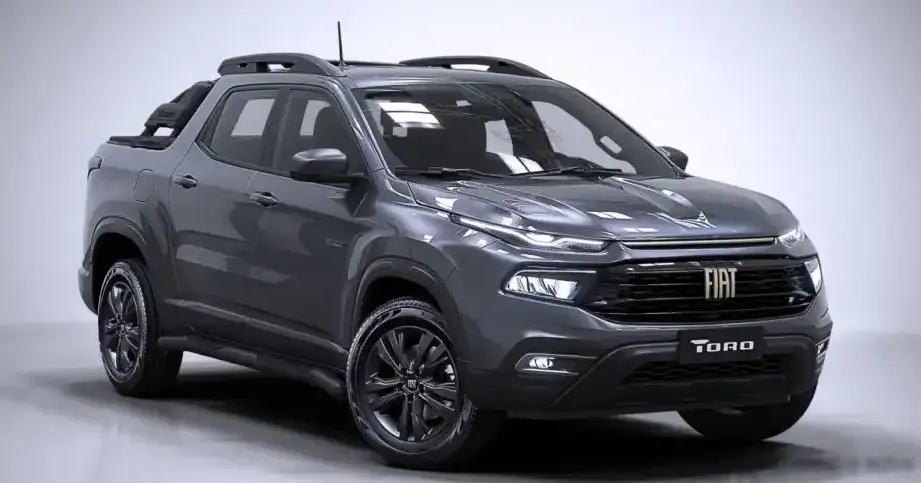
The Fiat Toro 1.3 Turbo (180 hp) Automatic, introduced with the 2021 facelift, represents a significant offering in the compact pickup truck segment, particularly within the South American market where the Toro is primarily sold. Positioned as a mid-range option within the Toro lineup, this variant balances performance and fuel efficiency with the convenience of an automatic transmission. The Toro, launched in 2016, was designed to fill a unique niche – a smaller, more comfortable, and car-like pickup than traditional offerings, appealing to urban drivers and those seeking a versatile vehicle for both work and leisure. The 2021 facelift brought updated styling, improved technology, and refinements to the powertrain options, including this 1.3-liter turbocharged engine paired with a six-speed automatic transmission.
Technical Specifications
| Brand | Fiat |
| Model | Toro |
| Generation | Toro (facelift 2021) |
| Type (Engine) | 1.3 Turbo (180 Hp) Automatic |
| Start of production | April, 2021 |
| Powertrain Architecture | Internal Combustion engine |
| Body type | Pick-up |
| Seats | 5 |
| Doors | 4 |
| Fuel Type | Petrol (Gasoline) |
| Acceleration 0 – 100 km/h | 11.2 sec |
| Acceleration 0 – 62 mph | 11.2 sec |
| Acceleration 0 – 60 mph | 10.6 sec |
| Maximum speed | 195 km/h (121.17 mph) |
| Emission standard | Euro 5 |
| Weight-to-power ratio | 9.5 kg/Hp, 105.6 Hp/tonne |
| Weight-to-torque ratio | 6.3 kg/Nm, 158.4 Nm/tonne |
| Power | 180 Hp @ 5750 rpm |
| Power per litre | 135.1 Hp/l |
| Torque | 270 Nm @ 1750 rpm (199.14 lb.-ft. @ 1750 rpm) |
| Engine layout | Front, Transverse |
| Engine displacement | 1332 cm3 (81.28 cu. in.) |
| Number of cylinders | 4 |
| Engine configuration | Inline |
| Compression ratio | 10.5:1 |
| Number of valves per cylinder | 4 |
| Fuel injection system | Multi-port manifold injection |
| Engine aspiration | Turbocharger, Intercooler |
| Engine systems | Start & Stop System |
| Kerb Weight | 1705 kg (3758.88 lbs) |
| Max. weight | 2375 kg (5235.98 lbs) |
| Max load | 670 kg (1477.1 lbs) |
| Trunk (boot) space – minimum | 820 l (28.96 cu. ft.) |
| Fuel tank capacity | 55 l (14.53 US gal | 12.1 UK gal) |
| Permitted trailer load without brakes | 400 kg (881.85 lbs) |
| Length | 4945 mm (194.69 in) |
| Width | 1845 mm (72.64 in) |
| Height | 1739 mm (68.46 in) |
| Wheelbase | 2990 mm (117.72 in) |
| Ride height (ground clearance) | 260 mm (10.24 in) |
| Minimum turning circle | 12.9 m (42.32 ft) |
| Drivetrain Architecture | Front wheel drive |
| Number of gears and type of gearbox | 6 gears, automatic transmission |
| Front suspension | Independent, type McPherson with coil spring and anti-roll bar |
| Rear suspension | Independent multi-link spring suspension with stabilizer |
| Front brakes | Ventilated discs, 305 mm |
| Rear brakes | Drum, 254 mm |
| Assisting systems | ABS (Anti-lock braking system) |
| Steering type | Steering rack and pinion |
| Power steering | Electric Steering |
| Tires size | 215/65 R16 102H; 225/60 R17 103H; 225/60 R18 104H |
| Wheel rims size | 6.5J x 16 ET40; 6.5J x 17 ET40; 6.5J x 18 ET40 |
Powertrain & Engine Architecture
The heart of the Toro 1.3 Turbo Automatic is the Fiat Firefly 1.3-liter inline-four cylinder engine. This engine, designated as a “turbo flex” unit, is capable of running on both gasoline and ethanol (in markets where ethanol blends are common). It utilizes a single-scroll turbocharger with an intercooler to boost power output. The engine employs multi-point fuel injection and features a double overhead camshaft (DOHC) valvetrain with four valves per cylinder. The 10.5:1 compression ratio is a compromise between efficiency and performance. The six-speed automatic transmission is a crucial component, providing smooth shifts and enhancing drivability. This transmission is not a dual-clutch unit, but a conventional torque-converter automatic, prioritizing comfort over outright speed. The Start & Stop system contributes to improved fuel economy in urban driving conditions.
Driving Characteristics
The 180 hp and 270 Nm (199 lb-ft) of torque delivered by the 1.3 Turbo engine provide adequate performance for everyday driving and light-duty hauling. Acceleration from 0-60 mph takes around 10.6 seconds, which is competitive within its class, but noticeably slower than versions equipped with more powerful engines. The automatic transmission is tuned for comfort, with relatively smooth gear changes. However, it can sometimes feel hesitant during quick acceleration or when attempting to downshift for overtaking. The front-wheel-drive configuration provides predictable handling, but limits off-road capability compared to four-wheel-drive variants. The Toro’s suspension is tuned to prioritize ride comfort, making it a pleasant vehicle for long journeys, even with a load in the bed.
Equipment & Trim Levels
The 1.3 Turbo Automatic trim typically includes standard features such as air conditioning, power windows and locks, a touchscreen infotainment system with Bluetooth connectivity, and basic safety equipment like ABS and airbags. Higher trim levels add features like alloy wheels, a rearview camera, parking sensors, automatic headlights, and rain-sensing wipers. Interior upholstery is generally cloth, with leather options available on higher-spec models. The dashboard layout is functional and modern, with a focus on ease of use. Optional extras often include a premium sound system, navigation, and advanced driver-assistance systems.
Chassis & Braking
The Toro utilizes a McPherson strut front suspension and an independent multi-link rear suspension, providing a good balance between ride comfort and handling. The front suspension incorporates a stabilizer bar to reduce body roll. Braking duties are handled by ventilated discs at the front and drum brakes at the rear. While the front discs provide adequate stopping power, the rear drums are a cost-saving measure and can feel less effective under heavy braking. The electric power steering provides light and easy steering, making it maneuverable in urban environments.
Market Reception & Comparison
The Toro 1.3 Turbo Automatic was generally well-received by critics as a practical and versatile pickup truck. It was praised for its comfortable ride, spacious interior, and fuel efficiency. However, some reviewers noted that the engine could feel underpowered when fully loaded or when driving uphill. Compared to the more powerful 2.0-liter diesel variants, the 1.3 Turbo offers lower running costs but sacrifices performance. Against competitors like the Chevrolet Montana and Renault Oroch, the Toro stands out with its more refined interior and car-like driving experience. Fuel economy is a strong point, typically achieving around 25-28 mpg in mixed driving conditions.
Legacy
The Fiat Toro 1.3 Turbo Automatic has proven to be a relatively reliable powertrain. The Firefly engine is known for its durability, and the six-speed automatic transmission has a good track record. Common maintenance items include regular oil changes, air filter replacements, and spark plug replacements. On the used car market, these models represent a good value proposition, offering a practical and affordable pickup truck option. The Toro’s unique positioning as a compact, comfortable pickup has helped it establish a loyal following, and it continues to be a popular choice for buyers seeking a versatile vehicle for both work and personal use.