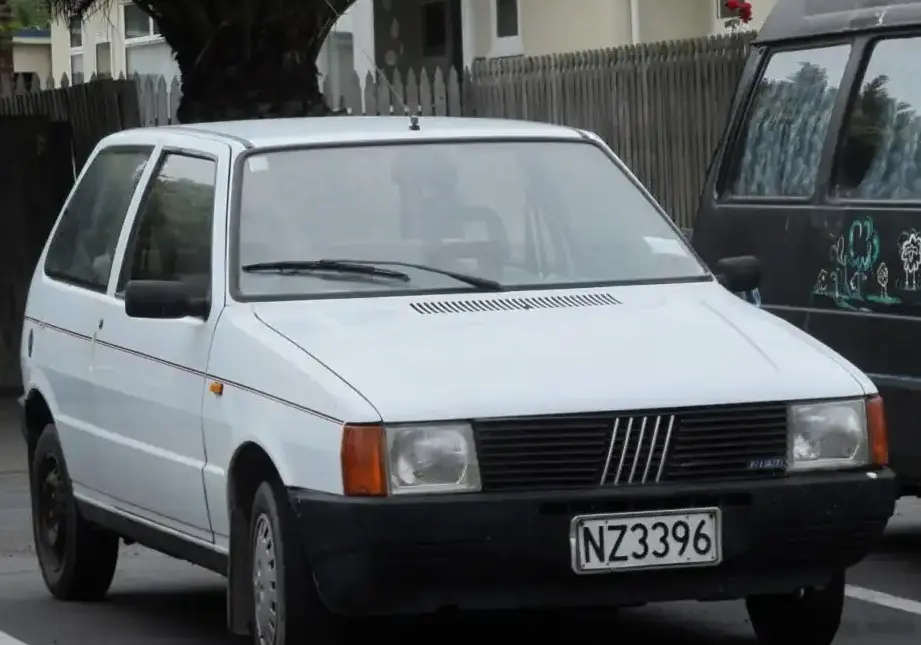
The Fiat UNO (Type 146A) 0.9, producing 45 horsepower, was a foundational model in Fiat’s lineup from 1983 to 1992. It represented a significant departure from the rear-wheel-drive 127 it replaced, embracing a modern, front-wheel-drive layout. The UNO was designed as an affordable and practical city car, aimed at providing basic transportation for a wide demographic. This particular 0.9-liter variant served as the entry point to the UNO range, offering a balance of economy and usability. It was a key player in the supermini segment, particularly in Europe and South America, where it gained considerable popularity due to its low cost and relatively spacious interior for its size.
Technical Specifications
| Brand | Fiat |
| Model | UNO |
| Generation | UNO (146A) |
| Type (Engine) | 0.9 (45 Hp) |
| Start of production | 1983 |
| End of production | 1992 |
| Powertrain Architecture | Internal Combustion engine |
| Body type | Hatchback |
| Seats | 5 |
| Doors | 3-5 |
| Fuel consumption (urban) | 7.1 l/100 km (33.1 US mpg, 39.8 UK mpg, 14.1 km/l) |
| Fuel consumption (extra urban) | 4.7 l/100 km (50 US mpg, 60.1 UK mpg, 21.3 km/l) |
| Fuel consumption (combined) | 6.2 l/100 km (37.9 US mpg, 45.6 UK mpg, 16.1 km/l) |
| Fuel Type | Petrol (Gasoline) |
| Acceleration 0 – 100 km/h | 17.9 sec |
| Acceleration 0 – 62 mph | 17.9 sec |
| Acceleration 0 – 60 mph | 17 sec |
| Maximum speed | 140 km/h (86.99 mph) |
| Weight-to-power ratio | 16.4 kg/Hp, 60.8 Hp/tonne |
| Weight-to-torque ratio | 11.2 kg/Nm, 89.2 Nm/tonne |
| Power | 45 Hp @ 5600 rpm |
| Power per litre | 49.8 Hp/l |
| Torque | 66 Nm @ 3000 rpm (48.68 lb.-ft. @ 3000 rpm) |
| Engine layout | Front, Transverse |
| Engine Model/Code | 146 A1.000 |
| Engine displacement | 903 cm3 (55.1 cu. in.) |
| Number of cylinders | 4 |
| Engine configuration | Inline |
| Cylinder Bore | 65 mm (2.56 in.) |
| Piston Stroke | 68 mm (2.68 in.) |
| Compression ratio | 9:1 |
| Number of valves per cylinder | 2 |
| Fuel injection system | Carburettor |
| Engine aspiration | Naturally aspirated |
| Engine oil capacity | 3.4 l (3.59 US qt | 2.99 UK qt) |
| Kerb Weight | 740 kg (1631.42 lbs.) |
| Max. weight | 1200 kg (2645.55 lbs.) |
| Max load | 460 kg (1014.13 lbs.) |
| Trunk (boot) space – minimum | 270 l (9.53 cu. ft.) |
| Trunk (boot) space – maximum | 970 l (34.26 cu. ft.) |
| Fuel tank capacity | 40 l (10.57 US gal | 8.8 UK gal) |
| Length | 3690 mm (145.28 in.) |
| Width | 1560 mm (61.42 in.) |
| Height | 1420 mm (55.91 in.) |
| Wheelbase | 2360 mm (92.91 in.) |
| Front track | 1340 mm (52.76 in.) |
| Rear (Back) track | 1300 mm (51.18 in.) |
| Minimum turning circle | 9.8 m (32.15 ft.) |
| Drivetrain Architecture | Front wheel drive |
| Number of gears | 5 gears, manual transmission |
| Front suspension | Coil spring |
| Rear suspension | Coil spring |
| Front brakes | Disc |
| Rear brakes | Drum |
| Steering type | Steering rack and pinion |
| Power steering | Hydraulic |
| Tires size | 155/70 R13 |
| Wheel rims size | 13 |
Powertrain & Engine Architecture
The heart of the UNO 0.9 was the 146 A1.000 engine, a 903cc inline-four cylinder unit. This engine utilized a relatively simple carbureted fuel system, reflecting the cost-conscious design philosophy of the UNO. The engine featured a two-valve per cylinder configuration and a compression ratio of 9:1. Its modest output of 45 horsepower at 5600 rpm and 66 Nm (48.68 lb-ft) of torque at 3000 rpm was sufficient for urban driving, but performance on highways was limited. The engine was transversely mounted, contributing to the UNO’s compact footprint and maximizing interior space. The five-speed manual transmission was the standard offering, providing a reasonable spread of gears for optimizing fuel economy and managing the engine’s limited power band.
Driving Characteristics
The UNO 0.9 Automatic, while offering the convenience of an automatic transmission, suffered from noticeably slower acceleration compared to the manual version. The 0-60 mph time hovered around 17 seconds, and top speed was limited to approximately 87 mph. The automatic transmission, a three-speed unit, was geared for economy rather than performance. Gear changes were relatively slow and lacked the responsiveness of more modern automatics. In city driving, the UNO 0.9 was manageable, but overtaking maneuvers required careful planning. The light weight of the vehicle (around 1631 lbs) helped to mitigate the lack of power to some extent, making it feel more nimble than its specifications might suggest.
Equipment & Trim Levels
The base-level UNO 0.9 was sparsely equipped, reflecting its position as the entry-level model. Standard features typically included cloth upholstery, basic instrumentation (speedometer, fuel gauge), and a simple dashboard layout. Power steering was often an optional extra, as were features like a radio and upgraded interior trim. Higher trim levels, such as the UNO Selecta, offered additional features like central locking, electric windows, and a more refined interior. The 0.9 version was often seen as a practical choice for those prioritizing affordability over luxury.
Chassis & Braking
The UNO featured a relatively simple chassis design. Front suspension utilized coil springs, while the rear employed a twist-beam axle with coil springs. Front brakes were discs, providing adequate stopping power for the vehicle’s weight and performance. However, the rear brakes were drums, which offered less stopping power and were more prone to fading under heavy use. The steering was a rack-and-pinion system, providing reasonable precision, although it lacked the feedback of more sophisticated steering setups. The relatively narrow tires (155/70 R13) contributed to fuel economy but limited grip in cornering.
Market Reception & Comparison
The Fiat UNO 0.9 was generally well-received as an affordable and practical city car. Critics praised its fuel efficiency and spacious interior for its size. However, the engine’s lack of power and the basic nature of the interior were common criticisms. Compared to other superminis of the era, such as the Renault 5 and the Peugeot 205, the UNO 0.9 offered a more affordable price point but lacked the refinement and performance of its rivals. The manual transmission versions were generally preferred by enthusiasts due to their improved performance and driver engagement. The automatic version, while convenient, was often seen as a compromise.
Legacy
The Fiat UNO, and specifically the 0.9-liter variant, holds a significant place in automotive history as a pioneering example of a modern, affordable supermini. While the early carbureted engines are known for requiring regular maintenance, they are relatively simple to repair. Today, the UNO 0.9 is a popular choice among classic car enthusiasts and collectors, particularly in Europe and South America. Its affordability, simplicity, and iconic design have ensured its continued appeal. Finding well-maintained examples can be challenging, but the UNO 0.9 remains a testament to Fiat’s ability to create practical and accessible transportation for the masses.