
Technical Specifications
| Brand | Fiat |
| Model | UNO |
| Generation | UNO (146A) |
| Type (Engine) | 1.0 i.e. (46 Hp) CAT |
| Start of production | 1985 year |
| End of production | 1995 year |
| Powertrain Architecture | Internal Combustion engine |
| Body type | Hatchback |
| Seats | 5 |
| Doors | 3-5 |
| Fuel consumption (urban) | 6.7 l/100 km (35.1 US mpg, 42.2 UK mpg, 14.9 km/l) |
| Fuel consumption (extra urban) | 4.6 l/100 km (51.1 US mpg, 61.4 UK mpg, 21.7 km/l) |
| Fuel consumption (combined) | 6.4 l/100 km (36.8 US mpg, 44.1 UK mpg, 15.6 km/l) |
| Fuel Type | Petrol (Gasoline) |
| Acceleration 0 – 100 km/h | 17.7 sec |
| Acceleration 0 – 62 mph | 17.7 sec |
| Acceleration 0 – 60 mph | 16.8 sec |
| Maximum speed | 145 km/h (90.1 mph) |
| Weight-to-power ratio | 16.1 kg/Hp, 62.2 Hp/tonne |
| Weight-to-torque ratio | 9.9 kg/Nm, 101.4 Nm/tonne |
| Power | 46 Hp @ 5250 rpm |
| Power per litre | 46 Hp/l |
| Torque | 75 Nm @ 3250 rpm (55.32 lb.-ft. @ 3250 rpm) |
| Engine layout | Front, Transverse |
| Engine Model/Code | 156 A2.000 |
| Engine displacement | 999 cm3 (60.96 cu. in.) |
| Number of cylinders | 4 |
| Engine configuration | Inline |
| Cylinder Bore | 70 mm (2.76 in.) |
| Piston Stroke | 64.9 mm (2.56 in.) |
| Compression ratio | 9.1:1 |
| Number of valves per cylinder | 2 |
| Fuel injection system | Single-point injection |
| Engine aspiration | Naturally aspirated engine |
| Engine oil capacity | 3.8 l (4.02 US qt | 3.34 UK qt) |
| Kerb Weight | 740 kg (1631.42 lbs.) |
| Max. weight | 1200 kg (2645.55 lbs.) |
| Max load | 460 kg (1014.13 lbs.) |
| Trunk (boot) space – minimum | 270 l (9.53 cu. ft.) |
| Trunk (boot) space – maximum | 970 l (34.26 cu. ft.) |
| Fuel tank capacity | 40 l (10.57 US gal | 8.8 UK gal) |
| Length | 3690 mm (145.28 in.) |
| Width | 1560 mm (61.42 in.) |
| Height | 1420 mm (55.91 in.) |
| Wheelbase | 2360 mm (92.91 in.) |
| Front track | 1340 mm (52.76 in.) |
| Rear (Back) track | 1300 mm (51.18 in.) |
| Minimum turning circle | 9.8 m (32.15 ft.) |
| Drivetrain Architecture | The Internal combustion engine (ICE) drives the front wheels of the vehicle. |
| Drive wheel | Front wheel drive |
| Number of gears and type of gearbox | 5 gears, manual transmission |
| Front suspension | Coil spring |
| Rear suspension | Coil spring |
| Front brakes | Disc |
| Rear brakes | Drum |
| Assisting systems | ABS (Anti-lock braking system) |
| Steering type | Steering rack and pinion |
| Power steering | Hydraulic Steering |
| Tires size | 155/70 R13 |
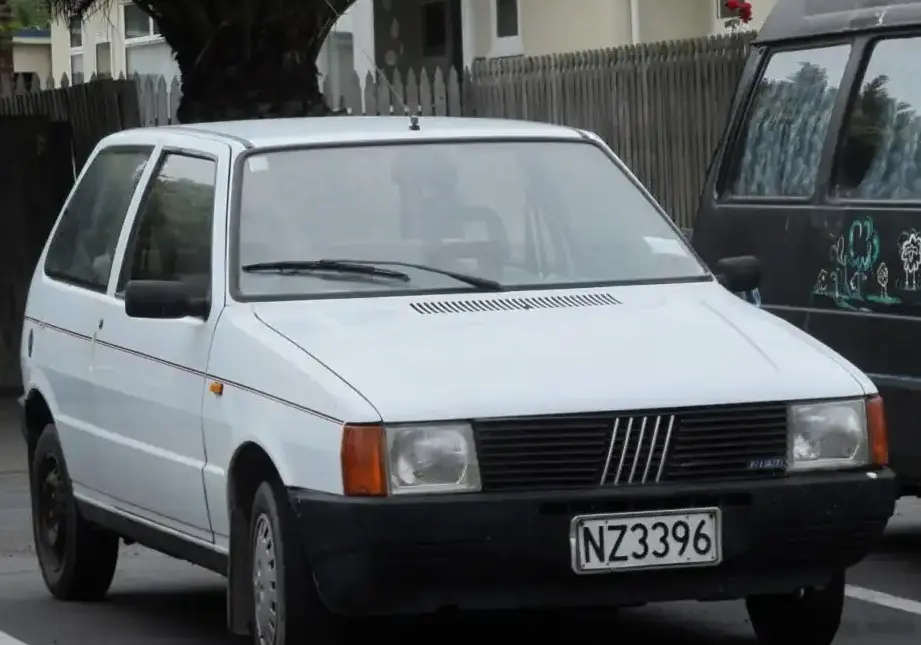
The Fiat Uno 1.0 i.e. (46 hp) CAT, produced from 1985 to 1995, represents an entry-level variant of the popular Uno (146A) hatchback. Positioned as the most economical option in the range, it was designed to provide affordable transportation within the European market, particularly in countries where smaller, fuel-efficient cars were highly valued. This model played a significant role in democratizing car ownership, offering a practical and reliable vehicle to a broad customer base. The “i.e.” designation signified the use of electronic fuel injection, a relatively modern feature for its time, and the “CAT” indicated the inclusion of a catalytic converter, addressing growing environmental concerns.
Powertrain & Engine Architecture
The heart of the Uno 1.0 i.e. CAT is the 156 A2.000 engine, a 999cc inline-four cylinder unit. This engine utilized a single-point fuel injection system, a step up from the carburetors found in earlier Uno models. While not as sophisticated as multi-point injection, it offered improved fuel efficiency and smoother operation. The engine featured a relatively low compression ratio of 9.1:1 and two valves per cylinder. The engine’s modest 46 horsepower at 5250 rpm and 55.32 lb-ft of torque at 3250 rpm were sufficient for city driving and shorter journeys, but performance on highways or when fully loaded was limited. The engine was transversely mounted, a common layout in front-wheel-drive cars, contributing to a compact engine bay and maximizing interior space. The five-speed manual transmission was the standard offering, providing a reasonable spread of gears for optimizing fuel economy and managing the engine’s limited power band.
Driving Characteristics
The Uno 1.0 i.e. CAT offered a predictable, if uninspiring, driving experience. Acceleration was slow, taking approximately 17.7 seconds to reach 62 mph. The focus was clearly on fuel economy rather than performance. The gear ratios were optimized for low-speed cruising and maximizing mileage. Compared to higher-spec Uno models equipped with larger engines (like the 1.4 or 1.6 liter variants), the 1.0 i.e. felt noticeably underpowered, especially when climbing hills or overtaking. The manual transmission, while basic, was light and easy to use. The suspension, tuned for comfort, provided a reasonably smooth ride on typical urban roads, but body roll was noticeable during cornering. Steering was light and precise, making it easy to maneuver in tight spaces.
Equipment & Trim Levels
The 1.0 i.e. CAT typically represented the base trim level of the Uno range. Standard equipment was relatively sparse, reflecting its position as an affordable car. Features generally included basic cloth upholstery, a simple dashboard layout, and manual windows and door locks. ABS (Anti-lock braking system) was often included as standard, a notable safety feature for its time. Optional extras included a radio, upgraded interior trim, and sometimes, power steering. The interior was designed for practicality and durability, with hard-wearing plastics and a focus on maximizing space. The rear seats could be folded down to increase luggage capacity, adding to the car’s versatility.
Chassis & Braking
The Uno 146A utilized a relatively simple chassis design. Front suspension consisted of coil springs and independent wishbones, while the rear employed a twist-beam axle with coil springs. This setup prioritized cost-effectiveness and simplicity over outright handling performance. Braking was typically comprised of front disc brakes and rear drum brakes. The drum brakes on the rear were a cost-saving measure, common on entry-level models. The hydraulic steering provided adequate assistance for maneuvering, but lacked the feel and precision of more advanced systems.
Market Reception & Comparison
The Fiat Uno 1.0 i.e. CAT was generally well-received as an affordable and economical city car. Critics praised its fuel efficiency, practicality, and ease of driving. However, its lack of power and basic interior were often noted. Compared to other small cars of the era, such as the Renault 5 or Peugeot 205, the Uno offered a competitive price point and a slightly more spacious interior. The 1.4-liter Uno models offered significantly better performance, but at a higher cost. The 1.9 TDI diesel versions, while less common, provided excellent fuel economy but were more expensive to purchase and maintain. The 1.0 i.e. CAT appealed to buyers who prioritized affordability and fuel efficiency over performance and luxury.
Legacy
The Fiat Uno 1.0 i.e. CAT remains a relatively common sight on European roads today, testament to its durability and reliability. The 156 A2.000 engine, while not known for its high performance, is generally considered to be a robust and long-lasting unit. Maintenance is relatively straightforward and parts are readily available. However, age-related issues such as corrosion and wear and tear on rubber components are common. In the used car market, the Uno 1.0 i.e. CAT represents an extremely affordable option for those seeking basic transportation. It’s often favored by first-time car owners or those on a tight budget. The Uno, in general, is remembered as a groundbreaking car that brought affordable motoring to the masses, and the 1.0 i.e. CAT played a key role in that success.

