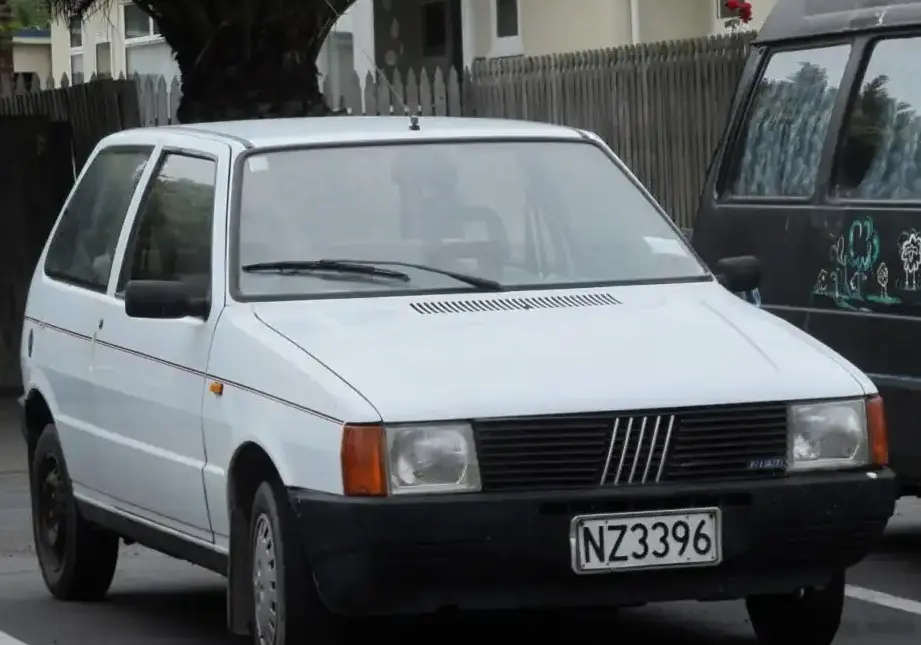
The Fiat UNO 1.1 (57 hp) was a foundational model within the 146A series, produced from 1989 to 1992. It represented the entry point into the UNO range, a supermini designed to offer affordable and practical transportation. The UNO, launched in 1983, was a revolutionary vehicle for Fiat, utilizing a space-efficient design and modular construction. The 1.1-liter variant, particularly with its carburetor and manual transmission, was a mainstay in many European and South American markets, offering a balance of economy and usability. It was positioned as the most accessible version of the UNO, targeting budget-conscious buyers and those seeking a simple, reliable city car.
Technical Specifications
| Brand | Fiat |
| Model | UNO |
| Generation | UNO (146A) |
| Type (Engine) | 1.1 (57 Hp) |
| Start of production | 1989 |
| End of production | 1992 |
| Powertrain Architecture | Internal Combustion engine |
| Body type | Hatchback |
| Seats | 5 |
| Doors | 3-5 |
| Fuel consumption (urban) | 7.6 l/100 km (30.9 US mpg) |
| Fuel consumption (extra urban) | 4.8 l/100 km (49 US mpg) |
| Fuel consumption (combined) | 6.5 l/100 km (36.2 US mpg) |
| Fuel Type | Petrol (Gasoline) |
| Acceleration 0 – 100 km/h | 16 sec |
| Acceleration 0 – 62 mph | 16 sec |
| Acceleration 0 – 60 mph | 15.2 sec |
| Maximum speed | 150 km/h (93.21 mph) |
| Weight-to-power ratio | 13.3 kg/Hp |
| Weight-to-torque ratio | 8.7 kg/Nm |
| Power | 57 Hp @ 5500 rpm |
| Power per litre | 51.4 Hp/l |
| Torque | 87 Nm @ 2750 rpm (64.17 lb.-ft. @ 2750 rpm) |
| Engine layout | Front, Transverse |
| Engine Model/Code | 160 A3.000 |
| Engine displacement | 1108 cm3 (67.61 cu. in.) |
| Number of cylinders | 4 |
| Engine configuration | Inline |
| Cylinder Bore | 70 mm (2.76 in.) |
| Piston Stroke | 72 mm (2.83 in.) |
| Compression ratio | 9.6:1 |
| Number of valves per cylinder | 2 |
| Fuel injection system | Carburettor |
| Engine aspiration | Naturally aspirated |
| Engine oil capacity | 4.1 l (4.33 US qt | 3.61 UK qt) |
| Coolant capacity | 6 l (6.34 US qt | 5.28 UK qt) |
| Kerb Weight | 760 kg (1675.51 lbs.) |
| Max. weight | 1260 kg (2777.82 lbs.) |
| Max load | 500 kg (1102.31 lbs.) |
| Trunk (boot) space – minimum | 270 l (9.53 cu. ft.) |
| Trunk (boot) space – maximum | 970 l (34.26 cu. ft.) |
| Fuel tank capacity | 40 l (10.57 US gal | 8.8 UK gal) |
| Length | 3690 mm (145.28 in.) |
| Width | 1560 mm (61.42 in.) |
| Height | 1420 mm (55.91 in.) |
| Wheelbase | 2360 mm (92.91 in.) |
| Front track | 1340 mm (52.76 in.) |
| Rear track | 1300 mm (51.18 in.) |
| Minimum turning circle | 9.8 m (32.15 ft.) |
| Drivetrain Architecture | Front wheel drive |
| Number of gears | 5 gears, manual transmission |
| Front suspension | Spring Strut |
| Rear suspension | Spring Strut |
| Front brakes | Disc |
| Rear brakes | Drum |
| Assisting systems | ABS (Anti-lock braking system) |
| Steering type | Steering rack and pinion |
| Power steering | Hydraulic Steering |
| Tires size | 155/70 R13 |
Powertrain & Engine Architecture
The heart of the UNO 1.1 was the 160 A3.000 engine, a 1108cc inline-four cylinder unit. This engine was characterized by its simplicity and durability. It utilized a single overhead camshaft (SOHC) design with two valves per cylinder. Crucially, this version of the 1.1 engine employed a carburetor for fuel delivery, rather than fuel injection found in later iterations. This carburetor setup, while less efficient than injection, contributed to the engine’s lower cost and ease of maintenance. The engine produced 57 horsepower at 5500 rpm and 87 Nm (64.17 lb-ft) of torque at 2750 rpm. The transmission was a standard five-speed manual, providing a reasonable spread of gears for both city driving and highway cruising. The front-wheel-drive configuration was typical for cars in this segment, maximizing interior space and improving fuel efficiency.
Driving Characteristics
The UNO 1.1, with its 57 hp and relatively light weight of 760 kg (1675 lbs), offered modest but adequate performance. Acceleration from 0 to 100 km/h (0-62 mph) took around 16 seconds, making it no performance car. However, the engine was surprisingly tractable, with usable torque available from low revs. The five-speed manual transmission allowed drivers to keep the engine in its sweet spot, maximizing efficiency and responsiveness. Compared to the more powerful 1.3 and 1.4-liter versions of the UNO, the 1.1 felt noticeably slower, particularly when fully loaded or climbing hills. However, it excelled in urban environments, where its nimble handling and low running costs were highly appreciated. The gear ratios were tuned for economy, with a relatively long fifth gear for highway cruising.
Equipment & Trim Levels
The UNO 1.1 was typically offered in a basic trim level, reflecting its position as the entry-level model. Standard features generally included cloth upholstery, a basic dashboard with analog gauges, and manual windows and door locks. Power steering was often an optional extra, as was a radio. The interior was functional and durable, prioritizing practicality over luxury. Higher trim levels, available with the larger engines, offered features like upgraded upholstery, central locking, and electric windows, but these were rarely seen on the 1.1 model. The 3-door version was more common, further emphasizing the car’s affordability.
Chassis & Braking
The UNO utilized a simple but effective chassis design. Front suspension consisted of MacPherson strut springs, while the rear employed a twist-beam axle with coil springs. This setup provided a comfortable ride, although handling was not particularly sporty. Brakes were disc on the front wheels and drum brakes on the rear, a common configuration for cars in this price range. ABS (Anti-lock Braking System) was available as an option, enhancing safety. The steering was a rack-and-pinion system, providing reasonably precise control. The relatively narrow tires (155/70 R13) contributed to fuel efficiency but limited grip.
Market Reception & Comparison
The Fiat UNO 1.1 was well-received in its target markets, particularly in Europe and South America. Critics praised its affordability, fuel efficiency, and practicality. However, the engine’s lack of power was often noted, and some reviewers found the interior to be somewhat spartan. Compared to other superminis of the time, such as the Renault 5 and the Peugeot 205, the UNO offered a compelling value proposition. The 1.1-liter version was significantly cheaper to purchase and operate than the higher-powered variants, making it an attractive option for first-time buyers and those on a tight budget. Fuel economy was a key selling point, with combined figures around 36.2 US mpg.
Legacy
The Fiat UNO 1.1, while not a performance icon, played a significant role in democratizing car ownership. Its simple, robust design and low running costs made it a popular choice for many years. The 160 A3.000 engine proved to be remarkably durable, and many examples are still on the road today. In the used car market, the UNO 1.1 remains an affordable and practical option for those seeking a classic city car. Its simplicity makes it relatively easy to maintain, and spare parts are still readily available. While it may not offer the refinement or features of modern vehicles, the UNO 1.1 represents a significant chapter in Fiat’s history and a testament to the enduring appeal of simple, reliable transportation.