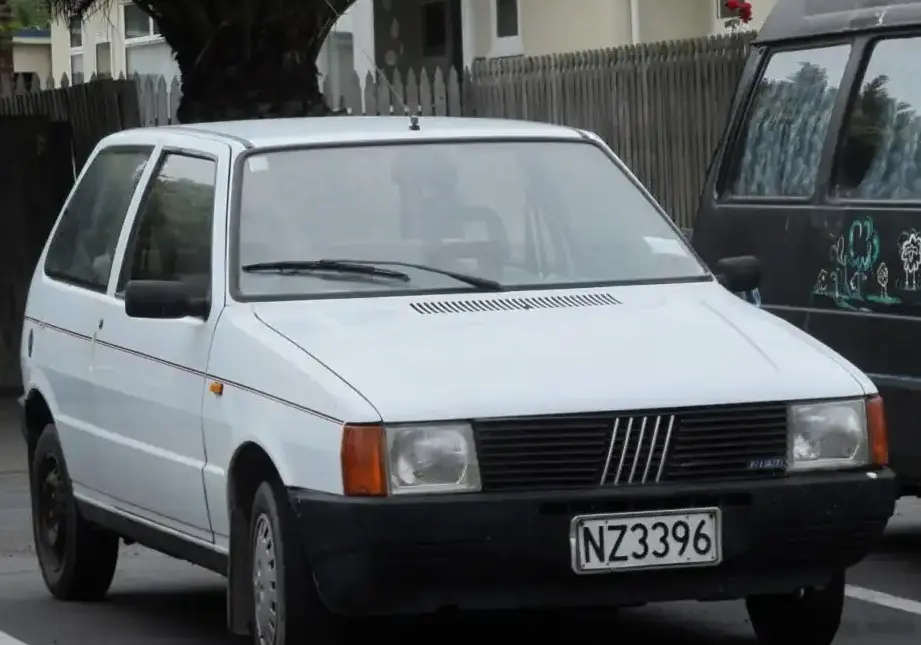
Technical Specifications
| Brand | Fiat |
| Model | UNO |
| Generation | UNO (146A) |
| Type (Engine) | 1.1 i (51 Hp) |
| Start of production | 1990 year |
| End of production | 1992 year |
| Powertrain Architecture | Internal Combustion engine |
| Body type | Hatchback |
| Seats | 5 |
| Doors | 3-5 |
| Fuel consumption (urban) | 7.6 l/100 km (30.9 US mpg, 37.2 UK mpg, 13.2 km/l) |
| Fuel consumption (extra urban) | 4.8 l/100 km (49 US mpg, 58.9 UK mpg, 20.8 km/l) |
| Fuel consumption (combined) | 6.5 l/100 km (36.2 US mpg, 43.5 UK mpg, 15.4 km/l) |
| Fuel Type | Petrol (Gasoline) |
| Acceleration 0 – 100 km/h | 16 sec |
| Acceleration 0 – 62 mph | 16 sec |
| Acceleration 0 – 60 mph | 15.2 sec |
| Maximum speed | 150 km/h (93.21 mph) |
| Weight-to-power ratio | 14.9 kg/Hp, 67.1 Hp/tonne |
| Weight-to-torque ratio | 9 kg/Nm, 110.5 Nm/tonne |
| Power | 51 Hp @ 5250 rpm |
| Power per litre | 46 Hp/l |
| Torque | 84 Nm @ 3000 rpm (61.96 lb.-ft. @ 3000 rpm) |
| Engine layout | Front, Transverse |
| Engine Model/Code | 156 C.046 |
| Engine displacement | 1108 cm3 (67.61 cu. in.) |
| Number of cylinders | 4 |
| Engine configuration | Inline |
| Cylinder Bore | 70 mm (2.76 in.) |
| Piston Stroke | 72 mm (2.83 in.) |
| Compression ratio | 9.6:1 |
| Number of valves per cylinder | 2 |
| Fuel injection system | Single-point injection |
| Engine aspiration | Naturally aspirated engine |
| Engine oil capacity | 3.8 l (4.02 US qt | 3.34 UK qt) |
| Coolant capacity | 4.5 l (4.76 US qt | 3.96 UK qt) |
| Kerb Weight | 760 kg (1675.51 lbs.) |
| Max. weight | 1260 kg (2777.82 lbs.) |
| Max load | 500 kg (1102.31 lbs.) |
| Trunk (boot) space – minimum | 270 l (9.53 cu. ft.) |
| Trunk (boot) space – maximum | 970 l (34.26 cu. ft.) |
| Fuel tank capacity | 40 l (10.57 US gal | 8.8 UK gal) |
| Length | 3690 mm (145.28 in.) |
| Width | 1560 mm (61.42 in.) |
| Height | 1420 mm (55.91 in.) |
| Wheelbase | 2360 mm (92.91 in.) |
| Front track | 1340 mm (52.76 in.) |
| Rear (Back) track | 1300 mm (51.18 in.) |
| Minimum turning circle | 9.8 m (32.15 ft.) |
| Drivetrain Architecture | Front wheel drive |
| Number of gears | 5 gears, manual transmission |
| Front suspension | Coil spring |
| Rear suspension | Coil spring |
| Front brakes | Disc |
| Rear brakes | Drum |
| Assisting systems | ABS (Anti-lock braking system) |
| Steering type | Steering rack and pinion |
| Power steering | Hydraulic Steering |
| Tires size | 155/70 R13 |
The Fiat UNO 1.1 i, produced from 1990 to 1992, was a cornerstone of Fiat’s strategy to provide affordable transportation. Built on the 146A platform – shared with the Fiat Panda – the UNO aimed to modernize the small car segment. The 1.1 i variant was the base model, offering a no-frills, economical package. It was particularly popular in Italy, France, and throughout South America, where its low running costs and compact size were highly valued. The UNO represented a significant departure from the rear-engined Fiat 126 it replaced, embracing a front-wheel-drive layout for improved space efficiency and handling.
Powertrain & Engine Architecture
The heart of the UNO 1.1 i is the 156 C.046 engine, a 1108cc inline-four cylinder petrol engine. This engine featured a single overhead camshaft (SOHC) and two valves per cylinder. Fuel delivery was handled by a single-point fuel injection system, a relatively simple and cost-effective technology for the time. The engine produced 51 horsepower at 5250 rpm and 84 Nm (62 lb-ft) of torque at 3000 rpm. The engine’s design prioritized fuel efficiency over outright performance. The most common transmission pairing was a four or five-speed manual gearbox. A three-speed automatic transmission was available in some markets, but it significantly impacted acceleration and fuel economy. The automatic was a conventional hydraulic unit, lacking the sophistication of modern electronically controlled transmissions.
Driving Characteristics
The UNO 1.1 i offered modest performance. Acceleration from 0 to 60 mph took around 15.2 seconds, and the top speed was approximately 93 mph. The engine felt strained at higher speeds, and overtaking required careful planning. The manual transmission allowed drivers to make the most of the limited power, while the automatic version felt sluggish. The car’s light weight (around 760 kg or 1675 lbs) helped to mitigate the lack of power, making it reasonably nimble in urban environments. The steering was light and easy, although lacking in feel. The suspension, while basic, provided a comfortable ride on most road surfaces.
Equipment & Trim Levels
The UNO 1.1 i was deliberately spartan in its equipment levels. Standard features typically included basic cloth upholstery, a simple dashboard with analog gauges, and manually operated windows and door locks. Power steering was not standard, although it was sometimes offered as an option. Optional extras included a radio, upgraded interior trim, and occasionally, a sunroof. The focus was on providing a functional and reliable vehicle at the lowest possible price point. Higher trim levels within the UNO range, such as the 1.3 Fire or 1.4 versions, offered more features and better performance.
Chassis & Braking
The UNO 1.1 i utilized a relatively simple chassis design. Front suspension consisted of coil springs and independent wishbones, while the rear suspension employed a twist-beam axle with coil springs. Brakes were disc brakes at the front and drum brakes at the rear. ABS (Anti-lock Braking System) was available as an option, but not standard on the base model. The steering system was a rack and pinion setup, providing reasonably precise steering. Tire size was typically 155/70 R13.
Market Reception & Comparison
The Fiat UNO 1.1 i was generally well-received as an affordable and practical city car. Critics praised its spacious interior, fuel efficiency, and low purchase price. However, the engine’s lack of power and the basic interior were often criticized. Compared to other small cars of the era, such as the Renault 5 or Peugeot 205, the UNO offered a more spacious interior but less refined driving experience. The 1.3 Fire and 1.4 versions of the UNO offered significantly better performance and were popular choices for those willing to spend a little more. The 1.1 i’s fuel economy was a key selling point, consistently achieving around 36-43 mpg in real-world driving.
Legacy
The Fiat UNO 1.1 i, while not a performance icon, played a significant role in democratizing car ownership in Europe and South America. Its simple, robust engine and readily available parts contribute to its continued presence on the roads today. The 156 C.046 engine, while not known for its longevity in high-stress applications, is generally reliable when properly maintained. In the used car market, the UNO 1.1 i remains an affordable and practical option for those seeking a basic, economical vehicle. Its enduring popularity is a testament to its original design brief: to provide simple, reliable, and affordable transportation for the masses.