
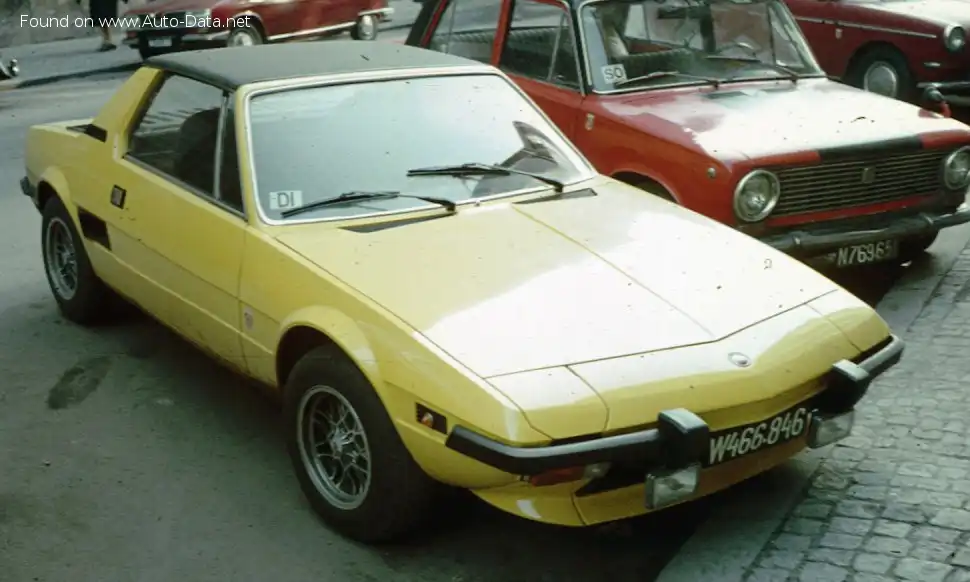
The Fiat X1/9, internally designated as the 128 AS, represents a unique chapter in Fiat’s history, offering an affordable and stylish mid-engined sports car to a broad audience. Produced from 1972 to 1982, the X1/9 distinguished itself with its targa top, nimble handling, and relatively accessible price point. The early models, specifically those built between 1975 and 1978, were powered by a 1.3-liter engine, with the 73 horsepower variant being a common configuration. This version served as the entry point into the X1/9 range, appealing to drivers seeking a sporty experience without the higher cost and performance of later, larger-displacement models.
Technical Specifications
| Brand | Fiat |
| Model | X 1/9 |
| Generation | X 1/9 (128 AS) |
| Type (Engine) | 1.3 (73 Hp) |
| Start of production | 1975 year |
| End of production | 1978 year |
| Powertrain Architecture | Internal Combustion engine |
| Body type | Targa |
| Seats | 2 |
| Doors | 2 |
| Fuel Type | Petrol (Gasoline) |
| Power | 73 Hp |
| Power per litre | 56.2 Hp/l |
| Engine layout | Middle, Transverse |
| Engine Model/Code | 128 AS.000 |
| Engine displacement | 1300 cm3 |
| Engine displacement (US) | 79.33 cu. in. |
| Number of cylinders | 4 |
| Engine configuration | Inline |
| Number of valves per cylinder | 2 |
| Fuel injection system | Multi-port manifold injection |
| Engine aspiration | Naturally aspirated engine |
| Engine oil capacity | 4.1 l |
| Engine oil capacity (US) | 4.33 US qt |
| Engine oil capacity (UK) | 3.61 UK qt |
| Coolant capacity | 11.6 l |
| Coolant capacity (US) | 12.26 US qt |
| Coolant capacity (UK) | 10.21 UK qt |
| Length | 3970 mm |
| Length (US) | 156.3 in. |
| Width | 1570 mm |
| Width (US) | 61.81 in. |
| Height | 1180 mm |
| Height (US) | 46.46 in. |
| Wheelbase | 2200 mm |
| Wheelbase (US) | 86.61 in. |
| Front track | 1350 mm |
| Front track (US) | 53.15 in. |
| Rear track | 1335 mm |
| Rear track (US) | 52.56 in. |
| Ride height (ground clearance) | 125 mm |
| Ride height (ground clearance) (US) | 4.92 in. |
| Drivetrain Architecture | Rear wheel drive |
| Drive wheel | Rear wheel drive |
| Number of gears | 4 |
| Type of gearbox | Manual transmission |
| Front suspension | Independent coil spring |
| Front brakes | Ventilated discs |
| Rear brakes | Disc |
Powertrain & Engine Architecture
The heart of the 1975-1978 X1/9 1.3 was the Fiat 128 AS.000 engine, a 1298cc inline-four cylinder unit. This engine featured a cast iron block and an aluminum cylinder head, contributing to a relatively lightweight construction. It employed a single overhead camshaft (SOHC) operating two valves per cylinder. Fuel delivery was managed by a Bosch multi-port fuel injection system, a relatively advanced feature for its time, replacing the earlier carburetor setups. This injection system helped improve fuel efficiency and responsiveness compared to carbureted alternatives. The engine produced 73 horsepower at 6000 rpm and 88 lb-ft of torque at 4000 rpm. The engine was transversely mounted behind the driver and ahead of the rear axle, a configuration that contributed to the car’s balanced handling characteristics. The transmission was a standard four-speed manual, known for its relatively light and precise shift action.
Driving Characteristics
The 73 hp X1/9 offered a spirited, though not overwhelming, driving experience. Acceleration from 0 to 60 mph took around 12-13 seconds, and top speed was approximately 105 mph. While slower than the later 1.5-liter and 1.6-liter versions, the 1.3-liter engine provided sufficient power for enjoyable backroad driving. The mid-engine layout resulted in neutral handling, with a tendency towards understeer at the limit. The four-speed gearbox was well-matched to the engine’s powerband, allowing for relatively quick and engaging shifts. Compared to the later, more powerful versions, the 1.3 felt more forgiving and easier to control, making it a good choice for drivers new to mid-engined cars. The relatively light weight of the vehicle (around 1,980 lbs) further enhanced its agility.
Equipment & Trim Levels
The 1975-1978 X1/9 1.3 was generally offered with a fairly basic level of equipment, reflecting its position as the entry-level model. Standard features included cloth upholstery, a three-spoke steering wheel, and basic instrumentation consisting of a speedometer, tachometer, and fuel gauge. The interior was functional and minimalist in design. Optional extras included leather upholstery, a radio, and a more comprehensive instrument cluster. The targa top, a defining feature of the X1/9, came standard with a removable roof panel that could be stored in a dedicated compartment behind the seats. Exterior trim was relatively simple, with chrome bumpers and basic wheel covers.
Chassis & Braking
The X1/9 featured a monocoque steel chassis, providing a rigid and lightweight structure. Suspension was independent on all four wheels, utilizing coil springs and telescopic shock absorbers. The front suspension employed a double wishbone setup, while the rear utilized a trailing arm configuration. This suspension design contributed to the car’s comfortable ride and predictable handling. Braking was provided by ventilated disc brakes at the front and solid disc brakes at the rear. The braking system was generally considered adequate for the car’s performance, though it lacked the sophistication of more modern systems. Steering was by rack and pinion, providing precise and responsive control.
Market Reception & Comparison
The X1/9 1.3 was generally well-received by automotive critics, who praised its sporty handling, attractive styling, and affordable price. However, some critics noted the engine’s lack of outright power, particularly when compared to larger-displacement sports cars. Compared to the later 1.5-liter and 1.6-liter X1/9 models, the 1.3 offered a more economical and accessible entry point into the range. Fuel economy was respectable for the era, averaging around 30-35 mpg. Reliability was generally good, though the engine was known to be somewhat sensitive to overheating if not properly maintained. The 1.3 was often seen as a good alternative to other small sports cars of the time, such as the MG Midget and the Triumph Spitfire.
Legacy
The Fiat X1/9 1.3, while not the most powerful version of the model, remains a fondly remembered classic. Its mid-engine layout and stylish targa top design set it apart from its contemporaries. The 128 AS engine, while relatively simple, proved to be durable and reliable when properly maintained. Today, the X1/9 1.3 is a popular choice among classic car enthusiasts, offering an affordable and engaging driving experience. Parts availability can be a challenge, but a dedicated community of owners and suppliers helps to keep these cars on the road. The X1/9’s influence can be seen in later mid-engined sports cars, and it continues to be celebrated as a unique and innovative design.
