
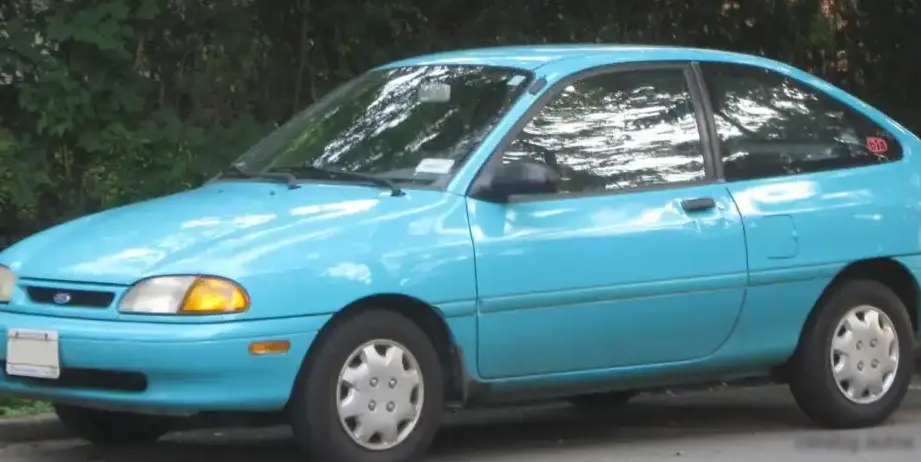
The Ford Aspire 1.3i Automatic, produced between 1994 and 1998, represented the entry-level powertrain option for Ford’s subcompact hatchback sold primarily in North America. Positioned as an affordable and fuel-efficient vehicle, the Aspire was a rebadged version of the European Ford Fiesta, tailored to meet the demands of the American market. This particular variant, with its 1.3-liter engine and three-speed automatic transmission, aimed to provide convenient, no-shift driving for urban commuters and first-time car buyers. It occupied the base trim level, offering a more accessible price point compared to the available manual transmission options.
Technical Specifications
| Brand | Ford |
| Model | Aspire |
| Generation | Aspire |
| Type (Engine) | 1.3i (64 Hp) Automatic |
| Start of production | 1994 |
| End of production | 1998 |
| Powertrain Architecture | Internal Combustion engine |
| Body type | Hatchback |
| Seats | 5 |
| Doors | 3 |
| Fuel consumption (combined) | 7.3 l/100 km (32.2 US mpg, 38.7 UK mpg, 13.7 km/l) |
| Fuel Type | Petrol (Gasoline) |
| Maximum speed | 145 km/h (90.1 mph) |
| Weight-to-power ratio | 14.2 kg/Hp (70.4 Hp/tonne) |
| Weight-to-torque ratio | 9.1 kg/Nm (110 Nm/tonne) |
| Power | 64 Hp @ 5000 rpm |
| Power per litre | 48.3 Hp/l |
| Torque | 100 Nm @ 3000 rpm (73.76 lb.-ft. @ 3000 rpm) |
| Engine layout | Front, Transverse |
| Engine Model/Code | B3 |
| Engine displacement | 1324 cm3 (80.8 cu. in.) |
| Number of cylinders | 4 |
| Engine configuration | Inline |
| Cylinder Bore | 71 mm (2.8 in.) |
| Piston Stroke | 83.6 mm (3.29 in.) |
| Compression ratio | 9.7:1 |
| Number of valves per cylinder | 2 |
| Fuel injection system | Single-point injection |
| Engine aspiration | Naturally aspirated engine |
| Valvetrain | OHC |
| Engine oil capacity | 3.4 l (3.59 US qt | 2.99 UK qt) |
| Coolant | 6 l (6.34 US qt | 5.28 UK qt) |
| Kerb Weight | 909 kg (2004 lbs.) |
| Fuel tank capacity | 38 l (10.04 US gal | 8.36 UK gal) |
| Length | 4440 mm (174.8 in.) |
| Width | 1680 mm (66.14 in.) |
| Height | 1360 mm (53.54 in.) |
| Wheelbase | 2305 mm (90.75 in.) |
| Front track | 1435 mm (56.5 in.) |
| Rear track | 1435 mm (56.5 in.) |
| Drivetrain Architecture | Front wheel drive |
| Number of gears and type of gearbox | 3 gears, automatic transmission |
| Front suspension | Spring Strut |
| Rear suspension | Coil spring |
| Front brakes | Disc |
| Rear brakes | Drum |
| Steering type | Steering rack and pinion |
| Tires size | 155/80 R13 |
| Wheel rims size | 13 |
Powertrain & Engine Architecture
The heart of the 1994-1998 Ford Aspire 1.3i Automatic is the Ford B3 engine, a 1.3-liter inline-four cylinder gasoline engine. This engine, derived from the European Ford Fiesta, utilizes a single-point fuel injection system, a relatively simple setup for the time, prioritizing affordability over peak performance. The engine features an overhead camshaft (OHC) valvetrain with two valves per cylinder. Its 9.7:1 compression ratio was a compromise between efficiency and the fuel quality available in the North American market. The B3 engine produced 64 horsepower at 5000 rpm and 100 Nm (73.76 lb-ft) of torque at 3000 rpm. Paired with this engine was a three-speed automatic transmission, designed for smooth, if not particularly sporty, operation. This transmission was chosen to appeal to buyers seeking the convenience of an automatic without the added cost of a more sophisticated four-speed unit.
Driving Characteristics
The Aspire 1.3i Automatic’s driving experience was characterized by its modest performance. Acceleration was adequate for city driving, but merging onto highways or overtaking required careful planning. The three-speed automatic transmission, while providing smooth shifts, lacked the responsiveness of a manual gearbox or a more modern automatic. The gear ratios were optimized for fuel economy rather than outright speed. Compared to the five-speed manual version of the Aspire, the automatic suffered a noticeable performance deficit. The manual offered quicker acceleration and a more engaging driving experience, appealing to enthusiasts. However, the automatic’s ease of use made it a more attractive option for a broader range of drivers.
Equipment & Trim Levels
The 1.3i Automatic trim level was the base model of the Aspire. Standard features typically included cloth upholstery, a basic AM/FM radio, and manual windows and door locks. Air conditioning was often an optional extra, as were power steering and upgraded sound systems. The interior was functional and utilitarian, prioritizing durability and cost-effectiveness over luxury. The dashboard layout was simple and straightforward, with easily accessible controls. Safety features were limited by the standards of the time, typically including only front seatbelts and a basic braking system.
Chassis & Braking
The Aspire’s chassis featured a front strut suspension and a rear coil spring suspension, providing a reasonably comfortable ride for a subcompact car. The front brakes were disc brakes, offering adequate stopping power, while the rear brakes were drum brakes, a cost-saving measure common in this class of vehicle. The steering system was a rack and pinion setup, providing precise and responsive steering. The car rode on 13-inch wheels with 155/80 R13 tires. The suspension tuning was geared towards comfort and ride quality, rather than sporty handling.
Market Reception & Comparison
The Ford Aspire 1.3i Automatic was generally well-received as an affordable and fuel-efficient option in the subcompact car segment. Critics praised its low price and good gas mileage, but noted its lack of power and refinement. Compared to other subcompacts of the time, such as the Chevrolet Metro and the Geo Prizm, the Aspire offered a similar level of value and practicality. However, the Metro often boasted slightly better fuel economy, while the Prizm offered a more refined driving experience. The automatic transmission version was often criticized for its sluggish performance compared to the manual transmission models.
Legacy
The Ford Aspire, while not a groundbreaking vehicle, played an important role in providing affordable transportation to a wide range of buyers. The 1.3i Automatic powertrain, while not known for its performance or longevity, proved to be reasonably reliable with proper maintenance. Today, these vehicles are relatively rare and are often sought after by collectors and enthusiasts looking for a nostalgic piece of automotive history. The B3 engine, while simple in design, is generally considered to be a durable and relatively easy-to-repair unit. However, finding replacement parts can be challenging due to the car’s age and limited production numbers. The Aspire’s legacy lies in its affordability and its contribution to the subcompact car market of the 1990s.
