Technical Specifications
| Brand | Ford |
| Model | Bronco |
| Generation | Bronco I |
| Type (Engine) | 4.9 V8 (127 Hp) AWD |
| Start of production | 1966 |
| End of production | 1977 |
| Powertrain Architecture | Internal Combustion engine |
| Body type | SUV |
| Seats | 5 |
| Doors | 3 |
| Fuel consumption (economy) – combined | 18.8 l/100 km |
| Fuel consumption (economy) – combined | 12.5 US mpg |
| Fuel consumption (economy) – combined | 15 UK mpg |
| Fuel consumption (economy) – combined | 5.3 km/l |
| Fuel Type | Petrol (Gasoline) |
| Acceleration 0 – 100 km/h | 14 sec |
| Acceleration 0 – 62 mph | 14 sec |
| Acceleration 0 – 60 mph | 13.3 sec |
| Maximum speed | 145 km/h |
| Maximum speed | 90.1 mph |
| Weight-to-power ratio | 12.7 kg/Hp |
| Weight-to-power ratio | 79 Hp/tonne |
| Weight-to-torque ratio | 5.4 kg/Nm |
| Weight-to-torque ratio | 185.3 Nm/tonne |
| Power | 127 Hp @ 3800 rpm |
| Power per litre | 25.7 Hp/l |
| Torque | 298 Nm @ 1800 rpm |
| Torque | 219.79 lb.-ft. @ 1800 rpm |
| Engine layout | Front, Longitudinal |
| Engine displacement | 4942 cm3 |
| Engine displacement | 301.58 cu. in. |
| Number of cylinders | 8 |
| Engine configuration | V-engine |
| Cylinder Bore | 101.6 mm |
| Cylinder Bore | 4 in. |
| Piston Stroke | 76.2 mm |
| Piston Stroke | 3 in. |
| Compression ratio | 8:1 |
| Number of valves per cylinder | 2 |
| Fuel injection system | Carburettor |
| Engine aspiration | Naturally aspirated engine |
| Kerb Weight | 1608 kg |
| Kerb Weight | 3545.03 lbs. |
| Max. weight | 1950 kg |
| Max. weight | 4299.01 lbs. |
| Max load | 342 kg |
| Max load | 753.98 lbs. |
| Length | 3863 mm |
| Length | 152.09 in. |
| Width | 1748 mm |
| Width | 68.82 in. |
| Height | 1859 mm |
| Height | 73.19 in. |
| Wheelbase | 2337 mm |
| Wheelbase | 92.01 in. |
| Front track | 1453 mm |
| Front track | 57.2 in. |
| Rear (Back) track | 1453 mm |
| Rear (Back) track | 57.2 in. |
| Ride height (ground clearance) | 201 mm |
| Ride height (ground clearance) | 7.91 in. |
| Drag coefficient (Cd) | 0.65 |
| Minimum turning circle (turning diameter) | 10.2 m |
| Minimum turning circle (turning diameter) | 33.46 ft. |
| Drive wheel | All wheel drive (4×4) |
| Number of gears and type of gearbox | 3 gears, manual transmission |
| Front brakes | Ventilated discs |
| Rear brakes | Drum |
| Tires size | 165/75 R16 |
| Wheel rims size | 16 |
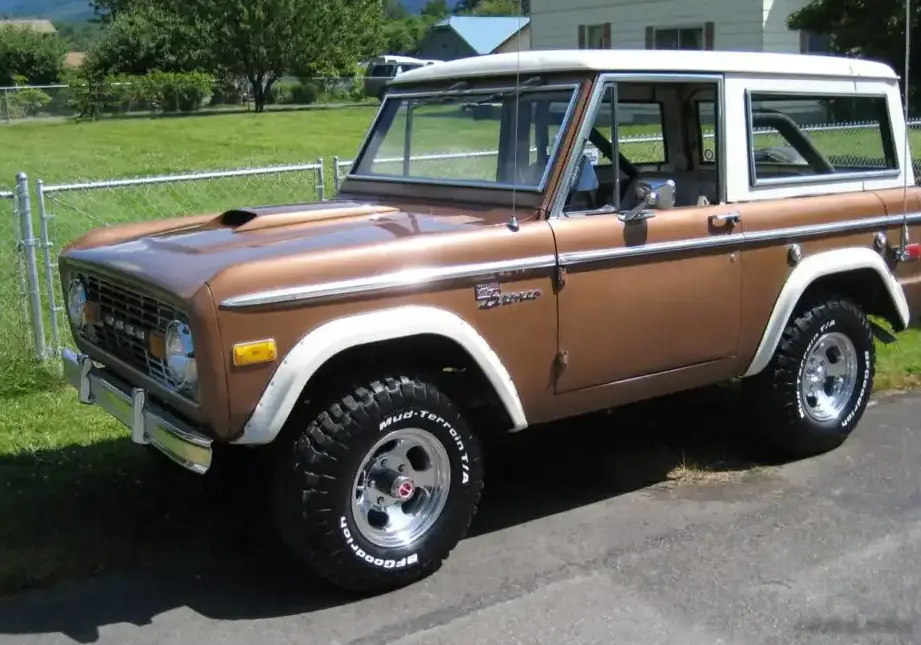
The Ford Bronco I, specifically the variant equipped with the 4.9-liter V8 engine producing 127 horsepower and featuring all-wheel drive (AWD), represents a pivotal entry point into the first generation of this iconic American SUV. Produced from 1966 to 1977, this configuration occupied a unique space in the Bronco lineup, offering a balance between affordability and capability. It was positioned as a step up from the base inline-six engine options, appealing to buyers who desired the added power of a V8 for towing, off-roading, or simply a more refined driving experience. This model played a significant role in establishing the Bronco’s reputation as a rugged and versatile vehicle, particularly in the North American market.
Powertrain & Engine Architecture
The heart of this Bronco variant is the 4.9-liter (302 cubic inch) Ford Windsor V8 engine. This engine, designated with various codes depending on the year (typically 302), is a pushrod engine with a cast iron block and cast iron cylinder heads. It utilizes a two-barrel carburetor for fuel delivery, a relatively simple system for the time, prioritizing reliability and ease of maintenance over ultimate efficiency. The engine features a 8:1 compression ratio and two valves per cylinder. The 4.9L V8 produced 127 horsepower at 3800 rpm and 298 Nm (219.79 lb-ft) of torque at 1800 rpm. This torque output, available at relatively low engine speeds, was a key characteristic that made the Bronco capable in off-road situations. The engine is longitudinally mounted in the chassis. The transmission is a three-speed manual, a common pairing for this engine and trim level. While an automatic transmission was available, the manual offered a more direct connection to the engine and was favored by those prioritizing control and fuel economy.
Driving Characteristics
The 127 hp V8-powered Bronco with a manual transmission offered a distinctly different driving experience compared to the inline-six models or the higher-output V8 options. Acceleration was adequate, with a 0-60 mph time of around 13.3 seconds, but it wasn’t particularly quick. The focus was on usable power and torque for tackling varied terrain. The three-speed manual transmission, while not offering the sophistication of modern gearboxes, provided a reasonable spread of ratios for both on-road cruising and off-road crawling. The relatively low gearing helped to maximize torque multiplication, making it easier to navigate challenging obstacles. Compared to the more powerful V8s, this variant felt less strained during prolonged climbs or when towing, but it lacked the outright punch for rapid acceleration. The ride quality, typical of early SUVs, was firm, and handling was best described as predictable rather than sporty.
Equipment & Trim Levels
The 4.9L V8 Bronco typically fell into a mid-range trim level. Standard equipment included basic instrumentation, a heater, and vinyl upholstery. Options were plentiful, allowing buyers to customize their Broncos to suit their needs. Popular options included a radio, upgraded interior trim, a winch, and various off-road packages. The interior was functional and utilitarian, designed to withstand the rigors of off-road use. The dashboard layout was simple, with clearly marked gauges and easy-to-reach controls. The seats were typically bench-style, providing seating for five passengers.
Chassis & Braking
The Bronco I utilized a body-on-frame construction, providing a robust and durable platform. The front suspension consisted of a solid axle with coil springs, while the rear suspension featured a solid axle with leaf springs. This setup was designed for durability and off-road capability, rather than refined on-road handling. The braking system consisted of ventilated discs at the front and drum brakes at the rear. While adequate for the time, the braking performance was not particularly strong by modern standards. The 16-inch wheels were typically fitted with 165/75 R16 tires, providing a good balance between on-road comfort and off-road traction.
Market Reception & Comparison
The 4.9L V8 Bronco was generally well-received by buyers who wanted a capable and affordable SUV. Critics praised its ruggedness, off-road capability, and relatively low price. However, some criticized its fuel economy, which was poor even by 1970s standards (around 12.5 US mpg). Compared to the inline-six models, the V8 offered a significant performance boost, but at the cost of increased fuel consumption. Compared to the larger V8 options, this 4.9L variant provided a good balance between power and efficiency, making it a popular choice for those who didn’t need the ultimate in towing or off-road performance.
Legacy
The 4.9L V8-powered Bronco I has become a highly sought-after classic vehicle. Its simple mechanical design and readily available parts make it relatively easy to maintain and repair. The engine itself is known for its durability and reliability, and many examples are still on the road today. The Bronco I, in all its variants, helped to establish the SUV as a popular vehicle segment, and the 4.9L V8 model played a significant role in that success. In the used car market, well-maintained examples of this Bronco variant command a premium price, reflecting their enduring appeal and historical significance.