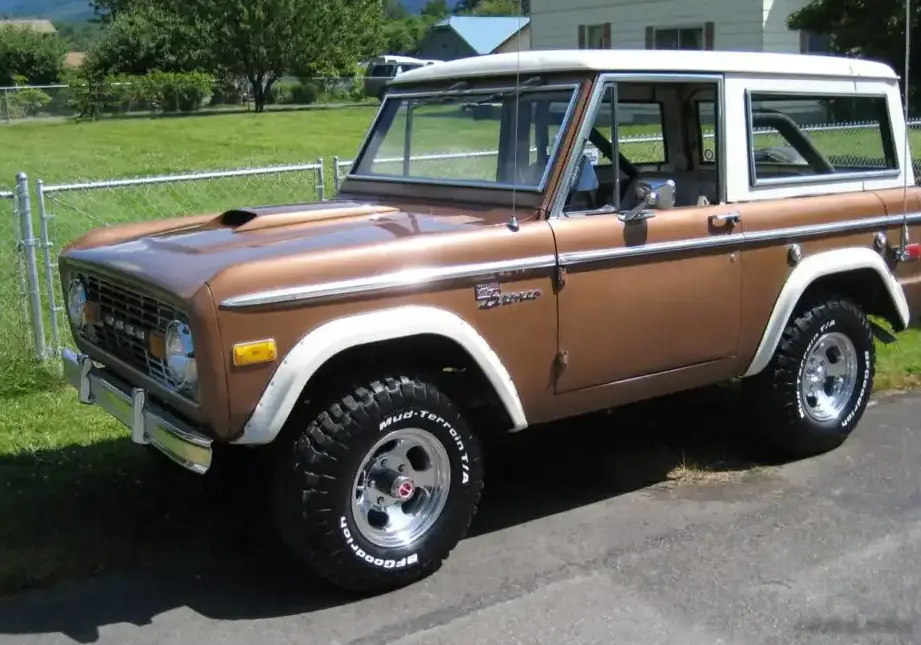
The Ford Bronco I, specifically the variant equipped with the 4.9-liter V8 engine producing 208 horsepower and all-wheel drive (AWD), represents a pivotal moment in Ford’s history and the burgeoning SUV market. Produced from 1966 to 1977, this first-generation Bronco was designed to compete directly with the Jeep CJ-5, offering a more comfortable and versatile alternative for recreational drivers. The 4.9L V8 AWD model occupied a mid-to-high position within the Bronco I lineup, appealing to buyers who desired more power and capability than the base inline-six engine offered, but didn’t necessarily require the larger and more expensive 5.8L V8 option. It was a workhorse intended for both on and off-road adventures.
Technical Specifications
| Brand | Ford |
| Model | Bronco |
| Generation | Bronco I |
| Type (Engine) | 4.9 V8 (208 Hp) AWD |
| Start of production | 1966 year |
| End of production | 1977 year |
| Powertrain Architecture | Internal Combustion engine |
| Body type | SUV |
| Seats | 5 |
| Doors | 3 |
| Fuel consumption (economy) – combined | 19.6 l/100 km |
| Fuel consumption (economy) – combined (US mpg) | 12 US mpg |
| Fuel consumption (economy) – combined (UK mpg) | 14.4 UK mpg |
| Fuel consumption (economy) – combined (km/l) | 5.1 km/l |
| Fuel Type | Petrol (Gasoline) |
| Acceleration 0 – 100 km/h | 10 sec |
| Acceleration 0 – 62 mph | 10 sec |
| Acceleration 0 – 60 mph | 9.5 sec |
| Maximum speed | 156 km/h (96.93 mph) |
| Weight-to-power ratio | 7.5 kg/Hp |
| Weight-to-torque ratio | 3.8 kg/Nm |
| Power | 208 Hp @ 4600 rpm |
| Power per litre | 42 Hp/l |
| Torque | 407 Nm @ 2600 rpm (300.19 lb.-ft. @ 2600 rpm) |
| Engine layout | Front, Longitudinal |
| Engine displacement | 4949 cm3 (302.01 cu. in.) |
| Number of cylinders | 8 |
| Engine configuration | V-engine |
| Cylinder Bore | 101.6 mm (4 in.) |
| Piston Stroke | 76.2 mm (3 in.) |
| Compression ratio | 8.6:1 |
| Number of valves per cylinder | 2 |
| Fuel injection system | Carburettor |
| Engine aspiration | Naturally aspirated engine |
| Kerb Weight | 1560 kg (3439.21 lbs.) |
| Length | 3863 mm (152.09 in.) |
| Width | 1748 mm (68.82 in.) |
| Height | 1859 mm (73.19 in.) |
| Wheelbase | 2337 mm (92.01 in.) |
| Front track | 1453 mm (57.2 in.) |
| Rear (Back) track | 1453 mm (57.2 in.) |
| Ride height (ground clearance) | 201 mm (7.91 in.) |
| Drag coefficient (Cd) | 0.65 |
| Minimum turning circle (turning diameter) | 10.2 m (33.46 ft.) |
| Drive wheel | All wheel drive (4×4) |
| Number of gears and type of gearbox | 3 gears, manual transmission |
| Front brakes | Ventilated discs |
| Rear brakes | Drum |
| Tires size | 165/75 R16 |
| Wheel rims size | 16 |
Powertrain & Engine Architecture
The heart of this Bronco variant is the 4.9-liter (302 cubic inch) Ford Windsor V8 engine. This engine, designated as the 302, was a mainstay of Ford’s lineup for decades, known for its reliability and relatively simple design. It utilized a cast iron block and cylinder heads, with a two-barrel carburetor handling fuel delivery. The engine featured a pushrod valvetrain with two valves per cylinder. While not the most technologically advanced engine of its time, its robust construction and ample torque made it well-suited for the Bronco’s intended purpose. The 208 horsepower was respectable for the era, and the 300 lb-ft of torque provided good low-end grunt for off-road driving and towing. The standard transmission for this configuration was a three-speed manual, although a three-speed automatic transmission (C4) was also available as an option. The automatic, while offering convenience, did slightly diminish the engine’s performance potential.
Driving Characteristics
The 4.9L V8-equipped Bronco offered a noticeable step up in performance compared to the base 2.8-liter inline-six engine. Acceleration to 60 mph took around 9.5 seconds, which was competitive for an SUV of its size and weight in the 1970s. The engine’s torque curve provided strong pulling power, making it capable of tackling steep inclines and navigating challenging terrain. The manual transmission allowed for greater driver control, particularly when off-roading, while the automatic offered a more relaxed driving experience on the highway. However, the automatic transmission’s gear ratios weren’t optimized for fuel efficiency, resulting in a combined fuel economy of only around 12 mpg. Compared to the 5.8L V8 Bronco, the 4.9L version felt less powerful, but it was also lighter and more nimble, offering a better balance between performance and handling.
Equipment & Trim Levels
The 4.9L V8 Bronco typically came standard with features like a basic interior with vinyl upholstery, a simple dashboard layout, and manual steering and brakes. However, buyers could opt for a range of optional extras, including power steering, power brakes, air conditioning, a radio, and upgraded interior trim. The trim levels varied throughout the production run, but generally included base models and more luxurious “Deluxe” versions. The Deluxe models featured upgraded interior appointments, such as carpeting and more comfortable seats. The 4.9L V8 was often paired with the Deluxe trim, offering a more comfortable and well-equipped package.
Chassis & Braking
The Bronco I utilized a body-on-frame construction, providing a rugged and durable platform. The suspension consisted of coil springs in the front and leaf springs in the rear. The 4.9L V8 models typically featured heavier-duty suspension components to handle the increased weight and power. Braking duties were handled by ventilated discs in the front and drum brakes in the rear. While adequate for the time, the braking system lacked the sophistication of modern systems. The Bronco’s relatively short wheelbase and high center of gravity contributed to a somewhat bouncy ride, but also enhanced its off-road capability.
Market Reception & Comparison
The 4.9L V8 Bronco was generally well-received by automotive critics and buyers alike. It was praised for its ruggedness, versatility, and ample power. Compared to the Jeep CJ-5, the Bronco offered a more comfortable ride and a more refined interior. However, the CJ-5 was often considered to be more capable in extreme off-road situations due to its shorter wheelbase and more focused design. The 4.9L V8 Bronco’s fuel economy was a common criticism, but this was typical for SUVs of the era. Compared to the larger 5.8L V8 Bronco, the 4.9L version offered a better balance between performance, fuel economy, and price.
Legacy
The first-generation Ford Bronco, including the 4.9L V8 AWD variant, has become a highly sought-after classic vehicle. Its simple design, robust construction, and iconic styling have made it a favorite among collectors and enthusiasts. The 302 Windsor V8 engine is known for its reliability and ease of maintenance, making it a relatively affordable engine to keep running. While finding a well-preserved example can be challenging, the 4.9L V8 Bronco remains a testament to Ford’s engineering prowess and a symbol of a bygone era of rugged American automotive design. Today, these Broncos command strong prices in the used car market, reflecting their enduring appeal and historical significance.