
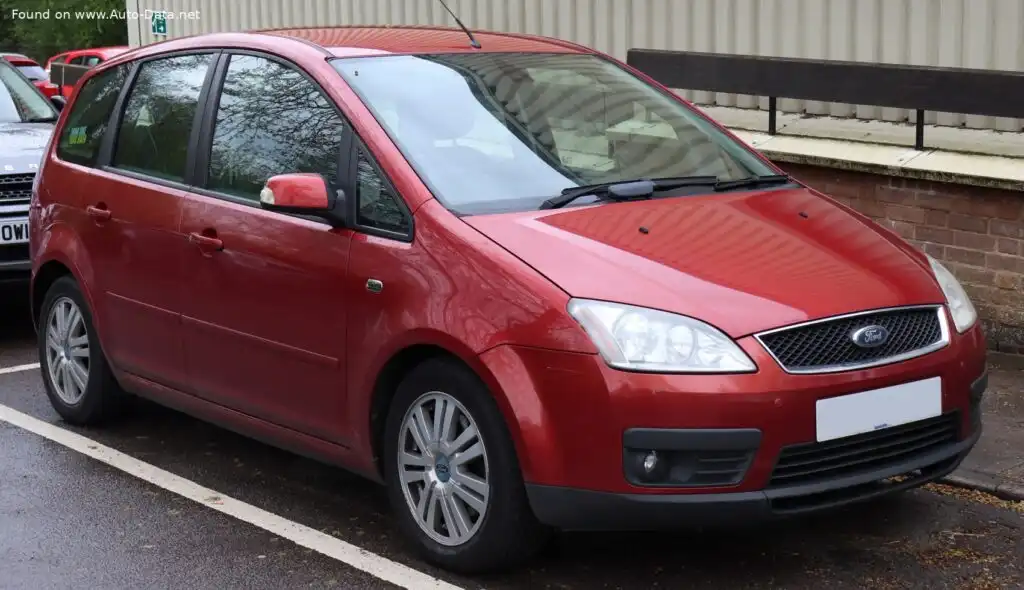
The Ford C-MAX 1.8L 16V FlexFuel, produced between December 2005 and May 2007, represented a key entry point into the first generation of Ford’s compact multi-purpose vehicle (MPV) lineup. Positioned within the C-MAX range, this variant offered a balance between affordability and practicality, targeting families and individuals seeking a versatile vehicle for everyday use. It was primarily sold in the European market, where compact MPVs were highly popular, offering a more space-efficient alternative to traditional hatchbacks and small estates. This model was built on the Ford C170 platform, shared with the Focus second generation.
Technical Specifications
| Brand | Ford |
| Model | C-MAX |
| Generation | C-MAX |
| Type (Engine) | 1.8 16V (125 Hp) FlexFuel |
| Start of production | December, 2005 |
| End of production | May, 2007 |
| Powertrain Architecture | Internal Combustion engine |
| Body type | MPV |
| Seats | 5 |
| Doors | 5 |
| Fuel consumption (urban) | 12.5 l/100 km (18.8 US mpg, 22.6 UK mpg, 8 km/l) |
| Fuel consumption (extra urban) | 7.4 l/100 km (31.8 US mpg, 38.2 UK mpg, 13.5 km/l) |
| Fuel consumption (combined) | 9.2 l/100 km (25.6 US mpg, 30.7 UK mpg, 10.9 km/l) |
| CO2 emissions | 169 g/km |
| Fuel Type | Petrol / Ethanol – E85 |
| Acceleration 0 – 100 km/h | 10.8 sec |
| Acceleration 0 – 62 mph | 10.8 sec |
| Acceleration 0 – 60 mph | 10.3 sec |
| Maximum speed | 193 km/h (119.92 mph) |
| Emission standard | Euro 4 |
| Weight-to-power ratio | 11 kg/Hp, 90.9 Hp/tonne |
| Weight-to-torque ratio | 8.3 kg/Nm, 120 Nm/tonne |
| Power | 125 Hp @ 6000 rpm |
| Power per litre | 69.5 Hp/l |
| Torque | 165 Nm @ 4000 rpm (121.7 lb.-ft. @ 4000 rpm) |
| Engine layout | Front, Transverse |
| Engine Model/Code | Q7DA |
| Engine displacement | 1798 cm3 (109.72 cu. in.) |
| Number of cylinders | 4 |
| Engine configuration | Inline |
| Cylinder Bore | 83 mm (3.27 in.) |
| Piston Stroke | 83.1 mm (3.27 in.) |
| Compression ratio | 10.8:1 |
| Number of valves per cylinder | 4 |
| Fuel injection system | Multi-port manifold injection |
| Engine aspiration | Naturally aspirated engine |
| Valvetrain | DOHC |
| Engine oil capacity | 4.3 l (4.54 US qt | 3.78 UK qt) |
| Coolant | 6.5 l (6.87 US qt | 5.72 UK qt) |
| Kerb Weight | 1375 kg (3031.36 lbs.) |
| Max. weight | 1910 kg (4210.83 lbs.) |
| Max load | 535 kg (1179.47 lbs.) |
| Trunk (boot) space – minimum | 460 l (16.24 cu. ft.) |
| Trunk (boot) space – maximum | 1620 l (57.21 cu. ft.) |
| Fuel tank capacity | 55 l (14.53 US gal | 12.1 UK gal) |
| Max. roof load | 75 kg (165.35 lbs.) |
| Permitted trailer load with brakes (12%) | 1200 kg (2645.55 lbs.) |
| Permitted trailer load without brakes | 685 kg (1510.17 lbs.) |
| Length | 4333 mm (170.59 in.) |
| Width | 1825 mm (71.85 in.) |
| Height | 1601 mm (63.03 in.) |
| Wheelbase | 2640 mm (103.94 in.) |
| Minimum turning circle | 10.7 m (35.1 ft.) |
| Drivetrain Architecture | ICE to Front Wheels |
| Drive wheel | Front wheel drive |
| Number of gears | 5 gears, manual transmission |
| Front brakes | Disc |
| Rear brakes | Disc |
| Assisting systems | ABS (Anti-lock braking system) |
| Steering type | Steering rack and pinion |
| Power steering | Hydraulic Steering |
| Tires size | 205/55 R16 |
| Wheel rims size | 16 |
Powertrain & Engine Architecture
The C-MAX 1.8 16V FlexFuel was powered by Ford’s Q7DA engine, a 1.8-liter inline-four cylinder gasoline engine. This engine was part of the Duratec family, known for its relatively simple design and durability. The ‘16V’ designation indicates the engine featured four valves per cylinder, enhancing breathing and contributing to improved power output. The Q7DA engine utilized a multi-port fuel injection system, delivering fuel directly into the intake ports. The engine’s double overhead camshaft (DOHC) valvetrain further optimized airflow. A key feature of this variant was its FlexFuel capability, allowing it to run on gasoline or a blend of up to 85% ethanol (E85). This was a response to growing environmental concerns and government incentives promoting the use of biofuels. The engine was mated to a five-speed manual transmission, providing a balance between fuel efficiency and driver control.
Driving Characteristics
The 125 horsepower and 165 Nm (121.7 lb-ft) of torque produced by the 1.8L engine provided adequate, but not exhilarating, performance. Acceleration from 0-60 mph took around 10.3 seconds, and top speed was approximately 119.92 mph. Compared to the higher-output 2.0L Duratec engine offered in other C-MAX trims, the 1.8L felt noticeably less powerful, particularly when fully loaded or tackling inclines. However, the five-speed manual transmission allowed drivers to keep the engine in its optimal power band. The gear ratios were fairly well-spaced, providing reasonable acceleration in each gear. The 1.8L engine was generally considered smoother and quieter than the diesel options available, making it a more comfortable choice for long journeys. The front-wheel-drive configuration provided predictable handling, although it wasn’t particularly sporty.
Equipment & Trim Levels
The 1.8L FlexFuel C-MAX typically came with a moderate level of standard equipment. Base models included power steering, ABS brakes, front airbags, and air conditioning. Interior features generally consisted of cloth upholstery, a basic audio system, and manually adjustable windows and mirrors. Optional extras included alloy wheels, upgraded audio systems, rear parking sensors, and a panoramic sunroof. Trim levels varied slightly depending on the market, but generally followed a progressive structure, with higher trims adding more comfort and convenience features. The focus was on providing a practical and affordable family vehicle, rather than a luxury experience.
Chassis & Braking
The C-MAX 1.8L utilized a MacPherson strut front suspension and a multi-link rear suspension, providing a comfortable ride and decent handling characteristics. The suspension was tuned for everyday use, prioritizing comfort over outright sportiness. Braking duties were handled by disc brakes on all four wheels, providing adequate stopping power. ABS (Anti-lock Braking System) was standard, enhancing safety in emergency braking situations. The steering was a hydraulic rack and pinion system, offering a reasonable level of feel and responsiveness. The relatively lightweight construction of the C-MAX helped to contribute to its nimble handling.
Market Reception & Comparison
The Ford C-MAX 1.8L FlexFuel was generally well-received by critics as a practical and affordable MPV. It was praised for its spacious interior, comfortable ride, and fuel efficiency. However, some reviewers noted that the engine lacked outright power, particularly when compared to higher-output alternatives. The FlexFuel capability was seen as a positive feature, appealing to environmentally conscious buyers. Compared to the diesel-powered C-MAX models, the 1.8L offered a quieter and smoother driving experience, but at the expense of fuel economy. Against competitors like the Renault Scenic and Opel Zafira, the C-MAX 1.8L offered a competitive package in terms of price, space, and practicality.
Legacy
The Ford C-MAX 1.8L FlexFuel has proven to be a relatively reliable vehicle in the used car market. The Duratec engine is known for its durability, and routine maintenance is generally straightforward and affordable. The FlexFuel system has also proven to be reliable, with few reported issues. However, as with any used vehicle, it’s important to check for signs of wear and tear, and to ensure that the vehicle has been properly maintained. Today, the C-MAX 1.8L FlexFuel represents an affordable and practical option for buyers seeking a compact MPV with a proven track record. Its blend of space, fuel efficiency, and reliability continues to make it a popular choice in the used car market.
