
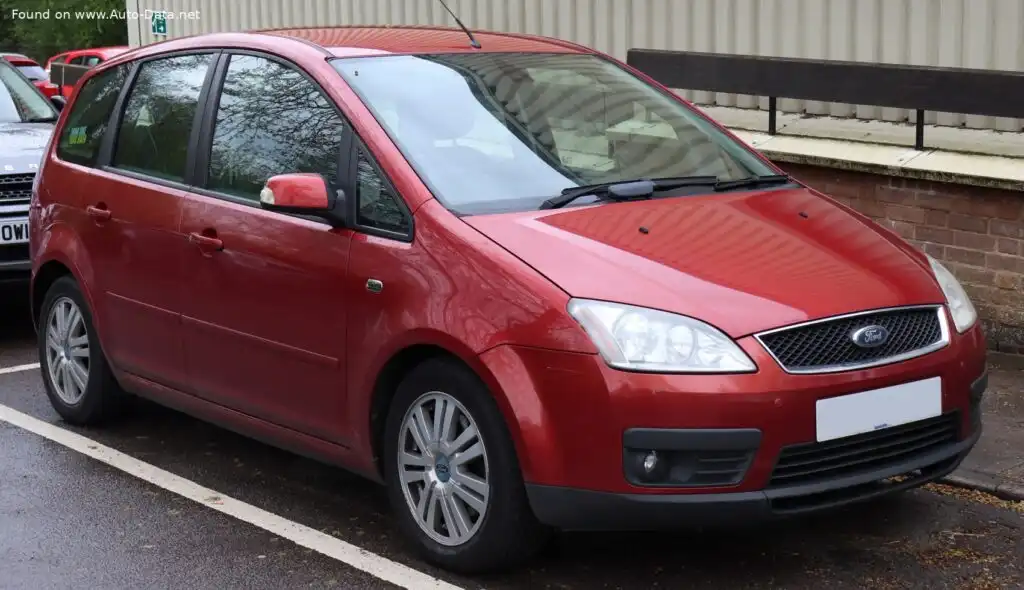
The Ford C-MAX 2.0L 16V Automatic, produced between 2003 and 2007, represented a key offering in Ford of Europe’s compact multi-purpose vehicle (MPV) lineup. Positioned as a mid-range trim, it aimed to provide a balance between practicality, comfort, and reasonable performance for family buyers. This generation C-MAX (internally designated as the first generation) was built on the Ford C170 platform, shared with the Ford Focus of the same era. The 2.0L engine and automatic transmission combination was particularly popular in markets where ease of driving and convenience were prioritized over outright sportiness.
Technical Specifications
| Brand | Ford |
| Model | C-MAX |
| Generation | C-MAX (First Generation) |
| Type (Engine) | 2.0 16V (145 Hp) Automatic |
| Start of production | 2003 |
| End of production | 2007 |
| Powertrain Architecture | Internal Combustion Engine |
| Body type | MPV |
| Seats | 5 |
| Doors | 5 |
| Fuel consumption (urban) | 11 l/100 km (21.4 US mpg) |
| Fuel consumption (extra urban) | 6.6 l/100 km (35.6 US mpg) |
| Fuel consumption (combined) | 8.3 l/100 km (28.3 US mpg) |
| Fuel Type | Petrol (Gasoline) |
| Acceleration 0 – 100 km/h | 10.8 sec |
| Acceleration 0 – 62 mph | 10.8 sec |
| Acceleration 0 – 60 mph | 10.3 sec |
| Maximum speed | 198 km/h (123.03 mph) |
| Weight-to-power ratio | 9.9 kg/Hp |
| Weight-to-torque ratio | 7.8 kg/Nm |
| Power | 145 Hp @ 6000 rpm |
| Torque | 185 Nm @ 4500 rpm (136.45 lb.-ft. @ 4500 rpm) |
| Engine layout | Front, Longitudinal |
| Engine Model/Code | AODA |
| Engine displacement | 1999 cm3 (121.99 cu. in.) |
| Number of cylinders | 4 |
| Engine configuration | Inline |
| Cylinder Bore | 87.5 mm (3.44 in.) |
| Piston Stroke | 83.1 mm (3.27 in.) |
| Compression ratio | 10.8:1 |
| Number of valves per cylinder | 4 |
| Fuel injection system | Multi-port manifold injection |
| Engine aspiration | Naturally aspirated |
| Valvetrain | DOHC |
| Engine oil capacity | 4.3 l (4.54 US qt | 3.78 UK qt) |
| Coolant capacity | 6.3 l (6.66 US qt | 5.54 UK qt) |
| Kerb Weight | 1441 kg (3176.86 lbs.) |
| Trunk (boot) space (minimum) | 550 l (19.42 cu. ft.) |
| Fuel tank capacity | 55 l (14.53 US gal | 12.1 UK gal) |
| Length | 4372 mm (172.13 in.) |
| Width | 2022 mm (79.61 in.) |
| Height | 1588 mm (62.52 in.) |
| Wheelbase | 2640 mm (103.94 in.) |
| Front track | 1535 mm (60.43 in.) |
| Rear track | 1531 mm (60.28 in.) |
| Drivetrain | Front wheel drive |
| Number of gears | 4 |
| Gearbox type | Automatic transmission |
| Front brakes | Disc |
| Rear brakes | Disc |
| Assisting systems | ABS (Anti-lock braking system) |
| Steering type | Steering rack and pinion |
| Power steering | Hydraulic |
| Tires size | 205/55 R16 |
| Wheel rims size | 16 |
Powertrain & Engine Architecture
The heart of this C-MAX variant is the Ford AODA 2.0-liter inline-four cylinder engine. This engine, part of the Zetec family, featured a double overhead camshaft (DOHC) valvetrain with four valves per cylinder, contributing to its relatively high output for its displacement. The AODA engine utilized multi-port fuel injection, a common technology at the time, delivering fuel directly into the intake ports. The engine’s 145 horsepower peak arrived at 6000 rpm, while its 185 Nm (136 lb-ft) of torque was readily available at 4500 rpm. This configuration favored mid-range usability over high-revving performance. The engine was mounted longitudinally in the front of the vehicle.
Paired with the 2.0L engine was a four-speed automatic transmission. While not as sophisticated as modern automatic gearboxes with more ratios, it provided smooth and convenient shifting, appealing to drivers who preferred a less involved driving experience. The transmission was tuned for comfort and fuel efficiency, with gear ratios optimized for everyday driving conditions.
Driving Characteristics
The C-MAX 2.0L Automatic offered a comfortable and predictable driving experience. Acceleration from 0-60 mph took around 10.3 seconds, which was adequate for most daily driving scenarios but didn’t position it as a particularly sporty vehicle. The automatic transmission, while smooth, did result in some power loss compared to the available five-speed manual transmission. The four-speed automatic meant the engine often operated at higher RPMs during highway cruising, potentially impacting fuel economy. However, the readily available torque made overtaking at highway speeds relatively effortless. The steering was light and precise, making maneuvering in urban environments easy.
Equipment & Trim Levels
The 2.0L Automatic C-MAX typically came equipped with features such as air conditioning, power windows, power door locks, and an integrated audio system. Higher trim levels, often denoted by “Ghia” or “Titanium” badges, added features like alloy wheels, upgraded interior trim, and optional extras such as a sunroof, rear parking sensors, and upgraded audio systems. Interior upholstery was typically cloth, with options for leather available on higher-spec models. The dashboard layout was functional and straightforward, prioritizing ease of use.
Chassis & Braking
The C-MAX utilized a MacPherson strut front suspension and a multi-link rear suspension, providing a good balance between ride comfort and handling. The suspension was tuned to prioritize comfort, absorbing bumps and imperfections in the road effectively. Braking duties were handled by disc brakes on all four wheels, providing adequate stopping power. Anti-lock Braking System (ABS) was standard, enhancing safety during emergency braking situations. Stabilizer bars were fitted to both the front and rear axles to reduce body roll during cornering.
Market Reception & Comparison
The Ford C-MAX 2.0L Automatic was generally well-received by automotive critics as a practical and comfortable family vehicle. It was praised for its spacious interior, versatile seating arrangements, and user-friendly controls. However, some critics noted that the automatic transmission detracted slightly from the engine’s performance and that the fuel economy wasn’t class-leading. Compared to the 1.6L versions, the 2.0L offered noticeably more power and refinement, justifying the higher price tag. Against diesel variants like the 1.6 TDCi or 2.0 TDCi, the petrol engine offered a smoother and quieter driving experience but suffered in terms of fuel economy.
Legacy
The Ford C-MAX 2.0L Automatic has proven to be a relatively reliable vehicle, with the AODA engine generally considered durable. Common maintenance items include regular oil changes, timing belt replacements (typically every 100,000 miles), and inspection of the cooling system. The automatic transmission, if properly maintained, is also known to be fairly robust. Today, these C-MAX models are readily available on the used car market at affordable prices, making them a practical and economical choice for buyers seeking a spacious and comfortable MPV. While not a performance icon, the 2.0L Automatic C-MAX remains a testament to Ford’s commitment to building versatile and dependable family vehicles.
