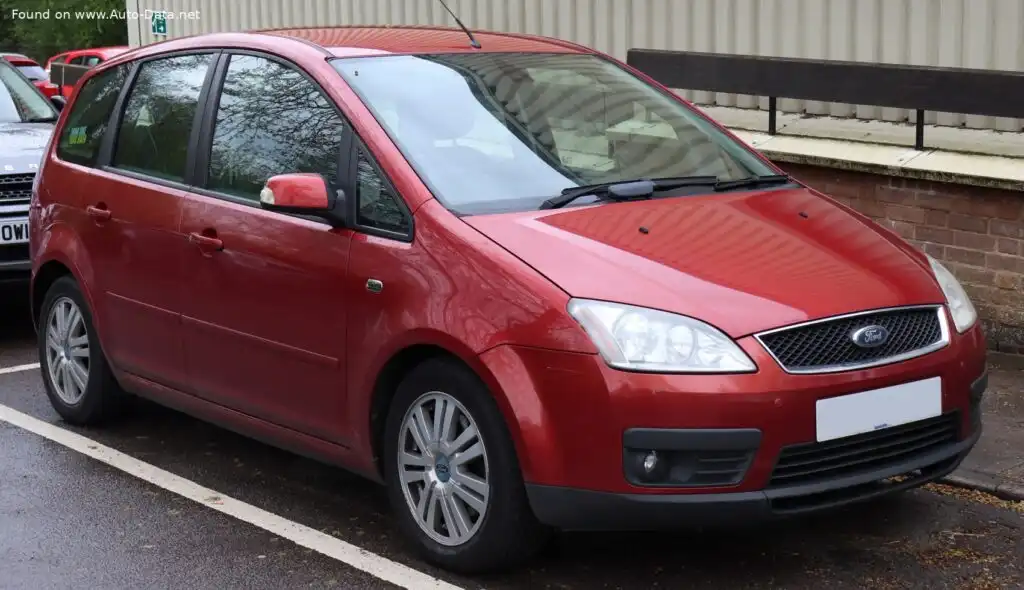
The Ford C-MAX, specifically the facelifted version produced from 2007 to 2010, represented Ford’s entry into the compact multi-purpose vehicle (MPV) segment in Europe. Positioned as a practical and versatile family car, the C-MAX aimed to offer a blend of space, comfort, and driving dynamics. The 2.0-liter 16V engine producing 145 horsepower was a mid-range offering within the C-MAX lineup, slotting between the lower-powered 1.6-liter variants and the more performance-oriented, though less common, higher-output engines. This version was primarily aimed at buyers seeking a balance between fuel economy and usable performance for everyday driving.
Technical Specifications
| Brand | Ford |
| Model | C-MAX |
| Generation | C-MAX (Facelift 2007) |
| Type (Engine) | 2.0 16V (145 Hp) |
| Start of production | 2007 |
| End of production | 2010 |
| Powertrain Architecture | Internal Combustion engine |
| Body type | MPV |
| Seats | 5 |
| Doors | 5 |
| Fuel consumption (urban) | 10 l/100 km (23.5 US mpg) |
| Fuel consumption (extra urban) | 5.6 l/100 km (42 US mpg) |
| Fuel consumption (combined) | 7.3 l/100 km (32.2 US mpg) |
| Fuel Type | Petrol (Gasoline) |
| Acceleration 0 – 100 km/h | 9.8 sec |
| Acceleration 0 – 62 mph | 9.8 sec |
| Acceleration 0 – 60 mph | 9.3 sec |
| Maximum speed | 203 km/h (126.14 mph) |
| Emission standard | Euro 4 |
| Weight-to-power ratio | 9.9 kg/Hp |
| Weight-to-torque ratio | 7.8 kg/Nm |
| Power | 145 Hp @ 6000 rpm |
| Torque | 185 Nm @ 4500 rpm (136.45 lb.-ft. @ 4500 rpm) |
| Engine layout | Front, Transverse |
| Engine Model/Code | AODE |
| Engine displacement | 1999 cm3 (121.99 cu. in.) |
| Number of cylinders | 4 |
| Engine configuration | Inline |
| Number of valves per cylinder | 4 |
| Fuel injection system | Multi-port manifold injection |
| Engine aspiration | Naturally aspirated engine |
| Valvetrain | DOHC |
| Engine oil capacity | 4.3 l (4.54 US qt | 3.78 UK qt) |
| Coolant capacity | 6.3 l (6.66 US qt | 5.54 UK qt) |
| Kerb Weight | 1441 kg (3176.86 lbs.) |
| Max. weight | 1925 kg (4243.9 lbs.) |
| Max load | 484 kg (1067.04 lbs.) |
| Trunk (boot) space – minimum | 550 l (19.42 cu. ft.) |
| Trunk (boot) space – maximum | 1620 l (57.21 cu. ft.) |
| Fuel tank capacity | 55 l (14.53 US gal | 12.1 UK gal) |
| Length | 4372 mm (172.13 in.) |
| Width | 1825 mm (71.85 in.) |
| Height | 1595 mm (62.8 in.) |
| Wheelbase | 2640 mm (103.94 in.) |
| Drivetrain Architecture | The Internal combustion engine (ICE) drives the front wheels of the vehicle. |
| Drive wheel | Front wheel drive |
| Number of gears | 5 gears, manual transmission |
| Front suspension | Independent, type McPherson with coil spring and anti-roll bar |
| Rear suspension | Independent multi-link spring suspension with stabilizer |
| Front brakes | Ventilated discs |
| Rear brakes | Disc |
| Assisting systems | ABS (Anti-lock braking system) |
Powertrain & Engine Architecture
The heart of this C-MAX variant is the 2.0-liter inline-four cylinder engine, typically identified by the AODE engine code. This engine is a naturally aspirated design, meaning it doesn’t utilize a turbocharger or supercharger. It features a double overhead camshaft (DOHC) valvetrain, operating four valves per cylinder, which contributes to improved breathing and higher-end power delivery. Fuel delivery is managed by a multi-port fuel injection system, providing precise fuel metering for optimal combustion. The engine’s 145 horsepower peak is achieved at 6000 rpm, while its 185 Nm (136 lb-ft) of torque is available at 4500 rpm. The engine is transversely mounted in the front of the vehicle, driving the front wheels. The five-speed manual transmission was the standard offering, providing a balance between fuel efficiency and driver engagement.
Driving Characteristics
The 2.0-liter C-MAX offered a reasonably refined driving experience. While not particularly sporty, the 145 hp engine provided adequate power for everyday driving situations, including highway merging and overtaking. The five-speed manual transmission allowed drivers to keep the engine in its optimal power band. Acceleration from 0-60 mph took around 9.3 seconds, which was competitive for its class at the time. Compared to the lower-powered 1.6-liter versions, the 2.0-liter offered noticeably more punch, especially when fully loaded with passengers and cargo. However, it didn’t possess the outright performance of potential higher-output variants. The gear ratios were tuned for a balance of fuel economy and usability, rather than outright acceleration.
Equipment & Trim Levels
The 2.0-liter C-MAX typically came equipped with a respectable level of standard features. These generally included air conditioning, power windows, power door locks, and a basic audio system. Higher trim levels, such as the Ghia, added features like alloy wheels, upgraded interior trim, and more advanced audio systems. Optional extras included a sunroof, parking sensors, and a trip computer. Interior upholstery was typically cloth, with higher trims offering partial leather options. The dashboard layout was functional and straightforward, prioritizing ease of use.
Chassis & Braking
The C-MAX utilized an independent suspension setup on both the front and rear axles. The front suspension employed a McPherson strut design with coil springs and an anti-roll bar, while the rear featured a multi-link setup, also with a stabilizer bar. This configuration provided a good balance of ride comfort and handling. Braking duties were handled by ventilated discs on the front wheels and solid discs on the rear. Anti-lock Braking System (ABS) was standard, enhancing safety during emergency braking situations. The chassis was designed to provide a stable and predictable driving experience, prioritizing comfort and practicality over outright sportiness.
Market Reception & Comparison
The Ford C-MAX 2.0-liter was generally well-received by automotive critics as a practical and versatile family vehicle. It was praised for its spacious interior, comfortable ride, and decent fuel economy. Compared to rivals like the Renault Scenic and Opel/Vauxhall Zafira, the C-MAX offered a more engaging driving experience. The 2.0-liter engine provided a noticeable step up in performance compared to the base 1.6-liter models, making it a popular choice for buyers who frequently carried passengers or drove on the highway. Fuel economy was respectable, averaging around 32.2 US mpg in combined driving. Reliability was generally good, although some owners reported minor issues with the electronic systems.
Legacy
The Ford C-MAX 2.0-liter (2007-2010) has proven to be a relatively reliable and durable vehicle in the used car market. The 2.0-liter engine is known for its longevity, provided it has been properly maintained. Common maintenance items include regular oil changes, timing belt replacement (typically around 100,000 miles), and inspection of the cooling system. While not a particularly collectible vehicle, the C-MAX remains a popular choice for budget-conscious buyers seeking a practical and spacious family car. Its blend of affordability, reliability, and versatility ensures its continued presence on roads today.