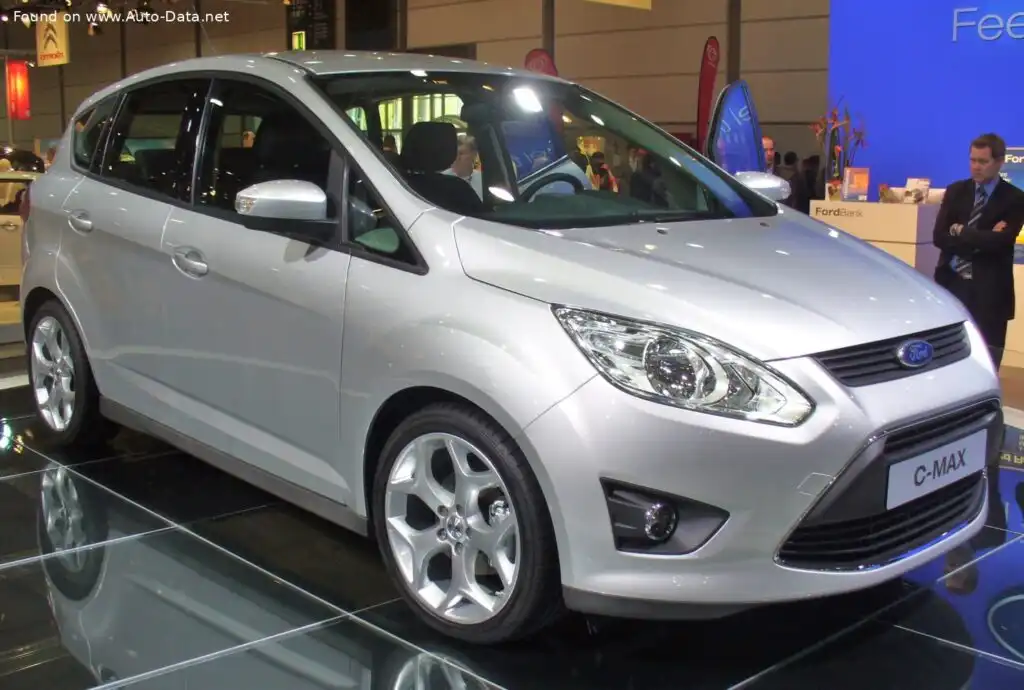
The Ford C-MAX II 1.0 EcoBoost (125 hp) S&S was a compact multi-purpose vehicle (MPV) produced by Ford from 2012 to 2015. Positioned as an entry-level to mid-range offering within the C-MAX II lineup, it aimed to provide fuel efficiency and practicality for families. This variant was primarily sold in the European market, where the C-MAX competed with vehicles like the Opel Meriva, Renault Scenic, and Volkswagen Touran. The “S&S” designation indicates the inclusion of Ford’s Auto-Start-Stop technology, further enhancing fuel economy. It was built on the Ford C-platform (Mk2), shared with the Ford Focus.
Technical Specifications
| Brand | Ford |
| Model | C-MAX |
| Generation | C-MAX II |
| Type (Engine) | 1.0 EcoBoost (125 Hp) S&S |
| Start of production | 2012 |
| End of production | 2015 |
| Powertrain Architecture | Internal Combustion engine |
| Body type | MPV |
| Seats | 5 |
| Doors | 5 |
| Fuel consumption (urban) | 6.3 l/100 km (37.3 US mpg, 44.8 UK mpg, 15.9 km/l) |
| Fuel consumption (extra urban) | 4.5 l/100 km (52.3 US mpg, 62.8 UK mpg, 22.2 km/l) |
| Fuel consumption (combined) | 5.1 l/100 km (46.1 US mpg, 55.4 UK mpg, 19.6 km/l) |
| CO2 emissions | 117 g/km |
| Fuel Type | Petrol (Gasoline) |
| Acceleration 0 – 100 km/h | 11.4 sec |
| Acceleration 0 – 62 mph | 11.4 sec |
| Acceleration 0 – 60 mph | 10.8 sec |
| Maximum speed | 187 km/h (116.2 mph) |
| Emission standard | Euro 5 |
| Weight-to-power ratio | 10.5 kg/Hp, 95 Hp/tonne |
| Weight-to-torque ratio | 7.7 kg/Nm, 129.2 Nm/tonne |
| Power | 125 Hp @ 6000 rpm |
| Power per litre | 125.3 Hp/l |
| Torque | 170 Nm @ 1500-4500 rpm (125.39 lb.-ft. @ 1500-4500 rpm) |
| Engine layout | Front, Transverse |
| Engine Model/Code | M1DA |
| Engine displacement | 998 cm3 (60.9 cu. in.) |
| Number of cylinders | 3 |
| Engine configuration | Inline |
| Cylinder Bore | 71.9 mm (2.83 in.) |
| Piston Stroke | 82 mm (3.23 in.) |
| Compression ratio | 10:1 |
| Number of valves per cylinder | 4 |
| Fuel injection system | Direct injection |
| Engine aspiration | Turbocharger, Intercooler |
| Valvetrain | DOHC |
| Engine oil capacity | 4.1 l (4.33 US qt | 3.61 UK qt) |
| Coolant | 5.8 l (6.13 US qt | 5.1 UK qt) |
| Kerb Weight | 1316 kg (2901.28 lbs.) |
| Max. weight | 1900 kg (4188.78 lbs.) |
| Max load | 584 kg (1287.5 lbs.) |
| Trunk (boot) space – minimum | 432 l (15.26 cu. ft.) |
| Trunk (boot) space – maximum | 1723 l (60.85 cu. ft.) |
| Fuel tank capacity | 55 l (14.53 US gal | 12.1 UK gal) |
| Max. roof load | 75 kg (165.35 lbs.) |
| Permitted trailer load with brakes (12%) | 1200 kg (2645.55 lbs.) |
| Permitted trailer load without brakes | 695 kg (1532.21 lbs.) |
| Length | 4380 mm (172.44 in.) |
| Width | 1828 mm (71.97 in.) |
| Width with mirrors folded | 1858 mm (73.15 in.) |
| Width including mirrors | 2067 mm (81.38 in.) |
| Height | 1626 mm (64.02 in.) |
| Wheelbase | 2648 mm (104.25 in.) |
| Front track | 1544 mm (60.79 in.) |
| Rear (Back) track | 1554 mm (61.18 in.) |
| Minimum turning circle | 10.7 m (35.1 ft.) |
| Drivetrain | Front wheel drive |
| Number of gears and type of gearbox | 6 gears, manual transmission |
| Front suspension | Independent, type McPherson with coil spring and anti-roll bar |
| Rear suspension | Independent multi-link spring suspension with stabilizer |
| Front brakes | Ventilated discs |
| Rear brakes | Disc |
| Assisting systems | ABS (Anti-lock braking system) |
| Steering type | Steering rack and pinion |
| Power steering | Electric Steering |
| Tires size | 205/55 R16; 215/55 R16 |
| Wheel rims size | 6.5 J x 16; 7.0 J x 16 |
Powertrain & Engine Architecture
The heart of the C-MAX II 1.0 EcoBoost was the M1DA engine, a 998cc, three-cylinder turbocharged gasoline engine. This engine was part of Ford’s EcoBoost family, designed to deliver a balance of power and fuel efficiency. It featured direct fuel injection, a single scroll turbocharger, and a variable valve timing system (Ti-VCT). The engine produced 125 horsepower at 6000 rpm and 170 Nm (125 lb-ft) of torque between 1500 and 4500 rpm. The 6-speed manual transmission was standard, offering relatively short gear ratios to maximize the engine’s responsiveness. The Auto-Start-Stop system, denoted by the “S&S” in the model name, automatically shut off the engine when the vehicle came to a stop, reducing idle fuel consumption and emissions.
Driving Characteristics
The 1.0 EcoBoost engine in the C-MAX II provided adequate performance for everyday driving. While not particularly quick, with a 0-60 mph time of around 10.8 seconds, it felt lively around town. The turbocharger provided a noticeable boost in power, but the engine could feel strained when fully loaded or during aggressive acceleration. The 6-speed manual transmission allowed drivers to keep the engine in its optimal power band. Compared to the 1.6-liter gasoline and 1.6-liter diesel versions of the C-MAX II, the 1.0 EcoBoost offered better fuel economy but less overall power and torque. The manual transmission provided a more engaging driving experience than the optional automatic transmission available on other C-MAX variants.
Equipment & Trim Levels
The 1.0 EcoBoost S&S typically came with a reasonable level of standard equipment. This included air conditioning, power windows, power mirrors, a basic audio system with USB connectivity, and ABS brakes. Higher trim levels, such as Titanium, added features like alloy wheels, a more advanced infotainment system, automatic climate control, and parking sensors. Interior upholstery was typically cloth, with options for upgraded materials on higher trims. The dashboard layout was functional and straightforward, prioritizing usability over luxury.
Chassis & Braking
The C-MAX II utilized an independent front suspension with McPherson struts and a multi-link independent rear suspension. This setup provided a comfortable ride quality and decent handling characteristics. Front brakes were ventilated discs, while rear brakes were solid discs. The steering was electrically assisted, providing light and precise control. Stabilizer bars were fitted to both the front and rear axles to reduce body roll during cornering. The suspension was tuned to prioritize comfort over sporty handling, making it well-suited for everyday driving and family use.
Market Reception & Comparison
The Ford C-MAX II 1.0 EcoBoost S&S was generally well-received by automotive critics for its fuel efficiency and practicality. It was praised for its responsive engine and comfortable ride. However, some reviewers noted that the engine could feel underpowered when fully loaded or on steep inclines. Compared to the diesel-powered C-MAX models, the 1.0 EcoBoost offered lower running costs but less torque. Against competitors like the Opel Meriva and Renault Scenic, the C-MAX II offered a competitive package in terms of space, fuel economy, and features.
Legacy
The 1.0 EcoBoost engine proved to be a reliable and durable powertrain. While early versions of the engine experienced some issues with coolant loss, these were largely addressed through software updates and revised components. Today, the C-MAX II 1.0 EcoBoost S&S remains a popular choice in the used car market, particularly for buyers seeking a fuel-efficient and practical family vehicle. Its relatively simple mechanical design and readily available parts contribute to its affordability and ease of maintenance. The engine’s continued presence in later Ford models demonstrates its success and longevity.