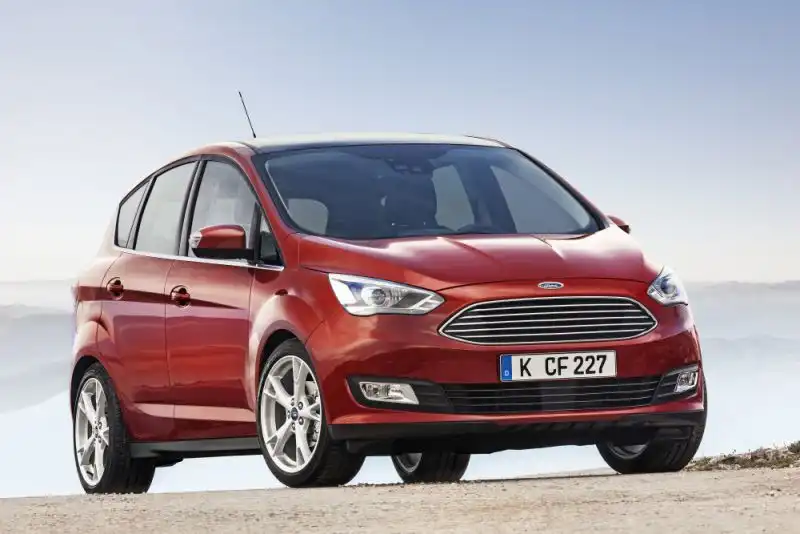
The Ford C-MAX II, specifically the 1.5 TDCi 120 horsepower variant equipped with the PowerShift dual-clutch transmission, was a key model in Ford of Europe’s compact multi-purpose vehicle (MPV) lineup from 2015 to 2019. This version represented a mid-range offering within the C-MAX II range, positioned between the lower-powered diesel options and the more potent gasoline engines. The facelifted C-MAX II, introduced in 2015, brought revised styling, updated technology, and refined engine options, aiming to maintain the model’s appeal in a competitive segment. This particular configuration was primarily marketed in Europe, where fuel efficiency and practicality were highly valued by consumers.
Technical Specifications
| Brand | Ford |
| Model | C-MAX |
| Generation | C-MAX II (facelift 2015) |
| Type (Engine) | 1.5 TDCi (120 Hp) PowerShift |
| Start of production | 2015 |
| End of production | June, 2019 |
| Powertrain Architecture | Internal Combustion engine |
| Body type | MPV |
| Seats | 5 |
| Doors | 5 |
| Fuel consumption (urban) | 5.4 l/100 km (43.6 US mpg, 52.3 UK mpg, 18.5 km/l) |
| Fuel consumption (extra urban) | 4.1 l/100 km (57.4 US mpg, 68.9 UK mpg, 24.4 km/l) |
| Fuel consumption (combined) | 4.6 l/100 km (51.1 US mpg, 61.4 UK mpg, 21.7 km/l) |
| CO2 emissions | 120 g/km |
| Fuel Type | Diesel |
| Acceleration 0 – 100 km/h | 12.4 sec |
| Acceleration 0 – 62 mph | 12.4 sec |
| Acceleration 0 – 60 mph | 11.8 sec |
| Maximum speed | 182 km/h (113.09 mph) |
| Emission standard | Euro 6 |
| Weight-to-power ratio | 11.6 kg/Hp, 85.9 Hp/tonne |
| Weight-to-torque ratio | 5.2 kg/Nm, 193.3 Nm/tonne |
| Power | 120 Hp @ 3600 rpm |
| Power per litre | 80.1 Hp/l |
| Torque | 270 Nm @ 1750-2500 rpm (199.14 lb.-ft. @ 1750-2500 rpm) |
| Engine layout | Front, Transverse |
| Engine Model/Code | XWDA, XWDB, XWDC, XWDD, XWDE |
| Engine displacement | 1499 cm3 (91.47 cu. in.) |
| Number of cylinders | 4 |
| Engine configuration | Inline |
| Cylinder Bore | 73.5 mm (2.89 in.) |
| Piston Stroke | 88.3 mm (3.48 in.) |
| Compression ratio | 16:1 |
| Number of valves per cylinder | 2 |
| Fuel injection system | Diesel Commonrail |
| Engine aspiration | Turbocharger, Intercooler |
| Valvetrain | SOHC |
| Engine oil capacity | 3.85 l (4.07 US qt | 3.39 UK qt) |
| Coolant capacity | 7.3 l (7.71 US qt | 6.42 UK qt) |
| Kerb Weight | 1397 kg (3079.86 lbs.) |
| Max. weight | 2000 kg (4409.25 lbs.) |
| Max load | 603 kg (1329.39 lbs.) |
| Trunk (boot) space – minimum | 432 l (15.26 cu. ft.) |
| Trunk (boot) space – maximum | 1684 l (59.47 cu. ft.) |
| Fuel tank capacity | 55 l (14.53 US gal | 12.1 UK gal) |
| Max. roof load | 75 kg (165.35 lbs.) |
| Permitted trailer load with brakes (12%) | 1200 kg (2645.55 lbs.) |
| Permitted trailer load without brakes | 735 kg (1620.4 lbs.) |
| Length | 4379 mm (172.4 in.) |
| Width | 1828 mm (71.97 in.) |
| Width with mirrors folded | 1858 mm (73.15 in.) |
| Width including mirrors | 2067 mm (81.38 in.) |
| Height | 1610 mm (63.39 in.) |
| Wheelbase | 2648 mm (104.25 in.) |
| Front track | 1543-1557 mm (60.75 – 61.3 in.) |
| Rear (Back) track | 1554-1569 mm (61.18 – 61.77 in.) |
| Minimum turning circle | 11.1 m (36.42 ft.) |
| Drivetrain | Front wheel drive |
| Number of gears and type of gearbox | 6 gears, automatic transmission PowerShift |
| Front suspension | Independent, type McPherson with coil spring and anti-roll bar |
| Rear suspension | Independent multi-link spring suspension with stabilizer |
| Front brakes | Ventilated discs, 278×25 mm |
| Rear brakes | Disc, 280×11 mm |
| Assisting systems | ABS (Anti-lock braking system) |
| Steering type | Steering rack and pinion |
| Power steering | Electric Steering |
| Tires size | 205/55 R16; 215/55 R16; 215/50 R17; 235/40 R18 |
| Wheel rims size | 6.5J x 16; 7J x 16; 7J x 17; 8J x 18 |
Powertrain & Engine Architecture
The heart of this C-MAX variant is the 1.5-liter TDCi diesel engine, part of Ford’s Duratorq engine family. Specifically, engine codes XWDA, XWDB, XWDC, XWDD, and XWDE were used. This engine utilizes a common-rail direct fuel injection system, delivering fuel at extremely high pressure for improved combustion efficiency and reduced emissions. The engine features a single overhead camshaft (SOHC) valvetrain operating two valves per cylinder. A turbocharger with an intercooler is employed to boost power output and improve torque across a wider rev range. The 1.5 TDCi engine is known for its relatively quiet operation and decent fuel economy. The PowerShift transmission is a 6-speed dual-clutch transmission (DCT) that provides quicker and smoother gear changes compared to a traditional automatic. It operates similarly to a manual transmission but with automated clutch operation and gear selection.
Driving Characteristics
The 120 horsepower and 270 Nm (199 lb-ft) of torque offered by this engine and transmission combination provided adequate performance for everyday driving. Acceleration from 0-60 mph took around 11.8 seconds, and top speed was approximately 113 mph. While not particularly sporty, the PowerShift transmission offered responsive shifts, making overtaking maneuvers relatively easy. Compared to the higher-output 1.5 TDCi (150 hp) or the gasoline engines, this variant felt less eager to accelerate. However, it offered a more relaxed driving experience and superior fuel economy. The PowerShift transmission’s gear ratios were tuned for efficiency, prioritizing fuel savings over outright performance.
Equipment & Trim Levels
The 1.5 TDCi 120 hp PowerShift C-MAX typically came equipped with features such as air conditioning, power windows, power mirrors, a basic audio system with USB connectivity, and alloy wheels. Higher trim levels, such as Titanium, added features like automatic climate control, a more advanced infotainment system with touchscreen display, rear parking sensors, and cruise control. Optional extras included a panoramic sunroof, leather upholstery, and a navigation system. Interior upholstery was typically cloth, with higher trims offering partial leather options.
Chassis & Braking
The C-MAX II utilized an independent front suspension with McPherson struts and a multi-link independent rear suspension, providing a comfortable ride and good handling characteristics. The front brakes were ventilated discs, while the rear brakes were solid discs. Anti-lock Braking System (ABS) was standard. The suspension was tuned to balance comfort and handling, making it suitable for both city driving and longer journeys. Stabilizer bars were fitted to both the front and rear axles to reduce body roll during cornering.
Market Reception & Comparison
The 1.5 TDCi 120 hp PowerShift C-MAX was generally well-received by automotive critics as a practical and fuel-efficient MPV. It was praised for its comfortable ride, spacious interior, and user-friendly technology. However, some critics noted that the PowerShift transmission could occasionally exhibit jerky shifts, particularly at low speeds. Compared to the 1.0 EcoBoost gasoline engine, the diesel offered significantly better fuel economy but less outright performance. The 1.5 TDCi 150 hp version provided a noticeable performance boost but at the expense of fuel efficiency.
Legacy
The Ford C-MAX II 1.5 TDCi 120 hp PowerShift has proven to be a relatively reliable powertrain in the used car market. The 1.5 TDCi engine is generally durable, and the PowerShift transmission, while sometimes criticized, can provide years of service with proper maintenance. Regular oil changes and transmission fluid services are crucial for maintaining the longevity of the PowerShift unit. Today, these C-MAX models represent a cost-effective option for buyers seeking a practical and fuel-efficient MPV.