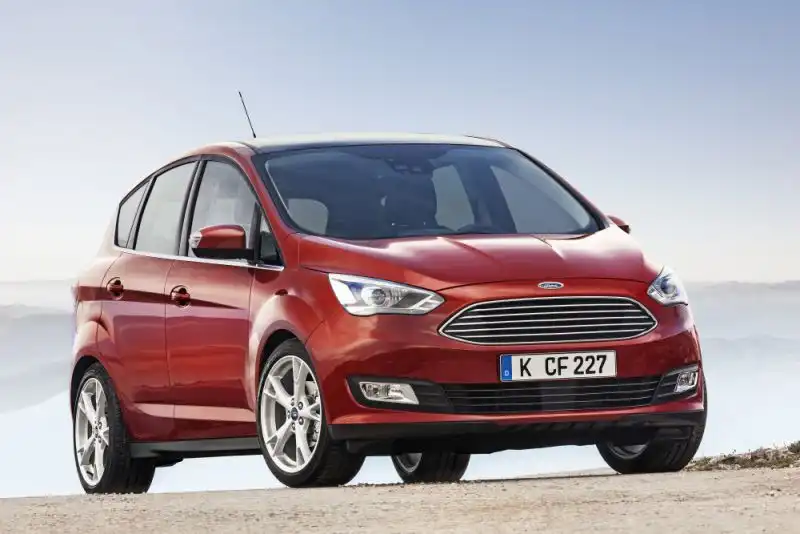
The Ford C-MAX II, particularly the 1.6 Ti-VCT (120 horsepower) variant produced from 2015 to 2019, represents a significant iteration of Ford’s compact multi-purpose vehicle (MPV) offering in the European market. This facelifted version of the second-generation C-MAX aimed to refine the original’s design and improve fuel efficiency while maintaining its practicality and family-focused appeal. Positioned as a mid-range option within the C-MAX lineup, it served as a more accessible alternative to the higher-performance EcoBoost models and a step up from the base 1.0 EcoBoost engine. The C-MAX II competed directly with vehicles like the Volkswagen Touran, Opel Meriva, and Citroën C4 Picasso, offering a blend of space, comfort, and affordability.
Technical Specifications
| Brand | Ford |
| Model | C-MAX |
| Generation | C-MAX II (facelift 2015) |
| Type (Engine) | 1.6 Ti-VCT (120 Hp) |
| Start of production | 2015 |
| End of production | June, 2019 |
| Powertrain Architecture | Internal Combustion engine |
| Body type | MPV |
| Seats | 5 |
| Doors | 5 |
| Fuel consumption (urban) | 8.4 l/100 km (28 US mpg, 33.6 UK mpg, 11.9 km/l) |
| Fuel consumption (extra urban) | 5.2 l/100 km (45.2 US mpg, 54.3 UK mpg, 19.2 km/l) |
| Fuel consumption (combined) | 6.4 l/100 km (36.8 US mpg, 44.1 UK mpg, 15.6 km/l) |
| CO2 emissions | 149 g/km |
| Fuel Type | Petrol (Gasoline) |
| Acceleration 0 – 100 km/h | 11.8 sec |
| Acceleration 0 – 62 mph | 11.8 sec |
| Acceleration 0 – 60 mph | 11.2 sec |
| Maximum speed | 188 km/h (116.82 mph) |
| Emission standard | Euro 6 |
| Weight-to-power ratio | 10.8 kg/Hp, 92.4 Hp/tonne |
| Weight-to-torque ratio | 8.2 kg/Nm, 122.4 Nm/tonne |
| Power | 120 Hp @ 6000 rpm |
| Power per litre | 75.2 Hp/l |
| Torque | 159 Nm @ 4000 rpm (117.27 lb.-ft. @ 4000 rpm) |
| Engine layout | Front, Transverse |
| Engine Model/Code | MUDA, MUDD |
| Engine displacement | 1596 cm3 (97.39 cu. in.) |
| Number of cylinders | 4 |
| Engine configuration | Inline |
| Cylinder Bore | 79 mm (3.11 in.) |
| Piston Stroke | 81.4 mm (3.2 in.) |
| Compression ratio | 11:1 |
| Number of valves per cylinder | 4 |
| Fuel injection system | Multi-port manifold injection |
| Engine aspiration | Naturally aspirated engine |
| Valvetrain | DOHC |
| Engine oil capacity | 4.1 l (4.33 US qt | 3.61 UK qt) |
| Coolant capacity | 5.7 l (6.02 US qt | 5.02 UK qt) |
| Kerb Weight | 1299 kg (2863.8 lbs.) |
| Max. weight | 1860 kg (4100.6 lbs.) |
| Max load | 561 kg (1236.79 lbs.) |
| Trunk (boot) space – minimum | 432 l (15.26 cu. ft.) |
| Trunk (boot) space – maximum | 1684 l (59.47 cu. ft.) |
| Fuel tank capacity | 53 l (14 US gal | 11.66 UK gal) |
| Max. roof load | 75 kg (165.35 lbs.) |
| Permitted trailer load with brakes (12%) | 1000 kg (2204.62 lbs.) |
| Permitted trailer load without brakes | 685 kg (1510.17 lbs.) |
| Length | 4379 mm (172.4 in.) |
| Width | 1828 mm (71.97 in.) |
| Width with mirrors folded | 1858 mm (73.15 in.) |
| Width including mirrors | 2067 mm (81.38 in.) |
| Height | 1610 mm (63.39 in.) |
| Wheelbase | 2648 mm (104.25 in.) |
| Front track | 1543-1557 mm (60.75 – 61.3 in.) |
| Rear (Back) track | 1554-1569 mm (61.18 – 61.77 in.) |
| Minimum turning circle | 11.1 m (36.42 ft.) |
| Drivetrain Architecture | Front wheel drive |
| Number of gears and type of gearbox | 6 gears, manual transmission |
| Front suspension | Independent, type McPherson with coil spring and anti-roll bar |
| Rear suspension | Independent multi-link spring suspension with stabilizer |
| Front brakes | Ventilated discs, 278×25 mm |
| Rear brakes | Disc, 280×11 mm |
| Assisting systems | ABS (Anti-lock braking system) |
| Steering type | Steering rack and pinion |
| Power steering | Electric Steering |
| Tires size | 205/55 R16; 215/55 R16; 215/50 R17; 235/40 R18 |
| Wheel rims size | 6.5J x 16; 7J x 16; 7J x 17; 8J x 18 |
INTRODUCTION
The Ford C-MAX II facelift, launched in 2015, built upon the foundation laid by the original C-MAX and its subsequent redesign. This version, characterized by a revised front fascia, updated interior materials, and enhanced technology, aimed to strengthen Ford’s position in the competitive compact MPV segment. The 1.6 Ti-VCT 120 hp engine option was a key component of this strategy, offering a balance between fuel economy and acceptable performance for everyday driving. It was built on the Ford C-platform (Mk2 Focus platform), also known as the 1HX0/A3 platform, shared with several other Ford and Mazda vehicles. This platform allowed for a relatively lightweight and structurally sound vehicle.
Powertrain & Engine Architecture
The heart of this C-MAX variant is the 1.6-liter Ti-VCT (Twin Independent Variable Camshaft Timing) four-cylinder gasoline engine, designated MUDA or MUDD depending on specific calibration and market. This engine is a naturally aspirated unit, meaning it doesn’t rely on turbocharging or supercharging for power. It utilizes multi-port fuel injection, delivering fuel directly into the intake ports. The Ti-VCT system allows for independent control of both intake and exhaust valve timing, optimizing engine performance and efficiency across a wider range of engine speeds. The engine produces 120 horsepower at 6000 rpm and 159 Nm (117.27 lb-ft) of torque at 4000 rpm. The engine’s design prioritizes fuel efficiency and smooth operation over outright performance. The 6-speed manual transmission was standard, offering a reasonable spread of gear ratios for both city and highway driving.
Driving Characteristics
The 1.6 Ti-VCT engine, paired with the 6-speed manual transmission, delivers a driving experience geared towards practicality and economy rather than sporty performance. Acceleration from 0-60 mph takes around 11.2 seconds, and the top speed is approximately 116.82 mph. The engine feels responsive enough for everyday driving situations, such as merging onto highways or overtaking slower vehicles, but it requires downshifting to access its full power potential. The gear ratios are well-matched, providing adequate acceleration in each gear. Compared to the more powerful EcoBoost variants, the 1.6 Ti-VCT feels noticeably less energetic, but it offers a smoother and more predictable power delivery. The manual transmission provides a more engaging driving experience than an automatic would, allowing the driver to maintain better control over the engine’s power band.
Equipment & Trim Levels
The 1.6 Ti-VCT C-MAX typically came equipped with a respectable level of standard features. These included air conditioning, power windows, power mirrors, a basic audio system with USB connectivity, and ABS brakes. Higher trim levels, such as Titanium, added features like alloy wheels, a more advanced infotainment system with a touchscreen display, automatic climate control, rear parking sensors, and cruise control. Interior upholstery was typically cloth, with options for upgraded materials on higher trims. Optional extras included a panoramic sunroof, navigation system, and various driver assistance features.
Chassis & Braking
The C-MAX II utilizes an independent McPherson strut suspension at the front and an independent multi-link suspension at the rear, providing a comfortable and controlled ride. The suspension is tuned to prioritize comfort over sporty handling, but it still offers decent body control in corners. Front brakes are ventilated discs measuring 278x25mm, while rear brakes are solid discs measuring 280x11mm. ABS (Anti-lock Braking System) is standard, enhancing braking performance and safety. The electric power steering provides light and precise steering feel, making it easy to maneuver in tight spaces.
Market Reception & Comparison
The 1.6 Ti-VCT C-MAX was generally well-received by critics as a practical and affordable MPV. It was praised for its spacious interior, comfortable ride, and good fuel economy. However, some reviewers noted that the engine lacked the punch of the EcoBoost variants and that the interior materials, while improved over the original C-MAX, still felt somewhat basic in lower trim levels. Compared to the 1.0 EcoBoost version, the 1.6 Ti-VCT offered more power and a smoother driving experience, but at the cost of slightly lower fuel economy. Against competitors like the Volkswagen Touran, the C-MAX offered a more affordable price point, but the Touran generally provided a more refined interior and a wider range of engine options.
Legacy
The 1.6 Ti-VCT engine in the C-MAX II is generally considered a reliable unit, with few major reported issues. Regular maintenance, including oil changes and timing belt replacements, is crucial for ensuring long-term reliability. On the used car market, these C-MAX variants represent a good value proposition for buyers seeking a practical and affordable MPV. While not the most exciting vehicle to drive, it offers a comfortable and spacious interior, good fuel economy, and a reputation for reliability. The C-MAX II, in all its variants, helped solidify Ford’s presence in the European MPV market, offering a compelling alternative to established competitors.