Technical Specifications
| Brand | Ford |
| Model | C-MAX |
| Generation | C-MAX II (facelift 2015) |
| Type (Engine) | 2.0 TDCi (150 Hp) S&S |
| Start of production | April, 2015 |
| End of production | June, 2019 |
| Powertrain Architecture | Internal Combustion engine |
| Body type | MPV |
| Seats | 5 |
| Doors | 5 |
| Fuel consumption (urban) | 5 l/100 km (47 US mpg, 56.5 UK mpg, 20 km/l) |
| Fuel consumption (extra urban) | 4 l/100 km (58.8 US mpg, 70.6 UK mpg, 25 km/l) |
| Fuel consumption (combined) | 4.4 l/100 km (53.5 US mpg, 64.2 UK mpg, 22.7 km/l) |
| CO2 emissions | 114 g/km |
| Fuel Type | Diesel |
| Acceleration 0 – 100 km/h | 9.5 sec |
| Acceleration 0 – 62 mph | 9.5 sec |
| Acceleration 0 – 60 mph | 9 sec |
| Maximum speed | 204 km/h (126.76 mph) |
| Emission standard | Euro 6 |
| Weight-to-power ratio | 9.4 kg/Hp, 105.9 Hp/tonne |
| Weight-to-torque ratio | 3.5 kg/Nm, 282.5 Nm/tonne |
| Power | 150 Hp @ 3500 rpm |
| Power per litre | 75.1 Hp/l |
| Torque | 400 Nm @ 2000-2500 rpm (295.02 lb.-ft. @ 2000-2500 rpm) |
| Engine layout | Front, Transverse |
| Engine Model/Code | T7DB, T7DC, T7DD |
| Engine displacement | 1997 cm3 (121.86 cu. in.) |
| Number of cylinders | 4 |
| Engine configuration | Inline |
| Cylinder Bore | 85 mm (3.35 in.) |
| Piston Stroke | 88 mm (3.46 in.) |
| Compression ratio | 16:1 |
| Number of valves per cylinder | 4 |
| Fuel injection system | Diesel Commonrail |
| Engine aspiration | Turbocharger, Intercooler |
| Valvetrain | DOHC |
| Engine oil capacity | 5.65 l (5.97 US qt | 4.97 UK qt) |
| Coolant capacity | 8 l (8.45 US qt | 7.04 UK qt) |
| Kerb Weight | 1416 kg (3121.75 lbs.) |
| Max. weight | 2050 kg (4519.48 lbs.) |
| Max load | 634 kg (1397.73 lbs.) |
| Trunk (boot) space – minimum | 432 l (15.26 cu. ft.) |
| Trunk (boot) space – maximum | 1684 l (59.47 cu. ft.) |
| Fuel tank capacity | 60 l (15.85 US gal | 13.2 UK gal) |
| Max. roof load | 75 kg (165.35 lbs.) |
| Permitted trailer load with brakes (12%) | 1500 kg (3306.93 lbs.) |
| Permitted trailer load without brakes | 745 kg (1642.44 lbs.) |
| Length | 4379 mm (172.4 in.) |
| Width | 1828 mm (71.97 in.) |
| Width with mirrors folded | 1858 mm (73.15 in.) |
| Width including mirrors | 2067 mm (81.38 in.) |
| Height | 1610 mm (63.39 in.) |
| Wheelbase | 2648 mm (104.25 in.) |
| Front track | 1543-1557 mm (60.75 – 61.3 in.) |
| Rear track | 1554-1569 mm (61.18 – 61.77 in.) |
| Minimum turning circle | 11.1 m (36.42 ft.) |
| Drivetrain | Front wheel drive |
| Number of gears | 6 |
| Gearbox type | Manual transmission |
| Front suspension | Independent, McPherson with coil spring and anti-roll bar |
| Rear suspension | Independent multi-link spring suspension with stabilizer |
| Front brakes | Ventilated discs, 300×25 mm |
| Rear brakes | Disc, 280×11 mm |
| Assisting systems | ABS (Anti-lock braking system) |
| Steering type | Steering rack and pinion |
| Power steering | Electric |
| Tires size | 205/55 R16; 215/55 R16; 215/50 R17; 235/40 R18 |
| Wheel rims size | 6.5J x 16; 7J x 16; 7J x 17; 8J x 18 |
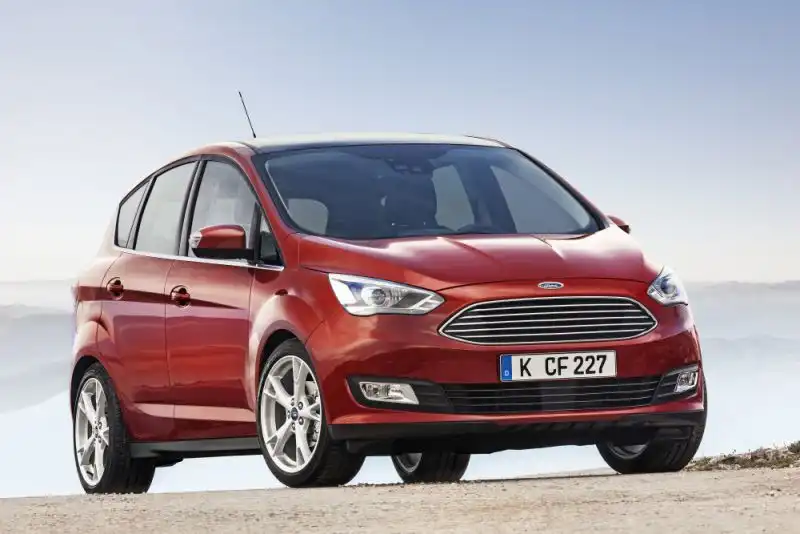
The Ford C-MAX II, launched in 2010 and facelifted in 2015, was designed to appeal to European buyers seeking a versatile and relatively affordable family vehicle. The 2.0 TDCi 150 horsepower variant, introduced with the facelift, offered a balance between performance and fuel economy, making it a popular choice for those covering significant distances. This engine was part of Ford’s Duratorq family of diesel engines, known for their robustness and relatively straightforward maintenance. The C-MAX II competed directly with vehicles like the Volkswagen Touran, Opel/Vauxhall Meriva, and Renault Scenic.
Powertrain & Engine Architecture
The 2.0 TDCi 150 PS C-MAX variant is powered by the 2.0-liter Duratorq TDCi diesel engine, utilizing engine codes T7DB, T7DC, or T7DD depending on the market and emissions standards. This engine is a four-cylinder, inline configuration with a displacement of 1997 cubic centimeters. It features a common-rail direct fuel injection system, delivering fuel at extremely high pressure for optimized combustion. A single turbocharger with an intercooler is employed to boost power and efficiency. The valvetrain is a Double Overhead Camshaft (DOHC) design with four valves per cylinder, contributing to improved breathing and power output. The engine produces 150 horsepower at 3500 rpm, while the substantial 400 Nm (295 lb-ft) of torque is available between 2000 and 2500 rpm. This engine was primarily paired with a six-speed manual transmission, providing a good balance of fuel economy and driver control. An automatic transmission option was also available, though less common. The Auto-Start-Stop system, denoted by the “S&S” in the model name, automatically shuts off the engine when the vehicle is stationary to reduce fuel consumption and emissions.
Driving Characteristics
The 2.0 TDCi 150 PS C-MAX offers a comfortable and capable driving experience. While not a performance-oriented vehicle, the engine provides ample torque for everyday driving situations, including overtaking and carrying a full load of passengers and luggage. The six-speed manual transmission allows for precise gear selection and helps to keep the engine within its optimal power band. Acceleration from 0-62 mph takes around 9.5 seconds, which is respectable for a compact MPV. The gear ratios are tuned for fuel efficiency, with taller gearing in higher gears for relaxed cruising. Compared to the lower-powered 1.6 TDCi versions, the 2.0 TDCi offers noticeably more punch and feels less strained when fully loaded. It also provides a more refined driving experience than the petrol-powered variants. However, it doesn’t match the responsiveness of higher-performance C-MAX models equipped with the 2.3-liter EcoBoost engine. The automatic transmission, while convenient, can feel slightly less responsive than the manual, and may result in slightly lower fuel economy.
Equipment & Trim Levels
The 2.0 TDCi 150 PS variant was typically offered in mid-range trim levels, such as Trend or Titanium. Standard equipment generally included air conditioning, power windows, power mirrors, a basic audio system with USB connectivity, and alloy wheels. Higher trim levels added features like automatic climate control, a touchscreen infotainment system with navigation, rear parking sensors, cruise control, and upgraded interior upholstery. Optional extras included a panoramic sunroof, leather seats, and advanced driver-assistance systems such as lane departure warning and automatic emergency braking. The interior generally featured durable plastics, but the overall design was functional and well-laid-out.
Chassis & Braking
The C-MAX II utilizes an independent front suspension with McPherson struts and a multi-link independent rear suspension, providing a comfortable ride and good handling characteristics. A stabilizer bar is fitted to both the front and rear axles to reduce body roll during cornering. The braking system consists of ventilated discs on the front wheels and solid discs on the rear wheels. Anti-lock Braking System (ABS) is standard, enhancing braking performance and stability. The steering is electrically assisted, providing a light and precise feel. The suspension tuning prioritized comfort over sporty handling, making it well-suited for everyday driving and long journeys.
Market Reception & Comparison
The Ford C-MAX II 2.0 TDCi 150 PS received generally positive reviews from automotive critics. It was praised for its spacious interior, comfortable ride, and fuel efficiency. The engine was considered a good compromise between performance and economy. Compared to the 1.6 TDCi variants, the 2.0 TDCi offered a more refined and capable driving experience, but at a slightly higher price point. The 2.0 TDCi also offered better fuel economy than the petrol-powered options. Some critics noted that the interior materials weren’t as premium as those found in some competitors. Reliability was generally good, although some owners reported issues with the diesel particulate filter (DPF) and the dual-mass flywheel, common concerns with modern diesel engines.
Legacy
The Ford C-MAX II 2.0 TDCi 150 PS remains a popular choice in the used car market. The Duratorq engine is known for its durability, and with proper maintenance, it can provide many years of reliable service. However, potential buyers should be aware of the potential for DPF issues, particularly if the vehicle has been primarily used for short journeys. Regular servicing and the use of quality diesel fuel are crucial for maintaining DPF health. The dual-mass flywheel is another component that may require replacement over time. Overall, the C-MAX II 2.0 TDCi 150 PS represents a well-rounded and practical family vehicle that continues to offer good value for money, providing a comfortable and economical transportation option for families.