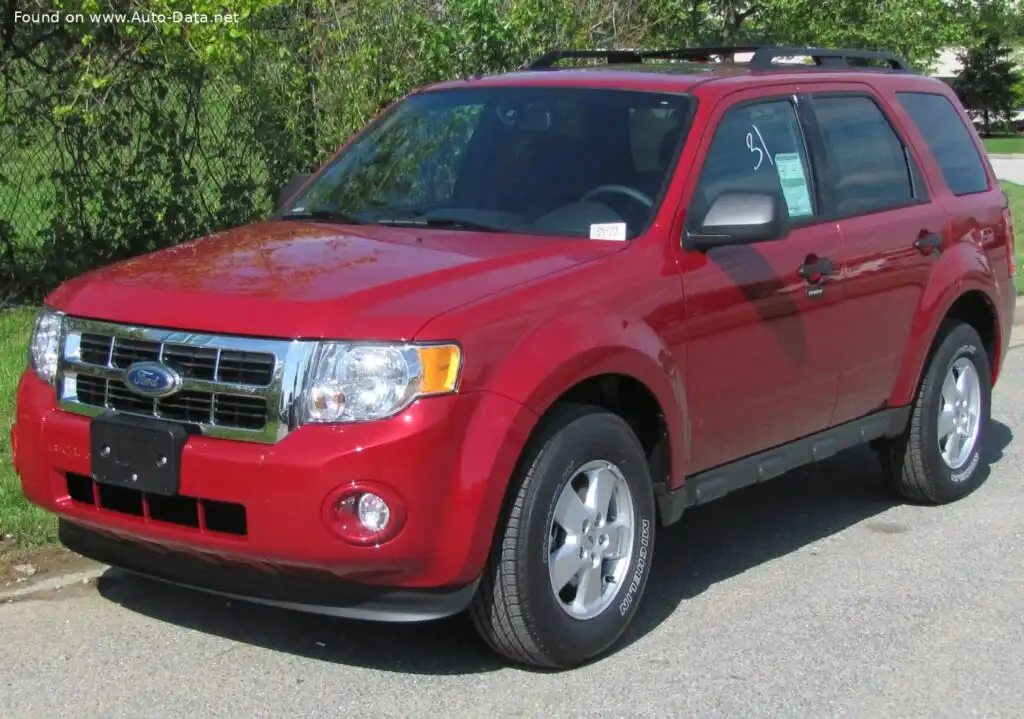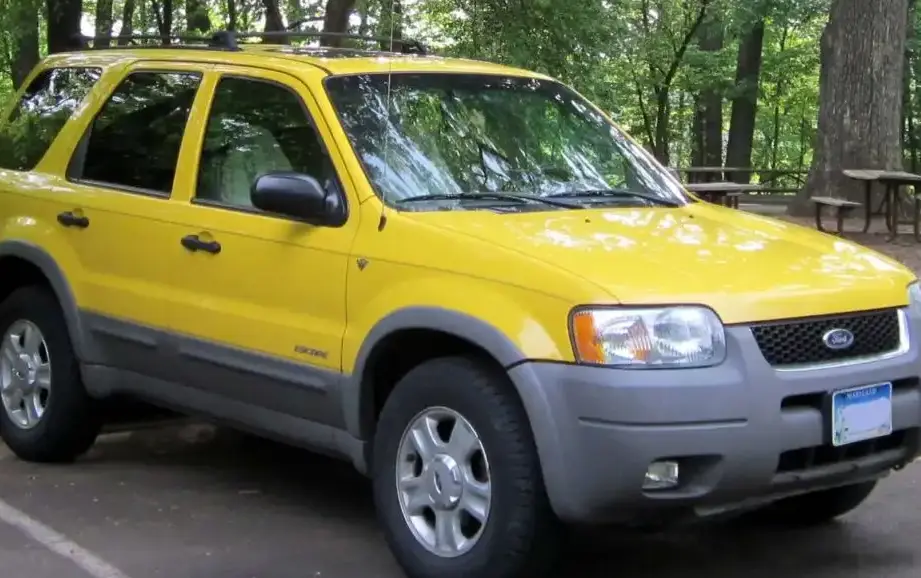
The Ford Escape, launched in 2001 for the 2002 model year, represented Ford’s entry into the rapidly growing compact SUV segment. The first generation, internally designated as the 2003-2007 model, was a significant departure for Ford, moving away from truck-based SUVs towards a more car-like unibody construction. The 2.3i 16V variant, producing 155 horsepower, was a mainstay of the Escape lineup during these years, positioned as a balance between affordability and acceptable performance. It served as the entry-level engine option for buyers prioritizing fuel economy and a lower purchase price over outright acceleration.
Technical Specifications
| Brand | Ford |
| Model | Escape |
| Generation | Escape I |
| Type (Engine) | 2.3i 16V (155 Hp) |
| Start of production | 2003 |
| End of production | 2007 |
| Powertrain Architecture | Internal Combustion engine |
| Body type | SUV |
| Seats | 5 |
| Doors | 5 |
| Fuel consumption (extra urban) | 8.1 l/100 km (29 US mpg, 34.9 UK mpg, 12.3 km/l) |
| Fuel consumption (combined) | 9.8 l/100 km (24 US mpg, 28.8 UK mpg, 10.2 km/l) |
| Fuel Type | Petrol (Gasoline) |
| Power | 155 Hp @ 5800 rpm |
| Power per litre | 68.6 Hp/l |
| Torque | 206 Nm @ 4250 rpm (151.94 lb.-ft. @ 4250 rpm) |
| Engine layout | Front, Transverse |
| Engine displacement | 2261 cm3 (137.97 cu. in.) |
| Number of cylinders | 4 |
| Engine configuration | Inline |
| Cylinder Bore | 87.5 mm (3.44 in.) |
| Piston Stroke | 94 mm (3.7 in.) |
| Compression ratio | 10:1 |
| Number of valves per cylinder | 4 |
| Fuel injection system | Multi-port manifold injection |
| Engine aspiration | Naturally aspirated engine |
| Engine oil capacity | 4.25 l (4.49 US qt | 3.74 UK qt) |
| Coolant | 5 l (5.28 US qt | 4.4 UK qt) |
| Trunk (boot) space – minimum | 934 l (32.98 cu. ft.) |
| Trunk (boot) space – maximum | 1835 l (64.8 cu. ft.) |
| Fuel tank capacity | 58 l (15.32 US gal | 12.76 UK gal) |
| Length | 4394 mm (172.99 in.) |
| Width | 1780 mm (70.08 in.) |
| Height | 1702 mm (67.01 in.) |
| Wheelbase | 2619 mm (103.11 in.) |
| Front track | 1554 mm (61.18 in.) |
| Rear (Back) track | 1550 mm (61.02 in.) |
| Drivetrain Architecture | The Internal combustion engine (ICE) drives the front wheels of the vehicle. |
| Drive wheel | Front wheel drive |
| Number of gears and type of gearbox | 5 gears, manual transmission |
| Front suspension | Coil spring |
| Rear suspension | Coil spring |
| Front brakes | Ventilated discs |
| Rear brakes | Drum |
| Steering type | Steering rack and pinion |
| Power steering | Hydraulic Steering |
| Tires size | 225/70 R15 |
Powertrain & Engine Architecture
The heart of the 2.3i Escape is the 2.3-liter inline-four cylinder engine. This engine, part of Ford’s Zetec family, utilized a single overhead camshaft (SOHC) design with four valves per cylinder. The engine code is typically associated with variations within the Zetec family, and while specific codes aren’t universally documented for this exact Escape configuration, it shares core components with other Zetec engines of the era. Fuel delivery was handled by a multi-port fuel injection system, providing a balance between efficiency and performance. The 155 horsepower output was achieved through careful tuning of the engine management system and the 10:1 compression ratio. The engine’s transverse mounting and front-wheel-drive configuration were standard for the Escape, maximizing interior space and improving packaging. The standard transmission for this variant was a five-speed manual, though a four-speed automatic transmission was also offered, impacting performance and fuel economy.
Driving Characteristics
The 2.3i Escape with the five-speed manual transmission offered adequate, though not exhilarating, performance. Acceleration from 0 to 60 mph typically took around 9-10 seconds. The engine felt relatively responsive in the lower and mid-range, making it suitable for everyday driving. The five-speed manual allowed drivers to keep the engine in its optimal power band, providing a more engaging driving experience. However, when paired with the four-speed automatic, the Escape’s performance was noticeably diminished. The automatic transmission’s gear ratios weren’t ideally suited to the engine’s characteristics, resulting in slower acceleration and a tendency for the engine to feel strained during uphill climbs or when fully loaded. The automatic also reduced fuel economy compared to the manual version.
Equipment & Trim Levels
The 2.3i Escape typically served as the base trim level. Standard features included air conditioning, power windows and locks, and an AM/FM stereo. Interior upholstery was typically cloth, with a relatively simple dashboard layout. Optional extras included alloy wheels, a CD player, cruise control, and a power sunroof. Higher trim levels, such as the XLT and Limited, added features like leather upholstery, upgraded audio systems, and additional convenience items. The 2.3i trim was often chosen by buyers seeking a practical and affordable SUV without the added cost of premium features.
Chassis & Braking
The first-generation Escape utilized a fully independent front suspension with coil springs and a multi-link rear suspension, also with coil springs. This suspension setup provided a comfortable ride quality, although it wasn’t particularly sporty. Front brakes were ventilated discs, offering good stopping power, while rear brakes were drum brakes, a cost-saving measure for the base model. Steering was rack-and-pinion with hydraulic power assist, providing a reasonably responsive feel. The standard tire size was 225/70R15, offering a good balance between ride comfort and handling.
Market Reception & Comparison
The 2.3i Escape was generally well-received by critics as a practical and affordable compact SUV. However, the engine’s performance was often criticized as being somewhat underpowered, especially when paired with the automatic transmission. Compared to the available V6 engine (3.0L), the 2.3i offered significantly less power and acceleration. However, it also delivered better fuel economy. The 2.3i was also more affordable to maintain than the V6, as it had fewer components and required less frequent servicing. Compared to competitors like the Honda CR-V and Toyota RAV4, the Escape offered a more rugged appearance and a slightly more spacious interior.
Legacy
The 2.3i engine in the first-generation Ford Escape proved to be a relatively reliable powertrain. While not without its quirks, such as occasional issues with the intake manifold gasket, the engine generally held up well over time with proper maintenance. Today, these Escapes are relatively affordable on the used car market, making them a popular choice for budget-conscious buyers. The 2.3i variant, while not the most powerful or feature-rich, remains a viable option for those seeking a dependable and practical compact SUV. Its simplicity and relatively low maintenance costs contribute to its continued appeal in the used car market.