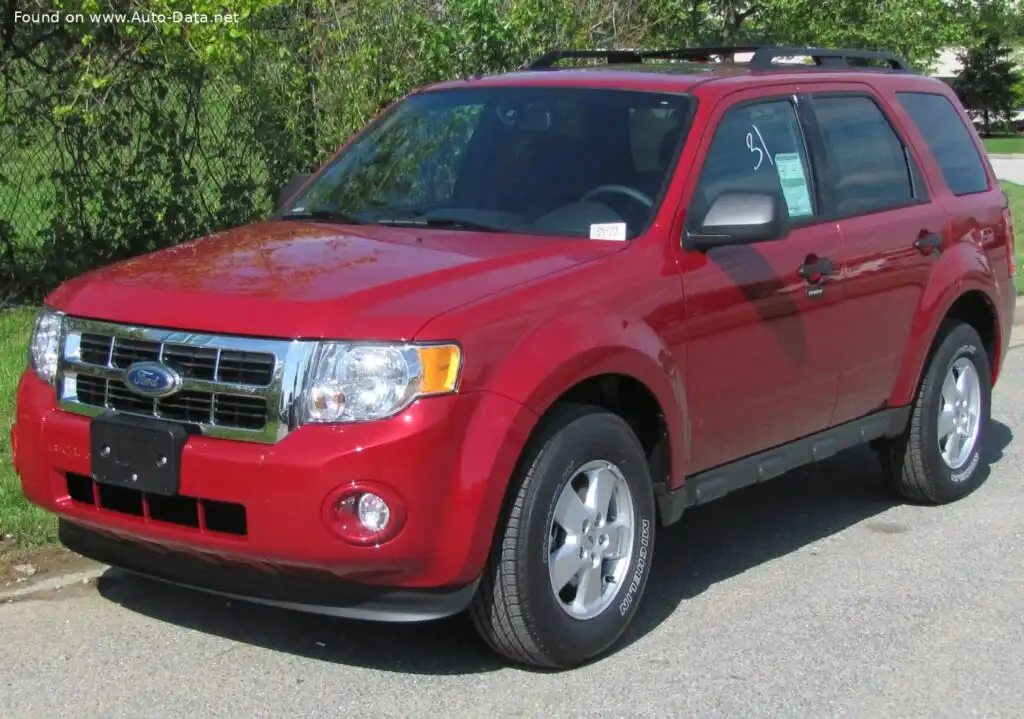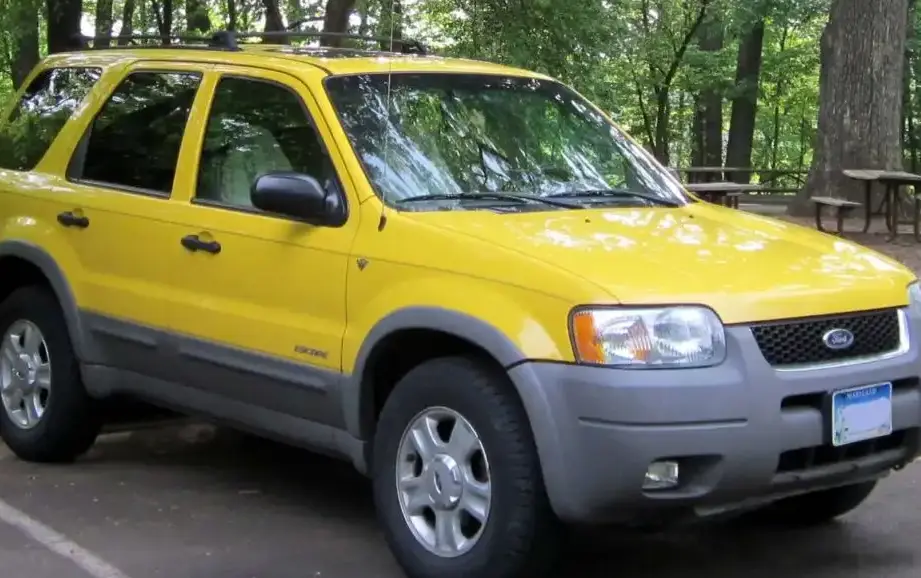
The Ford Escape, launched in 2001 for the 2002 model year, represented Ford’s entry into the rapidly growing compact SUV segment. The first generation, internally designated as the Ford Escape I (2001-2007), was based on the Mazda Tribute, a result of Ford’s ownership stake in Mazda. The 2.3i 16V (155 Hp) Automatic variant, produced from 2003 to 2007, served as a mid-range offering, positioned between the base 2.0L engine and the more powerful 3.0L V6. It aimed to provide a balance of affordability, fuel efficiency, and acceptable performance for the average family SUV buyer in the North American market.
Technical Specifications
| Brand | Ford |
| Model | Escape |
| Generation | Escape I |
| Type (Engine) | 2.3i 16V (155 Hp) Automatic |
| Start of production | 2003 |
| End of production | 2007 |
| Powertrain Architecture | Internal Combustion engine |
| Body type | SUV |
| Seats | 5 |
| Doors | 5 |
| Fuel consumption (extra urban) | 8.1 l/100 km (29 US mpg, 34.9 UK mpg, 12.3 km/l) |
| Fuel consumption (combined) | 9.8 l/100 km (24 US mpg, 28.8 UK mpg, 10.2 km/l) |
| Fuel Type | Petrol (Gasoline) |
| Power | 155 Hp @ 5800 rpm |
| Power per litre | 68.6 Hp/l |
| Torque | 206 Nm @ 4250 rpm (151.94 lb.-ft. @ 4250 rpm) |
| Engine layout | Front, Transverse |
| Engine displacement | 2261 cm3 (137.97 cu. in.) |
| Number of cylinders | 4 |
| Engine configuration | Inline |
| Cylinder Bore | 87.5 mm (3.44 in.) |
| Piston Stroke | 94 mm (3.7 in.) |
| Compression ratio | 10:1 |
| Number of valves per cylinder | 4 |
| Fuel injection system | Multi-port manifold injection |
| Engine aspiration | Naturally aspirated engine |
| Engine oil capacity | 4.25 l (4.49 US qt | 3.74 UK qt) |
| Coolant | 6 l (6.34 US qt | 5.28 UK qt) |
| Trunk (boot) space – minimum | 934 l (32.98 cu. ft.) |
| Trunk (boot) space – maximum | 1835 l (64.8 cu. ft.) |
| Fuel tank capacity | 58 l (15.32 US gal | 12.76 UK gal) |
| Length | 4394 mm (172.99 in.) |
| Width | 1780 mm (70.08 in.) |
| Height | 1702 mm (67.01 in.) |
| Wheelbase | 2619 mm (103.11 in.) |
| Front track | 1554 mm (61.18 in.) |
| Rear (Back) track | 1550 mm (61.02 in.) |
| Drivetrain Architecture | The Internal combustion engine (ICE) drives the front wheels of the vehicle. |
| Drive wheel | Front wheel drive |
| Number of gears and type of gearbox | 4 gears, automatic transmission |
| Front suspension | Coil spring |
| Rear suspension | Coil spring |
| Front brakes | Ventilated discs |
| Rear brakes | Drum |
| Steering type | Steering rack and pinion |
| Power steering | Hydraulic Steering |
| Tires size | 225/70 R15 |
| Wheel rims size | 15 |
Powertrain & Engine Architecture
The heart of the 2.3i variant was the 2.3-liter, inline-four cylinder engine, internally known as the 2.3L Duratec. This engine belonged to the Duratec family, Ford’s modern engine designs emphasizing improved refinement and efficiency. It featured a single overhead camshaft (SOHC) design with four valves per cylinder, controlled by hydraulic lifters. The multi-port fuel injection system delivered fuel directly into the intake ports, optimizing combustion. The engine produced 155 horsepower at 5,800 rpm and 206 Nm (151.94 lb-ft) of torque at 4,250 rpm. Paired with this engine was a four-speed automatic transmission, a common choice for buyers prioritizing ease of use over outright performance. This transmission was designed for smooth shifts and adequate responsiveness for everyday driving. The 4-speed automatic was a fairly standard unit for the time, offering a balance between cost and functionality.
Driving Characteristics
The 2.3L automatic Escape offered a comfortable, if not particularly exhilarating, driving experience. Acceleration was adequate for merging onto highways and navigating city streets, but it wasn’t a particularly quick vehicle. The four-speed automatic transmission, while smooth, lacked the responsiveness of a manual gearbox or a more modern automatic with additional gears. The gear ratios were tuned for fuel economy and relaxed cruising rather than sporty performance. Compared to the 3.0L V6 Escape, the 2.3L felt noticeably less powerful, especially when fully loaded with passengers and cargo. However, it offered a significant improvement in fuel economy. The front-wheel-drive configuration provided predictable handling, but it wasn’t designed for off-road adventures.
Equipment & Trim Levels
The 2.3i Automatic Escape typically came standard with features such as air conditioning, power windows and locks, an AM/FM stereo, and cloth upholstery. Higher trim levels, such as the XLS and XLT, added features like alloy wheels, upgraded audio systems, keyless entry, and cruise control. Optional extras included a sunroof, leather upholstery, and a premium sound system. The interior design was functional and straightforward, prioritizing practicality over luxury. The dashboard layout was clean and easy to use, with clearly labeled controls.
Chassis & Braking
The Escape I utilized a body-on-frame construction, providing a robust and durable platform. The front suspension consisted of independent coil springs and MacPherson struts, while the rear suspension employed a multi-link coil spring setup. This suspension configuration provided a comfortable ride, although it wasn’t particularly sporty. The braking system featured ventilated discs on the front wheels and drum brakes on the rear wheels. Hydraulic power steering provided light and easy steering effort. The 15-inch wheels were typically fitted with 225/70 R15 tires, offering a good balance of ride comfort and handling.
Market Reception & Comparison
The 2.3i Automatic Escape was generally well-received by critics as a practical and affordable compact SUV. It was praised for its comfortable ride, spacious interior, and decent fuel economy. However, some reviewers criticized its lack of power and the somewhat dated four-speed automatic transmission. Compared to the V6-powered Escape, the 2.3L offered a lower price point and better fuel economy, making it an attractive option for budget-conscious buyers. Against competitors like the Honda CR-V and Toyota RAV4, the Escape offered a more rugged appearance and a slightly lower price, but it generally lagged behind in terms of refinement and resale value.
Legacy
The 2.3L Duratec engine, when properly maintained, proved to be a relatively reliable powertrain. Common issues included minor oil leaks and occasional problems with the automatic transmission. However, these issues were generally not catastrophic and could often be addressed with routine maintenance. Today, the first-generation Ford Escape, including the 2.3i Automatic variant, can be found on the used car market at very affordable prices. It remains a popular choice for those seeking a basic, reliable, and inexpensive SUV for commuting or light-duty tasks. Its simplicity and relatively low maintenance costs make it an appealing option for those who prioritize practicality over performance or luxury.