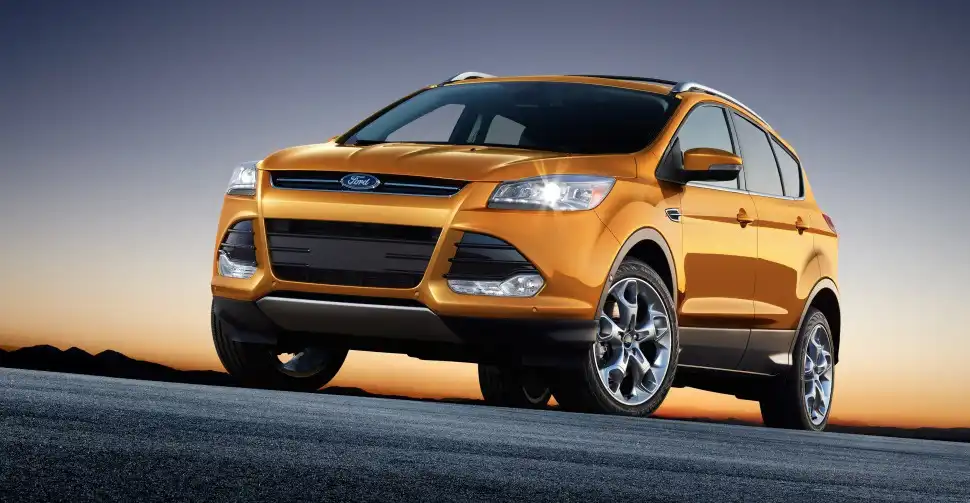
The Ford Escape III, produced from 2013 to 2016, represented a significant redesign for Ford’s popular compact SUV. Among the various powertrain options offered, the 2.0 EcoBoost engine paired with a six-speed automatic transmission and four-wheel drive (4WD) held a prominent position as a mid-range offering. This configuration, delivering 240 horsepower, aimed to balance performance with fuel efficiency, appealing to buyers seeking a more engaging driving experience than the base engine while remaining practical for everyday use. It was built on the global Ford C-platform, shared with models like the Ford Focus and the European Ford Kuga.
Technical Specifications
| Brand | Ford |
| Model | Escape |
| Generation | Escape III |
| Type (Engine) | 2.0 EcoBoost (240 Hp) 4WD Automatic |
| Start of production | 2013 |
| End of production | 2016 |
| Powertrain Architecture | Internal Combustion engine |
| Body type | SUV |
| Seats | 5 |
| Doors | 5 |
| Fuel consumption (urban) | 11.2 l/100 km (21 US mpg) |
| Fuel consumption (extra urban) | 8.4 l/100 km (28 US mpg) |
| Fuel consumption (combined) | 9.8 l/100 km (24 US mpg) |
| Fuel Type | Petrol (Gasoline) |
| Weight-to-power ratio | 7.1 kg/Hp |
| Weight-to-torque ratio | 4.6 kg/Nm |
| Power | 240 Hp @ 5500 rpm |
| Power per litre | 120.1 Hp/l |
| Torque | 366 Nm @ 3000 rpm (269.95 lb.-ft. @ 3000 rpm) |
| Engine layout | Front, Transverse |
| Engine displacement | 1999 cm3 (121.99 cu. in.) |
| Number of cylinders | 4 |
| Engine configuration | Inline |
| Cylinder Bore | 87.5 mm (3.44 in.) |
| Piston Stroke | 83.1 mm (3.27 in.) |
| Compression ratio | 9.3:1 |
| Number of valves per cylinder | 4 |
| Fuel injection system | Direct injection |
| Engine aspiration | Turbocharger, Intercooler |
| Valvetrain | DOHC, Ti-VCT |
| Engine oil capacity | 5.4 l (5.71 US qt | 4.75 UK qt) |
| Coolant | 9.2 l (9.72 US qt | 8.09 UK qt) |
| Kerb Weight | 1693 kg (3732.43 lbs.) |
| Trunk (boot) space – minimum | 971 l (34.29 cu. ft.) |
| Trunk (boot) space – maximum | 1920 l (67.8 cu. ft.) |
| Fuel tank capacity | 58 l (15.32 US gal | 12.76 UK gal) |
| Permitted trailer load with brakes (12%) | 1588 kg (3500.94 lbs.) |
| Length | 4524 mm (178.11 in.) |
| Width | 1839 mm (72.4 in.) |
| Width with mirrors folded | 1905 mm (75 in.) |
| Width including mirrors | 2078 mm (81.81 in.) |
| Height | 1684 mm (66.3 in.) |
| Wheelbase | 2690 mm (105.91 in.) |
| Front track | 1562 mm (61.5 in.) |
| Rear (Back) track | 1565 mm (61.61 in.) |
| Ride height (ground clearance) | 201 mm (7.91 in.) |
| Minimum turning circle (turning diameter) | 11.6 m (38.06 ft.) |
| Drive wheel | All wheel drive (4×4) |
| Number of gears and type of gearbox | 6 gears, automatic transmission |
| Front suspension | Independent, type McPherson with coil spring and anti-roll bar |
| Rear suspension | Independent coil spring |
| Front brakes | Ventilated discs |
| Rear brakes | Disc |
| Assisting systems | ABS (Anti-lock braking system) |
| Steering type | Steering rack and pinion |
| Power steering | Electric Steering |
| Tires size | 235/55 R17; 235/45 R19 |
| Wheel rims size | 17; 19 |
Powertrain & Engine Architecture
The heart of this Escape variant is the 2.0-liter EcoBoost inline-four cylinder engine. This engine, part of Ford’s EcoBoost family, utilizes direct fuel injection and a single turbocharger with an intercooler to deliver a substantial power output for its size. The engine code is generally identified as M2G1. The direct injection system allows for precise fuel delivery, improving efficiency and reducing emissions. The twin independent variable camshaft timing (Ti-VCT) further optimizes engine performance across the rev range. The six-speed automatic transmission (6F35) was chosen for its smooth shifting and efficiency. This transmission features a torque converter and electronically controlled gear changes, designed to work seamlessly with the engine’s power delivery. The 4WD system is an intelligent system that automatically engages when wheel slip is detected, providing enhanced traction in various driving conditions.
Driving Characteristics
The 2.0 EcoBoost Escape offered a noticeable step up in performance compared to the base 2.5-liter naturally aspirated engine. The turbocharger provides a surge of torque at lower RPMs, making it responsive in everyday driving situations. While not as quick as the V6 option, the 2.0 EcoBoost provided ample power for highway merging and passing maneuvers. The six-speed automatic transmission generally shifted smoothly, although some drivers noted occasional hesitation during downshifts. The 4WD system provided confident handling in inclement weather, but added some weight compared to the front-wheel-drive models. The gear ratios were tuned for a balance between acceleration and fuel economy, prioritizing usability over outright sportiness.
Equipment & Trim Levels
The 2.0 EcoBoost 4WD trim typically fell into the mid-range of the Escape lineup, often designated as the SEL or Limited. Standard features generally included alloy wheels, a rearview camera, a six-speaker audio system, and Ford’s SYNC infotainment system. Higher trims added features like leather upholstery, heated front seats, a power liftgate, and a premium audio system. Optional extras included navigation, a panoramic sunroof, and blind-spot monitoring. Interior upholstery was typically cloth on the SEL trim and leather on the Limited. The dashboard layout was functional and user-friendly, with a focus on ease of use.
Chassis & Braking
The Escape III utilized a McPherson strut front suspension and an independent multi-link rear suspension. This setup provided a comfortable ride while maintaining reasonable handling characteristics. The 2.0 EcoBoost models typically featured slightly stiffer suspension components compared to the base engine to handle the increased power. Braking duties were handled by ventilated discs on the front wheels and solid discs on the rear. Anti-lock brakes (ABS) were standard, along with electronic stability control. The 4WD system added to the vehicle’s overall weight, which slightly impacted braking performance compared to the front-wheel-drive models.
Market Reception & Comparison
Critics generally praised the 2.0 EcoBoost Escape for its combination of performance, fuel economy, and practicality. It was seen as a strong competitor to other compact SUVs like the Honda CR-V and Toyota RAV4. The 2.0 EcoBoost offered better fuel economy than the V6 engine, while still providing a more engaging driving experience than the base 2.5-liter engine. However, some reviewers noted that the automatic transmission could be occasionally hesitant. Compared to the 2.5L, the EcoBoost offered a significant power increase, but at a slightly higher price point. The V6 offered even more power, but at the expense of fuel economy.
Legacy
The 2.0 EcoBoost engine proved to be a relatively reliable powertrain, although some owners have reported issues with the turbocharger and fuel injectors over the long term. Regular maintenance, including oil changes and spark plug replacements, is crucial for ensuring longevity. Today, the 2013-2016 Ford Escape III 2.0 EcoBoost 4WD Automatic remains a popular choice in the used car market, offering a good balance of features, performance, and value. Its fuel efficiency and available all-wheel drive make it a practical option for a wide range of buyers. The EcoBoost engine, while requiring diligent maintenance, continues to be regarded as a capable and efficient powerplant.