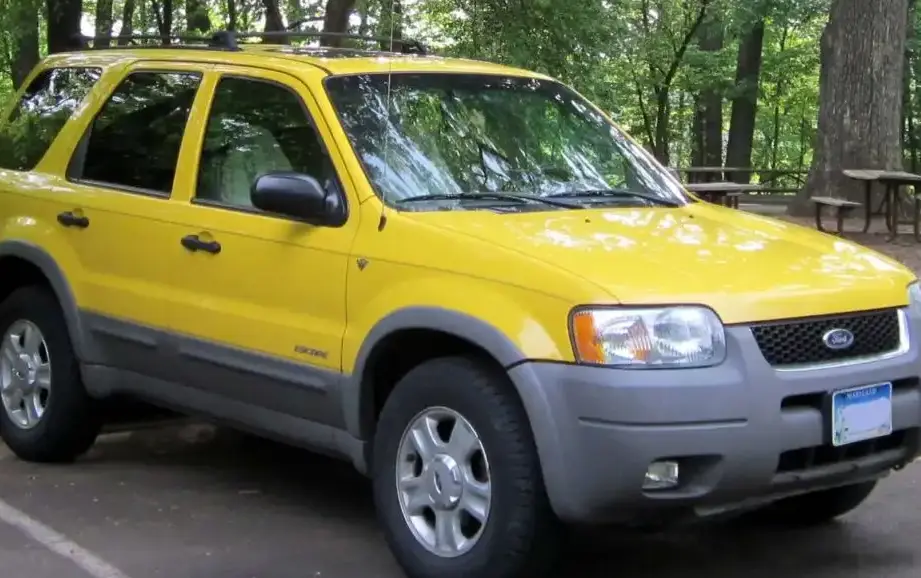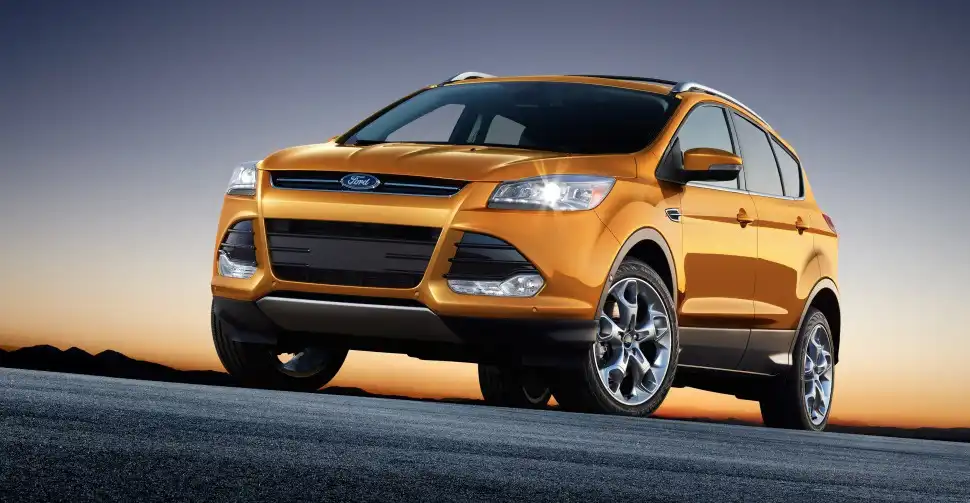
The Ford Escape III, produced from 2013 to 2016, represented a significant redesign for Ford’s popular compact SUV. Within the Escape III lineup, the 2.0 EcoBoost variant with a six-speed automatic transmission occupied a mid-range position, offering a balance between fuel efficiency and performance. This configuration aimed to appeal to buyers seeking more than the base 2.5L engine’s capabilities, but without the higher price point of the top-tier trims. It was a key offering in the North American market, where the Escape competed directly with vehicles like the Honda CR-V and Toyota RAV4.
Technical Specifications
| Brand | Ford |
| Model | Escape |
| Generation | Escape III |
| Type (Engine) | 2.0 EcoBoost (240 Hp) Automatic |
| Start of production | 2013 |
| End of production | 2016 |
| Powertrain Architecture | Internal Combustion engine |
| Body type | SUV |
| Seats | 5 |
| Doors | 5 |
| Fuel consumption (urban) | 10.7 l/100 km (22 US mpg) |
| Fuel consumption (extra urban) | 7.8 l/100 km (30.2 US mpg) |
| Fuel consumption (combined) | 9.4 l/100 km (25 US mpg) |
| Fuel Type | Petrol (Gasoline) |
| Weight-to-power ratio | 6.8 kg/Hp |
| Weight-to-torque ratio | 4.5 kg/Nm |
| Power | 240 Hp @ 5500 rpm |
| Power per litre | 120.1 Hp/l |
| Torque | 366 Nm @ 3000 rpm (269.95 lb.-ft. @ 3000 rpm) |
| Engine layout | Front, Transverse |
| Engine displacement | 1999 cm3 (121.99 cu. in.) |
| Number of cylinders | 4 |
| Engine configuration | Inline |
| Cylinder Bore | 87.5 mm (3.44 in.) |
| Piston Stroke | 83.1 mm (3.27 in.) |
| Compression ratio | 9.3:1 |
| Number of valves per cylinder | 4 |
| Fuel injection system | Direct injection |
| Engine aspiration | Turbocharger, Intercooler |
| Valvetrain | DOHC, Ti-VCT |
| Engine oil capacity | 5.4 l (5.71 US qt | 4.75 UK qt) |
| Coolant | 9.2 l (9.72 US qt | 8.09 UK qt) |
| Kerb Weight | 1629 kg (3591.33 lbs.) |
| Trunk (boot) space – minimum | 971 l (34.29 cu. ft.) |
| Trunk (boot) space – maximum | 1920 l (67.8 cu. ft.) |
| Fuel tank capacity | 58 l (15.32 US gal | 12.76 UK gal) |
| Permitted trailer load with brakes (12%) | 1588 kg (3500.94 lbs.) |
| Length | 4524 mm (178.11 in.) |
| Width | 1839 mm (72.4 in.) |
| Width with mirrors folded | 1905 mm (75 in.) |
| Width including mirrors | 2078 mm (81.81 in.) |
| Height | 1684 mm (66.3 in.) |
| Wheelbase | 2690 mm (105.91 in.) |
| Front track | 1562 mm (61.5 in.) |
| Rear (Back) track | 1565 mm (61.61 in.) |
| Ride height (ground clearance) | 201 mm (7.91 in.) |
| Minimum turning circle (turning diameter) | 11.6 m (38.06 ft.) |
| Drivetrain Architecture | Front wheel drive |
| Number of gears and type of gearbox | 6 gears, automatic transmission |
| Front suspension | Independent, type McPherson with coil spring and anti-roll bar |
| Rear suspension | Independent coil spring |
| Front brakes | Ventilated discs |
| Rear brakes | Disc |
| Assisting systems | ABS (Anti-lock braking system) |
| Steering type | Steering rack and pinion |
| Power steering | Electric Steering |
| Tires size | 235/55 R17; 235/45 R19 |
| Wheel rims size | 17; 19 |
Powertrain & Engine Architecture
The heart of this Escape variant is the 2.0-liter EcoBoost inline-four cylinder engine. This engine, part of Ford’s EcoBoost family, utilizes direct fuel injection and a single turbocharger with an intercooler to deliver a substantial 240 horsepower and 366 lb-ft of torque. The engine code is generally associated with the GTDI (Gasoline Turbocharged Direct Injection) family. The Ti-VCT (Twin Independent Variable Camshaft Timing) system optimizes valve timing for improved performance and efficiency across the engine’s operating range. The six-speed automatic transmission, specifically the 6F35, was chosen for its smooth shifting and responsiveness. This transmission featured a wide gear ratio spread, designed to balance acceleration with highway cruising efficiency. The transmission’s programming was tuned to work in conjunction with the engine’s torque curve, providing adequate power delivery for everyday driving situations.
Driving Characteristics
The 2.0 EcoBoost automatic Escape offered a noticeable step up in performance compared to the base 2.5L model. Acceleration was brisk, and the turbocharger provided a readily available boost of power for merging onto highways or passing other vehicles. While not a sports SUV, the 2.0L engine provided sufficient power for confident driving in most scenarios. The six-speed automatic transmission generally shifted smoothly, although some drivers noted occasional hesitation during downshifts. Compared to the manual transmission versions of the 2.0 EcoBoost, the automatic offered greater convenience, but at the expense of some driver engagement and potentially slightly lower fuel economy. The gear ratios were optimized for a balance between acceleration and fuel efficiency, with a relatively tall final drive ratio contributing to better highway mileage.
Equipment & Trim Levels
The 2.0 EcoBoost automatic trim typically included features such as air conditioning, power windows and locks, a basic audio system with a CD player and auxiliary input, and cloth upholstery. Higher trim levels, such as the SEL and Limited, added features like leather upholstery, a more advanced infotainment system with a touchscreen display, a rearview camera, and additional safety features. Optional extras included a panoramic sunroof, navigation system, and premium audio system. The standard interior configuration was functional and reasonably comfortable, with a focus on practicality rather than luxury. The dashboard layout was straightforward and easy to use, with clearly labeled controls.
Chassis & Braking
The Escape III utilized a unibody construction for improved rigidity and reduced weight. The front suspension featured independent MacPherson struts with coil springs and an anti-roll bar, while the rear suspension employed an independent multi-link setup with coil springs. This suspension configuration provided a comfortable ride quality while maintaining reasonable handling characteristics. Braking duties were handled by ventilated discs at the front and solid discs at the rear. The standard braking system included ABS (Anti-lock Braking System) to enhance safety during emergency stops. The chassis was tuned to provide a balance between ride comfort and handling, making it suitable for both city driving and highway cruising.
Market Reception & Comparison
The 2.0 EcoBoost automatic Escape received generally positive reviews from automotive critics. It was praised for its strong engine performance, comfortable ride, and spacious interior. However, some critics noted that the interior materials were not as upscale as those found in some competing models. Fuel economy was considered competitive for its class, averaging around 25 mpg in combined driving. Compared to the base 2.5L engine, the 2.0 EcoBoost offered a significant performance upgrade, but at a higher price point. The 2.0 EcoBoost was also more reliable than some of the other engine options in the Escape lineup, particularly the problematic 1.6L EcoBoost engine.
Legacy
The 2.0 EcoBoost engine proved to be a relatively reliable powertrain in the Escape III. While not entirely without issues, it generally held up well over time with proper maintenance. In the used car market, the 2.0 EcoBoost automatic Escape remains a popular choice for buyers seeking a well-rounded and capable compact SUV. Its combination of performance, fuel efficiency, and practicality continues to appeal to a wide range of drivers. The engine’s robust design and readily available parts contribute to its long-term durability and affordability.