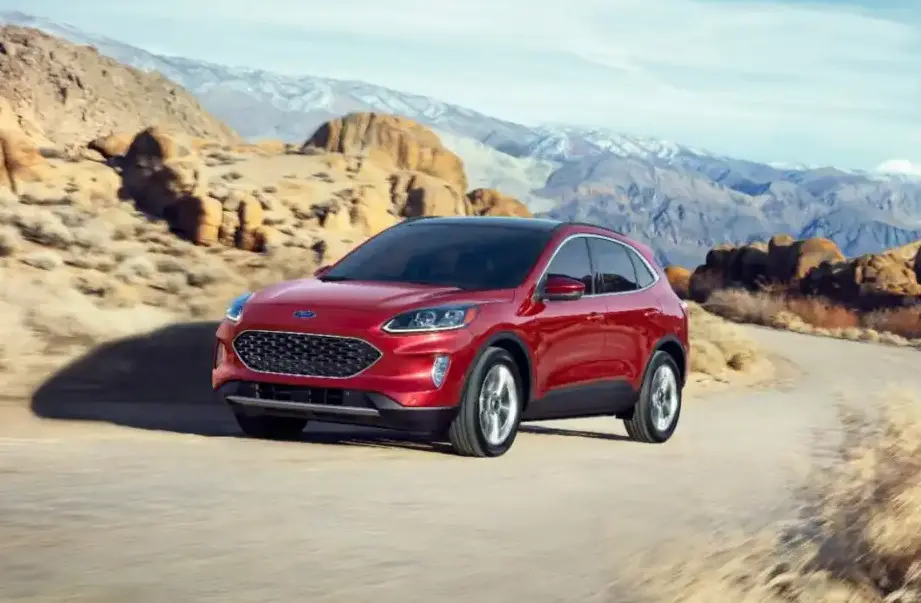
The Ford Escape Plug-In Hybrid, specifically the 2.5-liter (221 horsepower) variant with an eCVT transmission, was produced for the 2020 and 2021 model years as part of the fourth generation (Escape IV) of Ford’s popular compact SUV. Positioned as a premium offering within the Escape lineup, it represented Ford’s entry into the growing plug-in hybrid market in North America. This model aimed to provide a balance of fuel efficiency, electric driving range, and the versatility of an SUV, appealing to environmentally conscious consumers seeking a practical daily driver. It utilized the C2 platform, shared with the Bronco Sport and Maverick.
Technical Specifications
| Brand | Ford |
| Model | Escape |
| Generation | Escape IV |
| Type (Engine) | 2.5 (221 Hp) Plug-In Hybrid eCVT |
| Start of production | 2020 |
| End of production | 2022 |
| Powertrain Architecture | PHEV (Plug-in Hybrid Electric Vehicle) |
| Body type | SUV |
| Seats | 5 |
| Doors | 5 |
| Fuel consumption (urban) | 5.5 l/100 km (42.8 US mpg) |
| Fuel consumption (extra urban) | 6.2 l/100 km (37.9 US mpg) |
| Fuel consumption (combined) | 5.9 l/100 km (39.9 US mpg) |
| Fuel Type | Petrol / electricity |
| Weight-to-power ratio | 8 kg/Hp |
| Weight-to-torque ratio | 8.4 kg/Nm |
| Gross battery capacity | 14.4 kWh |
| Battery technology | Lithium-ion (Li-Ion) |
| All-electric range | 48 km (29.83 mi) |
| System power | 221 Hp @ 6250 rpm |
| Engine Power | 162 Hp |
| Torque | 210 Nm @ 4500 rpm (154.89 lb.-ft. @ 4500 rpm) |
| Engine displacement | 2491 cm3 (152.01 cu. in.) |
| Number of cylinders | 4 |
| Engine configuration | Inline |
| Cylinder Bore | 88.9 mm (3.5 in.) |
| Piston Stroke | 100.08 mm (3.94 in.) |
| Compression ratio | 13:1 |
| Number of valves per cylinder | 4 |
| Fuel injection system | Multi-port manifold injection |
| Engine aspiration | Naturally aspirated engine |
| Valvetrain | DOHC, IVCT |
| Engine oil capacity | 5.4 l (5.71 US qt | 4.75 UK qt) |
| Coolant capacity | 9.6 l (10.14 US qt | 8.45 UK qt) |
| Kerb Weight | 1762 kg (3884.55 lbs.) |
| Trunk (boot) space – minimum | 869 l (30.69 cu. ft.) |
| Trunk (boot) space – maximum | 1722 l (60.81 cu. ft.) |
| Fuel tank capacity | 42 l (11.1 US gal | 9.24 UK gal) |
| Length | 4585 mm (180.51 in.) |
| Width | 1882 mm (74.09 in.) |
| Width with mirrors folded | 1999 mm (78.7 in.) |
| Width including mirrors | 2174 mm (85.59 in.) |
| Height | 1679 mm (66.1 in.) |
| Wheelbase | 2710 mm (106.69 in.) |
| Front track | 1585 mm (62.4 in.) |
| Rear track | 1570 mm (61.81 in.) |
| Drive wheel | Front wheel drive |
| Number of gearse | eCVT automatic transmission |
| Front suspension | Independent, McPherson with coil spring and anti-roll bar |
| Rear suspension | Independent multi-link with stabilizer |
| Front brakes | Disc |
| Rear brakes | Disc |
| Tires size | 225/65 R17 |
| Wheel rims size | 17 |
Powertrain & Engine Architecture
The 2020-2022 Ford Escape Plug-In Hybrid utilizes a 2.5-liter four-cylinder Atkinson-cycle gasoline engine paired with an electric motor and a 14.4 kWh lithium-ion battery pack. The engine, internally designated as a variant of the Ford Duratec family, produces 162 horsepower. The electric motor contributes an additional 58 horsepower, resulting in a combined system output of 221 horsepower and 370 lb-ft of torque. The engine features multi-port fuel injection and a double overhead camshaft (DOHC) valvetrain with intelligent variable cam timing (IVCT). The eCVT (electronically controlled continuously variable transmission) seamlessly blends power from both the engine and the electric motor. The electric motor is integrated directly into the transmission housing, enhancing efficiency and responsiveness. The battery pack is located under the floor, minimizing impact on cargo space.
Driving Characteristics
The Escape Plug-In Hybrid offers a distinct driving experience compared to its gasoline-only counterparts. In pure electric mode, the vehicle provides quiet and smooth acceleration, suitable for short commutes and city driving. The electric range of approximately 30 miles allows for significant fuel savings for drivers with shorter daily trips. When the battery is depleted, the vehicle seamlessly transitions to hybrid mode, utilizing both the gasoline engine and electric motor. The eCVT transmission provides smooth, stepless acceleration, although some drivers may find it less engaging than a traditional automatic transmission. Compared to the 1.5L EcoBoost engine, the plug-in hybrid offers significantly more torque and a more refined driving experience. Compared to the hybrid version, the plug-in offers a longer all-electric range.
Equipment & Trim Levels
The Escape Plug-In Hybrid was primarily offered in a single, well-equipped trim level. Standard features included a 12.3-inch digital instrument cluster, an 8-inch touchscreen infotainment system with Apple CarPlay and Android Auto compatibility, Ford Co-Pilot360 suite of driver-assistance technologies (including automatic emergency braking, lane-keeping assist, and blind-spot monitoring), and a premium audio system. Available options included a panoramic sunroof, leather upholstery, and adaptive cruise control. Interior upholstery was typically cloth or leatherette, with a focus on comfort and practicality. The dashboard layout was similar to other Escape models, with a user-friendly design and intuitive controls.
Chassis & Braking
The Escape Plug-In Hybrid utilizes an independent front suspension with McPherson struts and a multi-link independent rear suspension, providing a comfortable ride and responsive handling. Stabilizer bars are included on both axles to reduce body roll during cornering. The braking system features disc brakes on all four wheels, providing ample stopping power. ABS (Anti-lock Braking System) and electronic brake-force distribution are standard safety features. The vehicle’s weight, due to the battery pack, is higher than the standard Escape models, which slightly impacts handling dynamics. The steering is electric power-assisted, offering light and precise control.
Market Reception & Comparison
The Ford Escape Plug-In Hybrid received generally positive reviews from automotive critics. It was praised for its fuel efficiency, electric range, and comfortable ride. However, some reviewers noted the relatively high price compared to other Escape models and the limited cargo space due to the battery pack. Compared to competitors like the Toyota RAV4 Prime and Mitsubishi Outlander PHEV, the Escape Plug-In Hybrid offered a competitive electric range and a more refined driving experience. Fuel economy was a key selling point, with the combined MPG rating of 39.9 US mpg being significantly higher than the gasoline-only models. Reliability reports have been generally positive, with few major issues reported.
Legacy
The Ford Escape Plug-In Hybrid represented a significant step forward for Ford in the electrification of its vehicle lineup. While production was relatively short-lived, the model helped to establish Ford as a player in the plug-in hybrid market. On the used car market, these models hold their value relatively well due to their fuel efficiency and environmental benefits. The powertrain has proven to be generally reliable, with the battery pack maintaining a good charge capacity over time. The Escape Plug-In Hybrid paved the way for Ford’s future electric vehicle offerings, including the Mustang Mach-E and the all-electric F-150 Lightning.