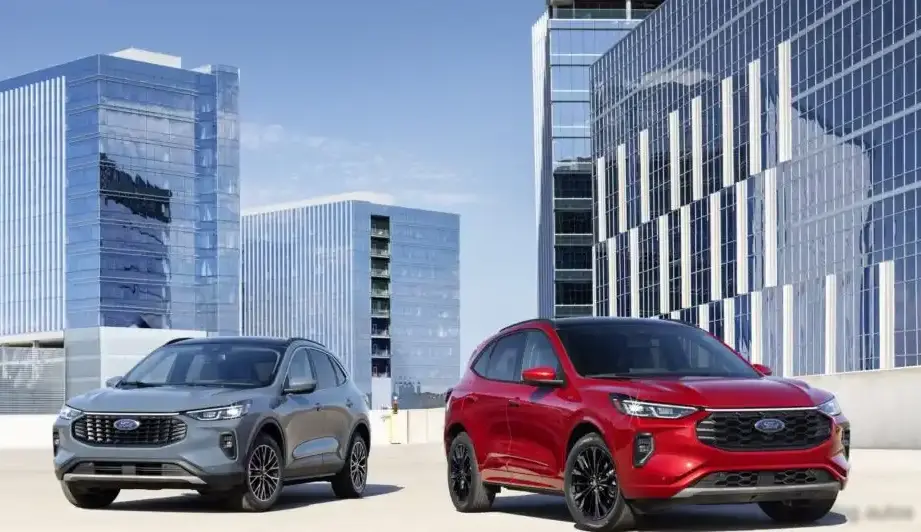
The Ford Escape IV, specifically the 2.5-liter Plug-in Hybrid (PHEV) variant introduced with the 2023 facelift, represents Ford’s commitment to electrification within its popular compact SUV lineup. Launched as a mid-cycle refresh of the fourth-generation Escape (introduced in 2019), this model year saw significant updates to both the exterior styling and interior technology. The 2.5L PHEV trim occupies a premium position within the Escape range, offering a blend of fuel efficiency, all-electric driving capability, and respectable performance. Production began in late 2022 for the 2023 model year and continues to be a key offering in the North American market.
Technical Specifications
| Brand | Ford |
| Model | Escape |
| Generation | Escape IV (facelift 2023) |
| Type (Engine) | 2.5 (210 Hp) Plug-in Hybrid eCVT |
| Start of production | 2023 |
| Powertrain Architecture | PHEV (Plug-in Hybrid Electric Vehicle) |
| Body type | SUV |
| Seats | 5 |
| Doors | 5 |
| Fuel Type | Petrol / electricity |
| Weight-to-power ratio | 8.4 kg/Hp, 118.6 Hp/tonne |
| Weight-to-torque ratio | 8.4 kg/Nm, 118.6 Nm/tonne |
| Battery technology | Lithium-ion (Li-Ion) |
| All-electric range | 59.5 km / 36.97 mi |
| System power | 210 Hp |
| Engine Power | 163 Hp @ 6250 rpm |
| Engine Torque | 210 Nm @ 4500 rpm / 154.89 lb.-ft. @ 4500 rpm |
| Engine displacement | 2490 cm3 / 151.95 cu. in. |
| Number of cylinders | 4 |
| Engine configuration | Inline |
| Cylinder Bore | 88.9 mm / 3.5 in. |
| Piston Stroke | 100.08 mm / 3.94 in. |
| Compression ratio | 13:1 |
| Fuel injection system | Multi-port manifold injection |
| Engine oil capacity | 5.4 l / 5.71 US qt | 4.75 UK qt |
| Coolant capacity | 9.6 l / 10.14 US qt | 8.45 UK qt |
| Kerb Weight | 1771 kg / 3904.39 lbs. |
| Trunk (boot) space – minimum | 974 l / 34.4 cu. ft. |
| Trunk (boot) space – maximum | 1722 l / 60.81 cu. ft. |
| Fuel tank capacity | 42 l / 11.1 US gal | 9.24 UK gal |
| Length | 4575 mm / 180.12 in. |
| Width | 1882 mm / 74.09 in. |
| Height | 1679 mm / 66.1 in. |
| Wheelbase | 2710 mm / 106.69 in. |
| Drivetrain | Front wheel drive, eCVT automatic transmission |
| Front suspension | Independent, McPherson with coil spring and anti-roll bar |
| Rear suspension | Independent multi-link with stabilizer |
| Front brakes | Disc |
| Rear brakes | Disc |
| Tire size | 225/60 R18 |
Powertrain & Engine Architecture
The 2023 Ford Escape PHEV utilizes a sophisticated powertrain combining a 2.5-liter four-cylinder naturally aspirated gasoline engine with an electric motor and a lithium-ion battery pack. The internal combustion engine (ICE) is a modified version of Ford’s Duratec engine family, employing multi-port fuel injection and a double overhead camshaft (DOHC) valvetrain with intelligent variable cam timing (IVCT). This engine produces 163 horsepower at 6250 rpm and 155 lb-ft of torque at 4500 rpm. The electric motor is integrated directly into the electronically controlled continuously variable transmission (eCVT), providing seamless transitions between electric, gasoline, and combined power modes. The battery pack, located under the rear seats, provides an all-electric range of approximately 37 miles (59.5 km). The eCVT is crucial to the efficiency of the system, allowing the engine to operate at its most efficient points while the electric motor fills in torque gaps and provides additional power when needed.
Driving Characteristics
The Escape PHEV offers a distinct driving experience compared to its gasoline-only counterparts. In pure electric mode, the vehicle provides near-silent acceleration and responsive performance for typical commuting scenarios. The electric motor delivers instant torque, making it feel surprisingly quick around town. When the gasoline engine engages, the transition is generally smooth and unobtrusive. The combined system output of 210 horsepower provides adequate power for highway merging and passing maneuvers. However, it doesn’t offer the same level of outright acceleration as the 2.0-liter turbocharged engine option available in the Escape lineup. The eCVT, while efficient, can sometimes exhibit a “rubber band” feel under hard acceleration, a common characteristic of continuously variable transmissions. The vehicle’s weight, at approximately 3904 lbs, is noticeable, particularly when compared to lighter, non-hybrid Escapes.
Equipment & Trim Levels
The 2.5L Plug-in Hybrid Escape typically comes well-equipped, often positioned as a mid-to-high trim level. Standard features generally include a large touchscreen infotainment system with Apple CarPlay and Android Auto compatibility, Ford’s Co-Pilot360 suite of driver-assistance technologies (including automatic emergency braking, lane-keeping assist, and blind-spot monitoring), and comfortable cloth upholstery. Higher trim levels add features such as leather seats, a premium sound system, a panoramic sunroof, and adaptive cruise control. Optional extras often include a hands-free power liftgate and upgraded wheels.
Chassis & Braking
The Escape PHEV utilizes a front-wheel-drive layout as standard, with all-wheel drive available as an option. The suspension consists of an independent McPherson strut setup at the front and an independent multi-link setup at the rear, providing a comfortable and controlled ride. Stabilizer bars are included at both ends to minimize body roll during cornering. The braking system features disc brakes on all four wheels, providing ample stopping power. ABS (Anti-lock Braking System) is standard, enhancing safety and control in emergency braking situations. The steering is electric power-assisted, offering a light and responsive feel.
Market Reception & Comparison
The 2023 Ford Escape PHEV was generally well-received by automotive critics, praised for its fuel efficiency, comfortable ride, and user-friendly technology. However, some reviewers noted that its acceleration wasn’t as brisk as some competitors and that the eCVT could feel somewhat unrefined at times. Compared to the standard gasoline-powered Escape, the PHEV offers significantly better fuel economy, especially for drivers who frequently commute short distances and can take advantage of the all-electric range. Compared to other PHEV SUVs in its class, such as the Toyota RAV4 Prime and the Mitsubishi Outlander PHEV, the Escape PHEV offers a competitive price point and a comfortable interior, but may fall slightly behind in terms of overall performance and all-electric range.
Legacy
The Ford Escape PHEV represents a significant step in Ford’s electrification strategy. While long-term reliability data is still emerging, the combination of a proven gasoline engine and a well-integrated electric powertrain suggests a reasonable level of durability. The PHEV powertrain, while complex, benefits from Ford’s extensive experience in hybrid technology. On the used car market, the 2023 Escape PHEV is expected to hold its value relatively well, particularly as demand for fuel-efficient vehicles continues to grow. The battery pack’s health will be a key factor in determining the vehicle’s resale value, and potential buyers should inquire about the battery’s remaining capacity and warranty coverage.