Technical Specifications
| Brand | Ford |
| Model | Escort |
| Generation | Escort II (ATH) |
| Type (Engine) | 1.1 (48 Hp) |
| Start of production | November, 1974 |
| End of production | July, 1980 |
| Powertrain Architecture | Internal Combustion engine |
| Body type | Sedan |
| Seats | 5 |
| Doors | 4 |
| Fuel Type | Petrol (Gasoline) |
| Power | 48 Hp @ 5500 rpm |
| Power per litre | 43.7 Hp/l |
| Torque | 74 Nm @ 3000 rpm |
| Torque (lb-ft) | 54.58 lb.-ft. @ 3000 rpm |
| Engine layout | Front, Longitudinal |
| Engine displacement | 1098 cm3 |
| Engine displacement (cu. in.) | 67 cu. in. |
| Number of cylinders | 4 |
| Engine configuration | Inline |
| Cylinder Bore | 80.98 mm |
| Cylinder Bore (in.) | 3.19 in. |
| Piston Stroke | 53.29 mm |
| Piston Stroke (in.) | 2.1 in. |
| Number of valves per cylinder | 2 |
| Fuel injection system | Carburettor |
| Engine aspiration | Naturally aspirated engine |
| Valvetrain | OHV |
| Engine oil capacity | 3.25 l |
| Engine oil capacity (US qt) | 3.43 US qt |
| Engine oil capacity (UK qt) | 2.86 UK qt |
| Coolant | 6 l |
| Coolant (US qt) | 6.34 US qt |
| Coolant (UK qt) | 5.28 UK qt |
| Trunk (boot) space – minimum | 385 l |
| Trunk (boot) space – minimum (cu. ft.) | 13.6 cu. ft. |
| Fuel tank capacity | 41 l |
| Fuel tank capacity (US gal) | 10.83 US gal |
| Fuel tank capacity (UK gal) | 9.02 UK gal |
| Length | 3977 mm |
| Length (in.) | 156.57 in. |
| Width | 1570 mm |
| Width (in.) | 61.81 in. |
| Height | 1406 mm |
| Height (in.) | 55.35 in. |
| Wheelbase | 1401 mm |
| Wheelbase (in.) | 55.16 in. |
| Minimum turning circle (turning diameter) | 8.9 m |
| Minimum turning circle (turning diameter) (ft) | 29.2 ft. |
| Drivetrain Architecture | The Internal combustion engine (ICE) drives the rear wheels of the vehicle. |
| Drive wheel | Rear wheel drive |
| Number of gears and type of gearbox | 4 gears, manual transmission |
| Front suspension | Independent, type McPherson with coil spring and anti-roll bar |
| Rear suspension | Leaf spring |
| Front brakes | Drum, 203 mm |
| Rear brakes | Drum, 203 mm |
| Steering type | Steering rack and pinion |
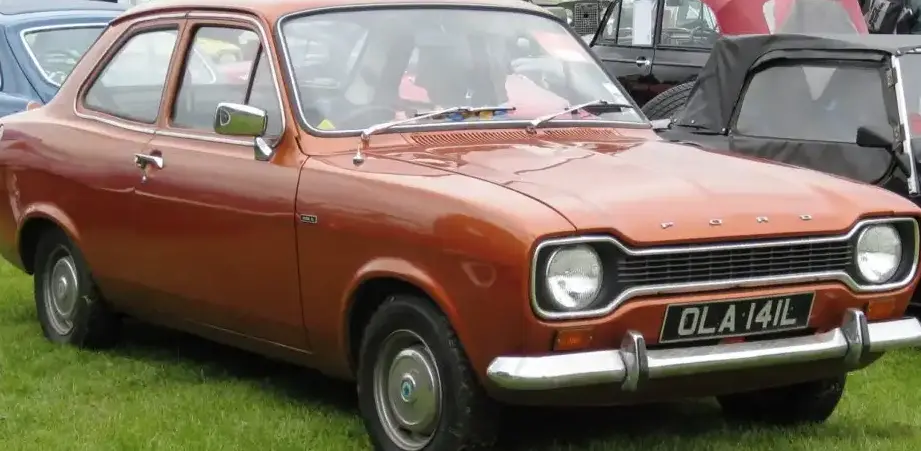
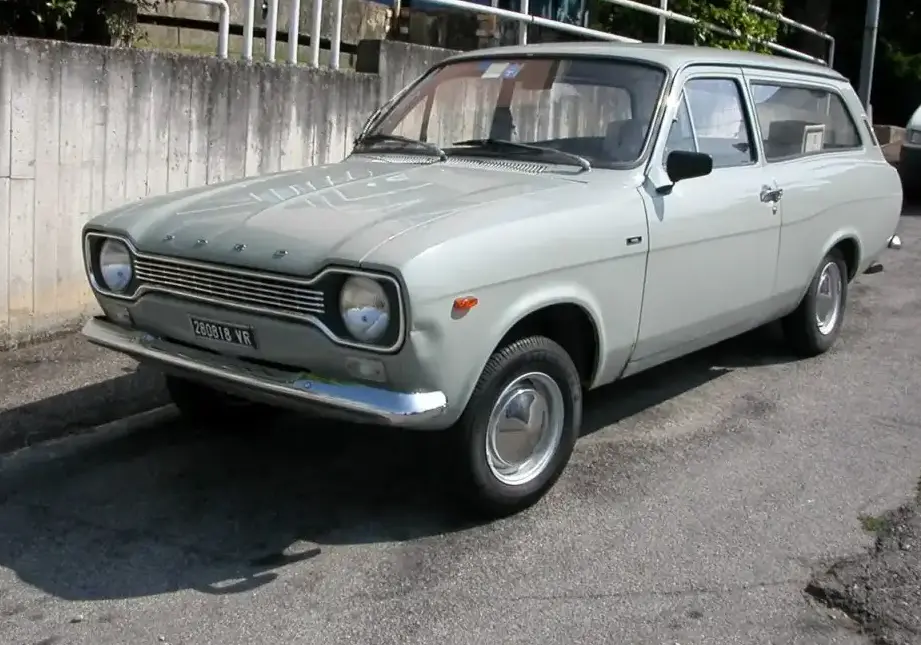
The Ford Escort II, produced between 1974 and 1980, marked a significant step forward in the evolution of Ford of Britain’s immensely popular Escort line. The ATH designation identifies this second generation, which aimed to modernize the original while preserving the core principles of affordability and practicality. Within the Escort II range, the 1.1-liter variant, delivering 48 horsepower, served as the entry-level model, appealing to budget-conscious buyers and those prioritizing economical transportation. This version was particularly important in the United Kingdom and European markets, where smaller displacement engines were favored due to prevailing taxation policies and fuel costs. It occupied the base trim level, offering a no-frills approach to personal mobility.
Powertrain & Engine Architecture
The heart of the Escort II 1.1 was the 1098cc inline-four cylinder engine. This engine, often identified by its internal code, was a relatively straightforward design employing an overhead valve (OHV) valvetrain and a single downdraft carburetor for fuel delivery. The carburetor, typically a Ford-sourced unit, was responsible for precisely mixing air and fuel for combustion. The engine’s modest 48 horsepower output at 5500 rpm and 74 Nm (54.58 lb-ft) of torque at 3000 rpm were a direct result of its small displacement and conservative tuning. The engine was mounted longitudinally in the front of the vehicle, powering the rear wheels. The standard transmission was a four-speed manual gearbox, selected for its simplicity and cost-effectiveness. This configuration was typical for European economy cars of the period.
Driving Characteristics
The 1.1-liter Escort II provided a functional driving experience. Acceleration was modest, and the car wasn’t engineered for high-speed performance. The four-speed manual transmission featured relatively wide gear ratios, prioritizing fuel economy over spirited driving. The engine felt somewhat strained at higher speeds, and overtaking maneuvers required careful planning. Compared to the more powerful 1.6-liter or even the later 1.3-liter versions, the 1.1 felt noticeably slower. However, its light weight and responsive steering made it enjoyable to drive around town. The rear-wheel-drive layout offered a balanced feel, though it lacked the handling precision of more contemporary front-wheel-drive cars. The suspension, while basic, provided a reasonable balance between ride comfort and handling.
Equipment & Trim Levels
The 1.1-liter Escort II was the base model, and consequently, it came with a minimal level of standard equipment. Typically, it featured vinyl upholstery, basic instrumentation – including a speedometer, fuel gauge, and temperature gauge – and a simple dashboard layout. Features such as a radio, heater, and upgraded interior trim were often available as optional extras. The exterior trim was also basic, with steel wheels, black plastic bumpers, and minimal chrome detailing. The emphasis was on providing a functional and affordable vehicle, rather than luxury or refinement. The interior space was adequate for a car of its size, comfortably seating five passengers.
Chassis & Braking
The Escort II utilized a body-on-frame construction, a common practice for cars of that era. The front suspension was independent, employing a McPherson strut design with coil springs and an anti-roll bar to enhance handling. The rear suspension was a traditional leaf spring setup, which was cost-effective but less sophisticated than independent rear suspension. The braking system consisted of drum brakes on all four wheels, measuring 203mm in diameter. While adequate for the car’s performance, the drum brakes lacked the stopping power and fade resistance of disc brakes. The steering was a rack and pinion system, providing precise and responsive steering feel.
Market Reception & Comparison
The Escort II 1.1 was generally well-received as an affordable and reliable mode of transportation. Critics acknowledged its modest performance but praised its fuel economy and practicality. Compared to other cars in its class, such as the Vauxhall Viva and the Austin Allegro, the Escort II offered a more modern design and a more engaging driving experience. However, it was often criticized for its basic interior and lack of features. The 1.1-liter engine was particularly popular in markets where fuel costs were high and taxation favored smaller displacement engines. Compared to the higher-spec Escort II models, such as the 1.6 GL, the 1.1 offered significantly lower running costs but at the expense of performance and refinement.
Legacy
The Ford Escort II 1.1, while not the most powerful or luxurious version of the Escort II, remains a fondly remembered classic. Its simple design and robust powertrain contribute to its relatively good reliability, and many examples are still on the road today. The 1.1-liter engine is known for its durability, although regular maintenance is essential to prevent potential issues. In the used car market, the Escort II 1.1 is often sought after by enthusiasts looking for a classic Ford that is affordable to maintain and enjoyable to drive. It represents a significant piece of automotive history, embodying the spirit of affordable and practical motoring of the 1970s.