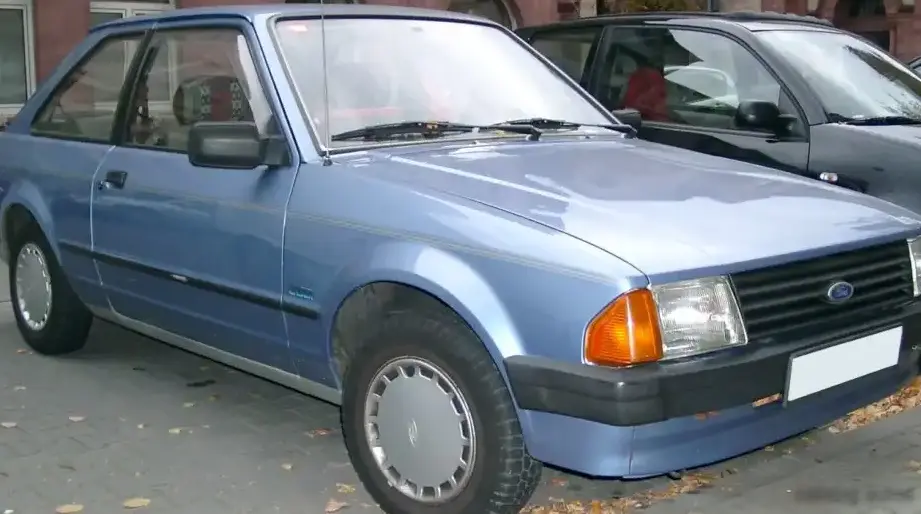
The Ford Escort III, produced between 1980 and 1985, represented a significant evolution of Ford of Europe’s popular compact car. Within the Escort III range (chassis codes GAA, AWA, ABFT, and AVA), the 1.1-liter variant, producing 50 horsepower, served as the entry-level model, aimed at providing affordable and economical transportation. This version was particularly important in markets where fuel efficiency and purchase price were primary concerns. It was a mainstay of the lineup during a period of economic uncertainty and rising fuel costs, offering a practical solution for everyday commuting and family use. The Escort III, as a whole, aimed to modernize the Escort line, offering improved comfort, handling, and styling compared to its predecessor.
Technical Specifications
| Brand | Ford |
| Model | Escort |
| Generation | Escort III (GAA, AWA, ABFT, AVA) |
| Type (Engine) | 1.1 (50 Hp) |
| Start of Production | 1980 |
| End of Production | 1985 |
| Powertrain Architecture | Internal Combustion Engine |
| Body Type | Hatchback |
| Fuel Type | Petrol (Gasoline) |
| Power | 50 Hp |
| Engine Aspiration | Naturally Aspirated |
Powertrain & Engine Architecture
The heart of the Escort III 1.1 was the Ford 1.1-liter inline-four cylinder engine, internally designated as the HSS. This engine, while modest in output, was known for its durability and simplicity. It featured a single overhead camshaft (SOHC) operating two valves per cylinder. Fuel delivery was managed by a single-barrel carburetor, a common setup for vehicles of this era and price point. The engine’s relatively low compression ratio contributed to its ability to run on lower octane fuel, further enhancing its affordability. The 1.1-liter engine produced 50 horsepower at 6000 rpm and approximately 64 lb-ft of torque at 3600 rpm.
The 1.1-liter engine was typically paired with a four-speed manual transmission, although a three-speed automatic transmission was offered as an option. The automatic transmission, while providing ease of use, did noticeably impact the car’s acceleration and fuel economy. The transmission was a traditional torque converter automatic, lacking the sophistication of more modern electronically controlled units. The final drive ratios were geared towards economy, prioritizing fuel efficiency over outright performance.
Driving Characteristics
The Escort III 1.1, particularly in hatchback form, offered a practical and undemanding driving experience. With only 50 horsepower on tap, acceleration was leisurely, and overtaking required careful planning. The car felt most comfortable at lower speeds, making it well-suited for urban driving and short commutes. The four-speed manual transmission allowed drivers to make the most of the available power, while the optional automatic, though convenient, resulted in a more sluggish response. The steering was light and relatively precise, making the car easy to maneuver in tight spaces. The suspension, while basic, provided a reasonably comfortable ride, absorbing bumps and imperfections in the road surface adequately. Compared to the larger-engined Escort III models (like the 1.6), the 1.1 felt significantly underpowered, but it also offered superior fuel economy.
Equipment & Trim Levels
The Escort III 1.1 was positioned as the base model, and as such, it came with a relatively sparse equipment list. Standard features typically included cloth upholstery, basic instrumentation (speedometer, fuel gauge, and temperature gauge), and manually operated windows and door locks. The interior was functional and durable, designed to withstand the rigors of daily use. Optional extras included a radio, heated rear window, and upgraded interior trim. The trim level was often simply designated as “L” for base, with higher trims like “GL” and “Ghia” offering more luxurious appointments and additional features. The 1.1L models were rarely seen with the higher trim levels.
Chassis & Braking
The Escort III utilized a MacPherson strut front suspension and a leaf spring rear suspension. This configuration was a cost-effective solution that provided acceptable handling characteristics for a car in its class. The front suspension offered reasonable control and stability, while the rear leaf springs contributed to a comfortable ride, albeit at the expense of ultimate handling precision. Braking was typically accomplished with disc brakes on the front wheels and drum brakes on the rear wheels. The braking system was adequate for the car’s weight and performance, but it lacked the stopping power of more modern systems. Stabilizer bars were often omitted on the base 1.1 models to further reduce cost.
Market Reception & Comparison
The Escort III 1.1 was well-received in markets where affordability and fuel economy were paramount. Critics acknowledged its practicality and low running costs, but also noted its lack of performance. Compared to its siblings, such as the 1.3 and 1.6-liter models, the 1.1 offered significantly less power and refinement. However, it also boasted superior fuel economy, making it an attractive option for budget-conscious buyers. The 1.6-liter models, while more expensive, provided a more engaging driving experience and were better suited for longer journeys. The 1.1L was often compared to rivals like the Vauxhall Nova and Austin Metro, generally holding its own in terms of reliability and practicality.
Legacy
The Ford Escort III 1.1, while not a performance icon, played a vital role in providing affordable transportation to a wide range of customers. The HSS engine proved to be remarkably durable, and many examples are still on the road today. In the used car market, these Escorts are valued for their simplicity, ease of maintenance, and low running costs. Parts availability remains relatively good, making them a popular choice for classic car enthusiasts and those seeking a reliable and inexpensive vehicle. While not highly sought after by collectors, the Escort III 1.1 represents a significant piece of automotive history, embodying the spirit of practical and economical motoring of the early 1980s. The 1.1 engine, while basic, is known for its longevity, and with regular maintenance, can provide many more miles of service.