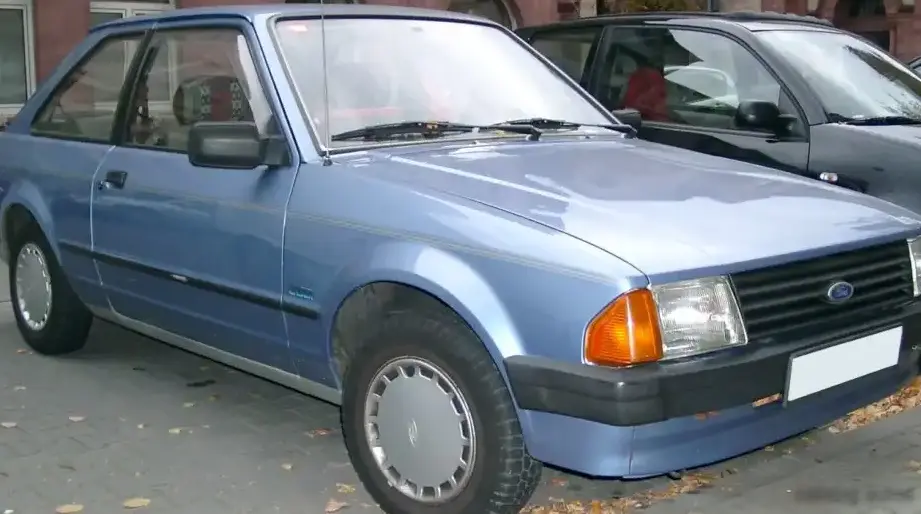
The Ford Escort III, produced between 1980 and 1985, represented a significant evolution of Ford of Europe’s popular compact car. This generation, internally designated GAA, AWA, ABFT, and AVA depending on market and specific features, aimed to modernize the Escort while retaining its core appeal as an affordable and practical family vehicle. The 1.6-liter, 97 horsepower variant occupied a middle ground in the Escort III lineup, offering a balance between performance and economy. It was positioned as a step up from the base 1.3L models, appealing to buyers who desired a bit more power for highway driving and carrying a full load, but didn’t require the expense of the more powerful XR3 or higher trim levels. This version was particularly popular in the UK and other European markets where fuel costs were a significant consideration.
Technical Specifications
| Brand | Ford |
| Model | Escort |
| Generation | Escort III (GAA, AWA, ABFT, AVA) |
| Type (Engine) | 1.6 (97 Hp) |
| Start of Production | 1980 |
| End of Production | 1985 |
| Powertrain Architecture | Internal Combustion Engine |
| Body Type | Hatchback |
| Fuel Type | Petrol (Gasoline) |
| Power | 97 Hp |
| Engine Aspiration | Naturally Aspirated |
Powertrain & Engine Architecture
The heart of the Escort III 1.6 was the Ford Pinto engine, specifically the 1597cc version. This engine, while sharing a family lineage with earlier Pinto designs, had undergone several refinements by the early 1980s. It featured a cast iron block and an aluminum cylinder head, employing a single overhead camshaft (SOHC) design. Fuel delivery was managed by a Weber or Motorcraft carburetor, depending on the specific market and year of production. The engine utilized a two-barrel downdraft carburetor, providing adequate fuel atomization for the time, though it wasn’t as efficient or responsive as later fuel injection systems. The Pinto engine was known for its relative simplicity and ease of maintenance. The 97 horsepower output was achieved at approximately 5,800 rpm, with peak torque of around 95 lb-ft at 3,500 rpm. This engine was typically paired with a four-speed manual transmission, but a three-speed automatic transmission (Ford C3) was also offered, and is the focus of this article. The automatic transmission, while providing convenience, did impact acceleration and fuel economy compared to the manual counterpart. The C3 automatic was a conventional hydraulic automatic, known for its durability but lacking the sophistication of electronically controlled transmissions that would emerge later.
Driving Characteristics
The Escort III 1.6 with the automatic transmission offered a comfortable, if not particularly sporty, driving experience. Acceleration from 0 to 60 mph was typically in the 12-13 second range, noticeably slower than the manual transmission versions. The automatic’s gear ratios were geared towards fuel efficiency and smooth cruising rather than outright performance. The transmission’s shift points were relatively conservative, prioritizing economy over responsiveness. In real-world driving, the 1.6L engine provided sufficient power for everyday tasks, including commuting and highway overtaking, but required careful planning when attempting more aggressive maneuvers. The automatic transmission did rob some of the engine’s available power, making the car feel somewhat sluggish compared to the manual versions. Handling was typical of front-wheel-drive cars of the era – safe and predictable, but not particularly engaging. The steering was light and easy, making it well-suited for urban driving.
Equipment & Trim Levels
The 1.6L automatic Escort III typically fell into the mid-range of the trim levels offered. Standard equipment generally included cloth upholstery, a basic instrument cluster with speedometer, fuel gauge, and temperature gauge, and a two-spoke steering wheel. The interior was functional and durable, prioritizing practicality over luxury. Optional extras included a radio (often a cassette player), heated rear window, and upgraded interior trim. Higher trim levels, such as the Ghia, offered more luxurious appointments, including upgraded upholstery, woodgrain trim, and additional features like central locking and electric windows. The base models were more spartan, lacking many of the comfort features found in the 1.6L automatic.
Chassis & Braking
The Escort III utilized a MacPherson strut front suspension and a leaf spring rear suspension. This configuration was a cost-effective solution that provided a reasonable balance between ride comfort and handling. The front suspension featured anti-roll bar, helping to reduce body roll during cornering. The rear suspension, while simple, could sometimes feel harsh over rough surfaces. Braking was typically accomplished with disc brakes on the front wheels and drum brakes on the rear wheels. The braking system was adequate for the car’s weight and performance, but lacked the stopping power of more modern systems. The 1.6L automatic models generally had slightly larger brakes than the base models to compensate for the added weight of the automatic transmission.
Market Reception & Comparison
The Escort III 1.6 automatic was generally well-received by critics as a practical and affordable family car. It was praised for its fuel efficiency, comfortable ride, and ease of use. However, it was also criticized for its lack of performance and somewhat dated interior. Compared to the manual transmission versions, the automatic suffered from slower acceleration and reduced fuel economy. The higher-output XR3 models offered significantly more performance, but at a higher price point. The 1.3L models were more affordable, but lacked the power and refinement of the 1.6L. Against competitors like the Vauxhall Astra and Volkswagen Golf, the Escort III 1.6 automatic held its own, offering a competitive package in terms of price, features, and reliability.
Legacy
The Ford Escort III 1.6 automatic, while not a particularly groundbreaking vehicle, remains a fondly remembered classic among enthusiasts. The Pinto engine, despite its occasional reliability issues (particularly with head gasket failures), was a durable and relatively easy-to-maintain powerplant. The automatic transmission, while not known for its performance, proved to be reasonably reliable. Today, well-maintained examples of the Escort III 1.6 automatic are becoming increasingly collectible, appealing to those seeking a nostalgic reminder of 1980s motoring. Parts availability is generally good, thanks to the Escort’s widespread popularity. However, finding rust-free examples can be a challenge, as many Escort IIIs have succumbed to corrosion over the years. The car represents a pivotal point in Ford’s history, bridging the gap between the simpler designs of the past and the more technologically advanced vehicles of the future.