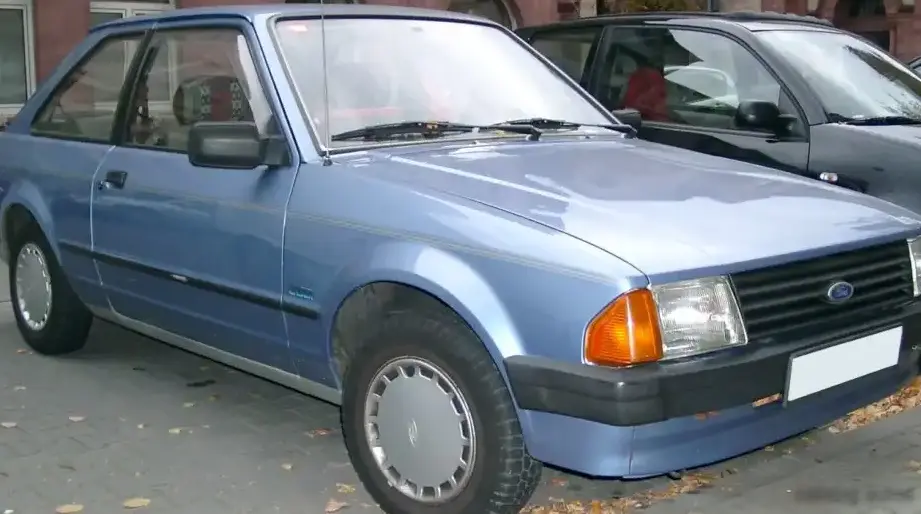
The Ford Escort III 1.6 RS Turbo, produced between 1984 and 1989, represented a performance-oriented variant within the third generation of the popular Escort. Falling under the chassis codes GAA, AWA, ABFT, and AVA, this model aimed to deliver a sporty driving experience, capitalizing on the growing hot hatch market of the 1980s. It occupied a position above the standard Escort models, offering significantly enhanced performance compared to the base trims, but remained more accessible than the larger and more expensive Ford Sierra RS Cosworth. The RS Turbo was primarily marketed in Europe, particularly the United Kingdom, where it quickly gained a reputation for its lively performance and relatively affordable price point.
Technical Specifications
| Brand | Ford |
| Model | Escort |
| Generation | Escort III (GAA, AWA, ABFT, AVA) |
| Type (Engine) | 1.6 RS Turbo (132 Hp) |
| Start of production | 1984 |
| End of production | 1989 |
| Powertrain Architecture | Internal Combustion engine |
| Body type | Hatchback |
| Seats | 4 |
| Doors | 3 |
| Fuel Type | Petrol (Gasoline) |
| Acceleration 0 – 100 km/h | 8 sec |
| Acceleration 0 – 62 mph | 8 sec |
| Acceleration 0 – 60 mph | 7.6 sec |
| Maximum speed | 203 km/h (126.14 mph) |
| Weight-to-power ratio | 6.8 kg/Hp, 147.5 Hp/tonne |
| Weight-to-torque ratio | 6.2 kg/Nm, 162 Nm/tonne |
| Power | 132 Hp @ 6000 rpm |
| Power per litre | 82.7 Hp/l |
| Torque | 145 Nm @ 4500 rpm (106.95 lb.-ft. @ 4500 rpm) |
| Engine displacement | 1597 cm3 (97.45 cu. in.) |
| Number of cylinders | 4 |
| Engine configuration | Inline |
| Compression ratio | 9:1 |
| Fuel injection system | Multi-port manifold injection |
| Engine aspiration | Turbocharger |
| Kerb Weight | 895 kg (1973.14 lbs) |
| Max. weight | 1375 kg (3031.36 lbs) |
| Max load | 480 kg (1058.22 lbs) |
| Trunk (boot) space – minimum | 305 l (10.77 cu. ft.) |
| Trunk (boot) space – maximum | 1378 l (48.66 cu. ft.) |
| Fuel tank capacity | 48 l (12.68 US gal | 10.56 UK gal) |
| Length | 3966 mm (156.14 in) |
| Width | 1640 mm (64.57 in) |
| Height | 1337 mm (52.64 in) |
| Wheelbase | 2396 mm (94.33 in) |
| Minimum turning circle | 10 m (32.81 ft) |
| Drivetrain Architecture | Front wheel drive |
| Number of gears and type of gearbox | 5 gears, manual transmission |
| Assisting systems | ABS (Anti-lock braking system) |
| Tires size | 195/50 VR15 |
Powertrain & Engine Architecture
The heart of the Escort III 1.6 RS Turbo was the 1597cc inline-four cylinder engine, designated as the CVH (Compound Valve angle Hemispherical) unit. This engine was significantly upgraded from the standard Escort 1.6 with the addition of a Garrett T25 turbocharger and intercooler. The multi-port fuel injection system, coupled with a 9:1 compression ratio, helped to deliver a respectable 132 horsepower at 6000 rpm and 145 Nm (106.95 lb-ft) of torque at 4500 rpm. The turbocharger provided a noticeable boost in power, transforming the Escort into a genuinely quick hatchback. The engine was mated to a five-speed manual transmission, chosen for its durability and ability to handle the increased power output. The transmission featured relatively short gear ratios, contributing to the car’s brisk acceleration.
Driving Characteristics
The 1.6 RS Turbo offered a distinctly sporty driving experience. The turbocharger provided a surge of power in the mid-range, making overtaking and quick acceleration easy. While not as refined as some of its contemporary rivals, the Escort RS Turbo was praised for its responsive handling and direct steering. The front-wheel-drive layout, while common for the time, could exhibit some torque steer under hard acceleration. Compared to the naturally aspirated 1.6-liter Escort, the RS Turbo offered a substantial performance improvement. It was also noticeably quicker than the diesel-powered models. However, it didn’t quite match the outright performance of larger, more expensive hot hatches like the Volkswagen Golf GTI or the Ford Sierra RS Cosworth.
Equipment & Trim Levels
The Escort III 1.6 RS Turbo was generally well-equipped for its time, although options were available to further enhance the interior. Standard features typically included Recaro sports seats, a leather-wrapped steering wheel, and a basic stereo system. The interior trim was generally functional and focused on providing a sporty feel. Optional extras included electric windows, a sunroof, and upgraded sound systems. The exterior was distinguished by a unique body kit, including a front spoiler, rear spoiler, and side skirts, along with distinctive RS Turbo badging. Alloy wheels were also standard, further enhancing the car’s sporty appearance.
Chassis & Braking
The Escort III 1.6 RS Turbo utilized a MacPherson strut front suspension and a semi-independent twist beam rear suspension. The suspension was tuned to provide a balance between comfort and handling, offering a reasonably compliant ride while maintaining good body control. Braking was initially provided by disc brakes on the front wheels and drum brakes on the rear. Later models often featured disc brakes all around, improving stopping performance. ABS (Anti-lock Braking System) was offered as an optional extra, providing enhanced safety in emergency braking situations. The steering was a rack-and-pinion system, providing precise and responsive control.
Market Reception & Comparison
The Ford Escort III 1.6 RS Turbo was generally well-received by automotive critics. It was praised for its performance, handling, and relatively affordable price. However, some critics noted the interior was somewhat basic compared to its rivals. Compared to the standard Escort models, the RS Turbo offered a significant performance upgrade, but at a higher price point. It competed directly with other hot hatches of the era, such as the Volkswagen Golf GTI, Vauxhall Astra SR, and Peugeot 205 GTI. The RS Turbo offered a compelling alternative, particularly for those seeking a sporty and affordable hatchback with a distinctive British character. Fuel economy, while not a primary concern for buyers of this model, was reasonable for a turbocharged vehicle of the time.
Legacy
The Ford Escort III 1.6 RS Turbo has become a sought-after classic car among enthusiasts. The CVH engine, while generally reliable, can be prone to issues if not properly maintained. Turbocharger failure and oil leaks are common concerns. However, parts availability remains relatively good, and the car is relatively easy to work on for experienced mechanics. Today, well-maintained examples of the Escort III 1.6 RS Turbo command a premium in the used car market, reflecting its status as a desirable and iconic hot hatch of the 1980s. It remains a popular choice for classic car rallies and shows, and continues to be enjoyed by enthusiasts who appreciate its spirited performance and distinctive styling.