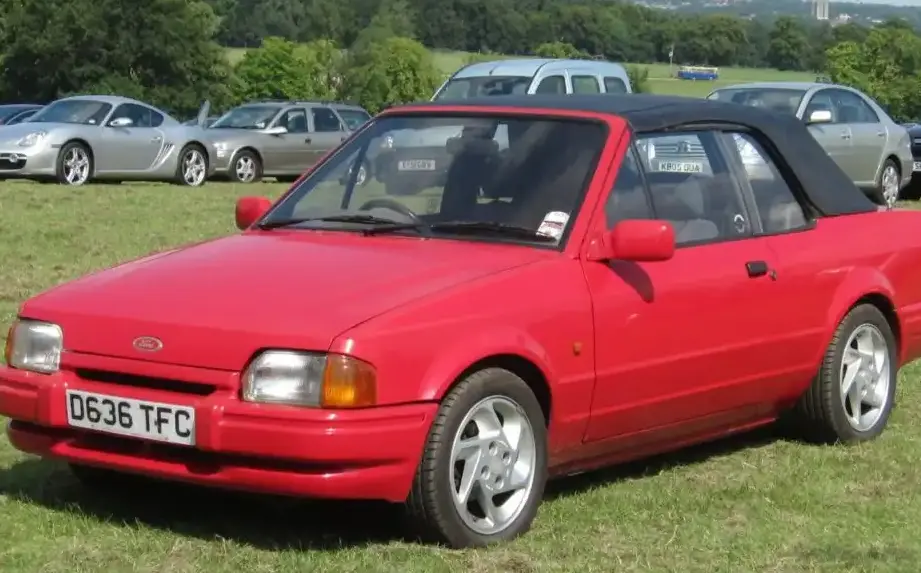
The Ford Escort IV Cabrio 1.6, producing 102 horsepower, was a short-lived but significant variant of the fourth-generation Escort, manufactured between 1989 and 1990. Positioned as a more accessible entry into the convertible market, it offered open-air motoring at a relatively affordable price point. This model represented Ford’s continued commitment to providing diverse options within the popular Escort range, catering to buyers seeking a stylish and practical vehicle. It was built on the Mk IV Escort platform, known for its improvements in handling and refinement over previous generations, and shared many components with the standard Escort but distinguished itself with its convertible top and slightly altered styling.
Technical Specifications
| Brand | Ford |
| Model | Escort |
| Generation | Escort IV Cabrio |
| Type (Engine) | 1.6 (102 Hp) |
| Start of production | 1989 |
| End of production | 1990 |
| Powertrain Architecture | Internal Combustion engine |
| Body type | Cabriolet |
| Fuel Type | Petrol (Gasoline) |
| Power | 102 Hp |
| Engine Model/Code | LJB |
| Engine aspiration | Naturally aspirated engine |
| Engine oil capacity | 3.5 l (3.7 US qt | 3.08 UK qt) |
| Coolant capacity | 7.9 l (8.35 US qt | 6.95 UK qt) |
Powertrain & Engine Architecture
The Escort IV Cabrio 1.6 was powered by Ford’s LJB engine, a 1.6-liter inline-four cylinder gasoline engine. This engine was a naturally aspirated unit, meaning it did not utilize a turbocharger or supercharger. It featured a single overhead camshaft (SOHC) valvetrain, operating two valves per cylinder. Fuel delivery was managed by Ford’s EEC-IV electronic fuel injection system, a significant advancement over earlier carburetor-based systems, contributing to improved fuel efficiency and reduced emissions. The LJB engine was known for its relative simplicity and durability, making it a reliable powerplant for the Escort. While not a high-performance engine, it provided adequate power for everyday driving. The engine’s block was constructed from cast iron, while the cylinder head was made of aluminum alloy, contributing to a reasonable weight balance. The engine’s output of 102 horsepower was achieved at approximately 5,500 rpm, with peak torque of around 100 lb-ft at 3,500 rpm. This configuration prioritized usability and fuel economy over outright performance.
Driving Characteristics
The 1.6-liter engine in the Escort IV Cabrio, paired with a typically four-speed automatic transmission, delivered a driving experience focused on comfort and ease of use. Acceleration was adequate for merging onto highways and navigating city streets, but it wasn’t particularly brisk. The automatic transmission, while convenient, did detract somewhat from the overall driving engagement compared to the available five-speed manual gearbox. Gear ratios were tuned for fuel efficiency and smooth cruising, rather than aggressive acceleration. The Cabrio’s convertible top added weight compared to the hardtop Escort, which slightly impacted handling and performance. However, the Escort IV chassis, with its MacPherson strut front suspension and independent rear suspension, provided a reasonably comfortable and controlled ride. Steering was light and responsive, making it easy to maneuver in urban environments. Compared to the higher-performance Escort RS2000, the 1.6 Cabrio offered a significantly more relaxed driving experience, prioritizing comfort and convenience over sporty handling.
Equipment & Trim Levels
The Escort IV Cabrio 1.6 typically came with a fairly basic level of standard equipment, reflecting its position as an entry-level convertible. Standard features generally included cloth upholstery, a basic AM/FM radio, and manual windows and door locks. Power steering was often included, but air conditioning was typically an optional extra. The interior design was functional and straightforward, with a focus on practicality. Dashboard layout was typical of the era, with clearly marked gauges and easy-to-reach controls. Optional extras included upgraded sound systems, alloy wheels, and a more luxurious interior trim. The convertible top was manually operated, although some later models may have featured an optional power-operated top. Trim levels were relatively limited, with most Cabrios being equipped with a similar set of features. The emphasis was on providing an affordable and enjoyable open-air driving experience.
Chassis & Braking
The Escort IV Cabrio shared its chassis with the standard Escort IV, featuring a MacPherson strut front suspension and an independent rear suspension with trailing arms. This suspension setup provided a good balance of ride comfort and handling. The Cabriolet’s chassis was reinforced to compensate for the loss of structural rigidity caused by the removal of the roof. Braking systems varied depending on the specific market and year of production. Early models often featured drum brakes on the rear wheels, while later models were upgraded to disc brakes all around. Front brakes were typically ventilated discs. Power-assisted steering was commonly included, making it easier to maneuver the vehicle. Stabilizer bars were fitted to both the front and rear suspension to reduce body roll during cornering. The braking system was adequate for the vehicle’s weight and performance, providing reliable stopping power in most driving conditions.
Market Reception & Comparison
The Ford Escort IV Cabrio 1.6 received mixed reviews from automotive critics. While praised for its affordability and stylish design, it was often criticized for its relatively modest performance and basic interior. Compared to other convertibles on the market at the time, such as the Volkswagen Cabriolet, the Escort offered a more budget-friendly option. However, it lacked the refinement and performance of some of its competitors. Fuel economy was generally considered to be good for a vehicle of its type, averaging around 28-32 mpg in mixed driving conditions. Reliability was generally good, with the LJB engine proving to be a durable and dependable powerplant. Compared to the higher-powered Escort variants, such as the 1.9-liter models, the 1.6 Cabrio offered a more relaxed and economical driving experience, appealing to buyers who prioritized comfort and affordability over performance.
Legacy
The Ford Escort IV Cabrio 1.6, despite its short production run, remains a popular choice among classic car enthusiasts. The LJB engine, while not particularly powerful, is known for its reliability and ease of maintenance. Parts availability is generally good, as many components are shared with other Ford models of the era. Today, these cars are often sought after as affordable entry points into classic convertible ownership. The Escort IV Cabrio represents a significant moment in Ford’s history, demonstrating the company’s ability to offer stylish and accessible vehicles to a wide range of buyers. While not a high-performance machine, the 1.6 Cabrio provided a fun and enjoyable driving experience, and its enduring popularity is a testament to its enduring appeal. Well-maintained examples command reasonable prices in the used car market, making them an attractive option for collectors and enthusiasts alike.