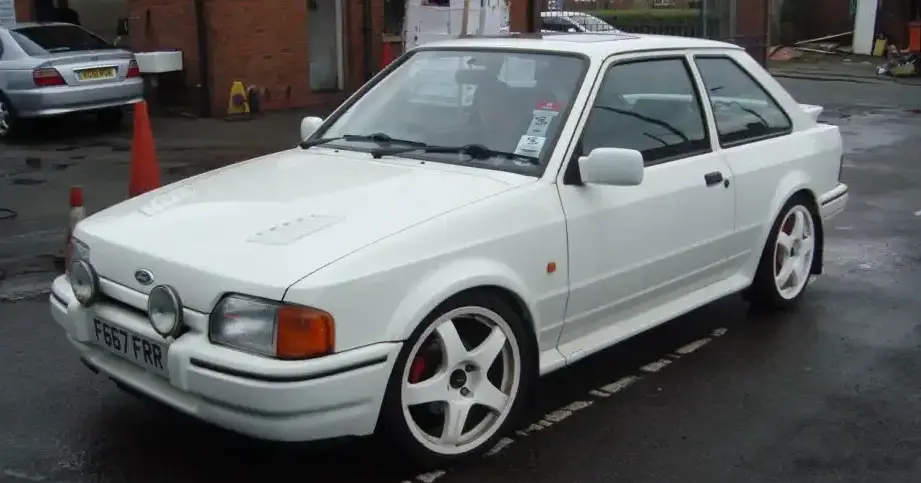
The Ford Escort IV, produced between 1986 and 1990, represented a significant evolution of Ford’s popular compact car. Within the Escort IV range (chassis codes GAF, AWF, and ABFT), the 1.3-liter, 60 horsepower variant occupied the entry-level position, aimed at buyers prioritizing affordability and fuel economy. This model served as the gateway to the Escort lineup, offering basic transportation with Ford’s established reputation for reliability. It was a key component in Ford’s strategy to maintain market share in the competitive European small car segment, particularly in the UK and Germany where the Escort was a consistently strong seller.
Technical Specifications
| Brand | Ford |
| Model | Escort |
| Generation | Escort IV (GAF, AWF, ABFT) |
| Type (Engine) | 1.3 (60 Hp) |
| Start of Production | 1986 |
| End of Production | 1990 |
| Powertrain Architecture | Internal Combustion Engine |
| Body Type | Hatchback |
| Fuel Type | Petrol (Gasoline) |
| Power | 60 Hp |
| Engine Model/Code | JBB, JLA, JLB |
| Engine Aspiration | Naturally Aspirated |
| Engine Oil Capacity | 3.25 l (3.43 US qt | 2.86 UK qt) |
| Coolant Capacity | 7.1 l (7.5 US qt | 6.25 UK qt) |
Powertrain & Engine Architecture
The heart of the Escort IV 1.3 was the Ford JBB, JLA, or JLB engine – a 1297cc inline-four cylinder petrol engine. This engine was a relatively simple design, utilizing a single overhead camshaft (SOHC) operating two valves per cylinder. Fuel delivery was managed by a carburetor, a common feature for entry-level models of this era, prioritizing cost-effectiveness over the more sophisticated fuel injection systems found in higher-spec Escorts. The carburetor type varied slightly depending on the specific market and year of production. The engine’s modest 60 horsepower output at 5,500 rpm and 78 lb-ft of torque at 3,000 rpm were sufficient for everyday driving, but didn’t offer significant performance reserves. The transmission paired with this engine was typically a four-speed manual, though a three-speed automatic transmission was also available, albeit less common. The automatic option further reduced performance and increased fuel consumption.
Driving Characteristics
The 1.3-liter Escort IV offered a predictable, if uninspiring, driving experience. Acceleration was leisurely, taking approximately 14-16 seconds to reach 60 mph. The four-speed manual transmission allowed drivers to make the most of the limited power, while the automatic version felt noticeably sluggish, particularly when attempting to overtake. Gear ratios were geared towards fuel efficiency rather than outright performance. Handling was typical of front-wheel-drive cars of the period – safe and predictable, but lacking in sharpness. The suspension, consisting of MacPherson struts at the front and a twist-beam rear axle, provided a comfortable ride on most road surfaces, but body roll was evident during cornering. The automatic transmission, while offering convenience, further diminished the driving experience, with noticeable torque converter slip and delayed responses.
Equipment & Trim Levels
The 1.3-liter Escort IV was positioned as the base model, and as such, came with a relatively sparse equipment list. Standard features typically included cloth upholstery, a basic instrument cluster, and manually operated windows and door locks. Central locking and electric windows were not usually offered on this trim level. The interior trim was functional and durable, prioritizing practicality over luxury. Optional extras were limited, but could include a radio, heated rear window, and upgraded seat fabrics. The dashboard layout was straightforward and easy to use, with clearly labeled controls. The exterior styling was also basic, with steel wheels, black plastic trim, and minimal chrome detailing.
Chassis & Braking
The Escort IV’s chassis was a monocoque construction, providing a good balance of strength and weight. The front suspension utilized MacPherson struts with an anti-roll bar, while the rear suspension employed a twist-beam axle. Braking was typically accomplished with disc brakes at the front and drum brakes at the rear. The braking system was adequate for the car’s performance, but lacked the stopping power of higher-spec Escorts equipped with all-round disc brakes. Steering was rack and pinion, providing reasonably precise control. The 1.3-liter model generally featured smaller tires than its more powerful siblings, further contributing to its focus on fuel economy and affordability.
Market Reception & Comparison
The Escort IV 1.3 received mixed reviews. Critics acknowledged its affordability and fuel efficiency, but often criticized its lack of performance and basic equipment levels. Compared to the 1.6-liter and 1.9-liter Escorts, the 1.3 felt significantly underpowered. The 1.6-liter offered a noticeable improvement in performance without a substantial increase in price, making it a more popular choice for many buyers. The diesel-powered Escorts, while slower, offered superior fuel economy. However, the 1.3-liter model found favor with buyers on a tight budget, such as first-time drivers or those seeking a reliable and economical runabout. Fuel economy was a key selling point, averaging around 35-40 mpg in real-world driving conditions.
Legacy
The Ford Escort IV 1.3, while not the most exciting variant in the lineup, played a crucial role in maintaining the Escort’s position as a best-selling car in Europe. The JBB/JLA/JLB engine proved to be reasonably reliable, and many examples are still on the road today, albeit often showing their age. Parts availability remains relatively good, making maintenance and repair relatively straightforward. In the used car market, these Escorts are valued for their simplicity, affordability, and nostalgic appeal. They are often sought after by classic car enthusiasts and those looking for a cheap and cheerful project car. While not a performance icon, the 1.3-liter Escort IV represents a significant chapter in Ford’s history and a testament to the enduring popularity of the Escort nameplate.