Technical Specifications
| Brand | Ford |
| Model | Escort |
| Generation | Escort IV (GAF, AWF, ABFT) |
| Type (Engine) | 1.6 (88 Hp) |
| Start of Production | 1989 |
| End of Production | 1990 |
| Powertrain Architecture | Internal Combustion Engine |
| Body Type | Hatchback |
| Fuel Type | Petrol (Gasoline) |
| Power | 88 Hp |
| Engine Aspiration | Naturally Aspirated |
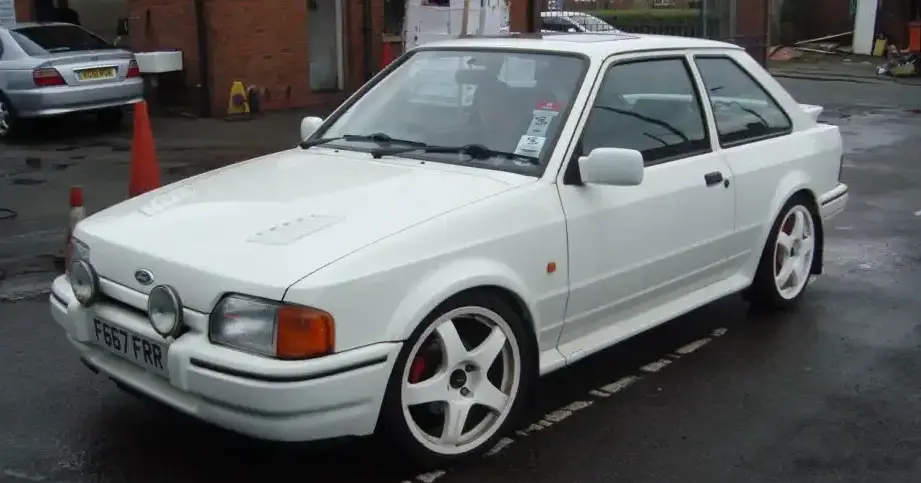
The Ford Escort IV, produced between 1986 and 1990, marked a substantial advancement in Ford of Europe’s well-regarded compact car. Within the fourth generation (chassis codes GAF, AWF, ABFT), the 1.6-liter, 88 horsepower variant occupied a key position in the lineup, providing a balance between affordability, fuel economy, and acceptable performance for the typical driver. This model was primarily targeted at the European market, where compact hatchbacks were – and remain – a dominant vehicle segment. While not officially offered for sale in the United States during this generation, the Escort nameplate was familiar, and the fourth generation represented a refinement of the formula that would later influence North American Escort models. The 1.6L engine and automatic transmission combination was positioned as an upgrade from the base 1.3L models, appealing to buyers who desired a more relaxed driving experience and a bit more power for highway travel.
Powertrain & Engine Architecture
The core of the Escort IV 1.6 was the Ford Valencia engine, a 1.6-liter inline-four cylinder gasoline engine. This engine, belonging to the CVH (Compound Valve angle Hemispherical) family, was a long-standing component of Ford’s European range. The 88 horsepower output was achieved through a relatively straightforward design featuring a single overhead camshaft (SOHC) operating two valves per cylinder. Fuel delivery was managed by Bosch fuel injection, a significant improvement over the carburetors found in earlier Escort models. This system enhanced fuel efficiency and reduced emissions. The engine’s bore and stroke measured 80.3mm x 79.5mm, resulting in a displacement of 1597cc.
Paired with the 1.6L engine was a three-speed automatic transmission. While offering convenience, this transmission wasn’t known for its sporty characteristics. It prioritized smooth operation and fuel economy over rapid acceleration. The automatic transmission was a popular choice for drivers who preferred a less demanding driving experience, especially in city traffic. The transmission’s torque converter played a vital role in multiplying engine torque at lower speeds, aiding initial acceleration, but also contributing to some power loss compared to a manual transmission.
Driving Characteristics
The Escort IV 1.6 Automatic delivered a comfortable, though not particularly thrilling, driving experience. With 88 horsepower and approximately 108 lb-ft of torque, acceleration was sufficient for everyday driving, but overtaking required careful consideration. The automatic transmission’s gear ratios were optimized for fuel efficiency, meaning the engine often operated at lower RPMs, resulting in a relaxed cruising experience. However, this also meant the car felt somewhat sluggish when pushed. Compared to the five-speed manual transmission available with the 1.6L engine, the automatic version sacrificed some responsiveness. The manual transmission allowed drivers to maintain the engine in its optimal power band, resulting in quicker acceleration and a more engaging drive. The automatic, while easier to manage in traffic, felt noticeably slower.
Equipment & Trim Levels
The 1.6L automatic Escort IV typically included a reasonable level of standard features for its time. These included power steering, a basic stereo system, and cloth upholstery. Trim levels varied by market, but generally, the 1.6 automatic was positioned as a mid-range offering. Optional extras included a sunroof, upgraded stereo systems, and central locking. Interior appointments were functional and durable, reflecting the car’s emphasis on practicality. The dashboard layout was straightforward and user-friendly, with clearly marked controls. The seats provided adequate support for longer trips, though they lacked the bolstering found in more performance-oriented models.
Chassis & Braking
The Escort IV employed a MacPherson strut front suspension and a twist-beam rear suspension. This setup provided a good compromise between ride comfort and handling. The front suspension offered responsive steering and decent cornering ability, while the rear suspension contributed to stability. Braking on the 1.6L automatic Escort usually consisted of disc brakes on the front wheels and drum brakes on the rear. This configuration was common for vehicles in this class during the late 1980s. While adequate for typical driving conditions, the rear drum brakes lacked the stopping power and fade resistance of disc brakes. A stabilizer bar was fitted to the front suspension to minimize body roll during cornering.
Market Reception & Comparison
The Escort IV 1.6 Automatic was generally well-received by automotive reviewers as a practical and reliable family car. It was praised for its fuel efficiency, comfortable ride, and ease of use. However, it was also criticized for its lack of performance and somewhat dated interior design. Compared to other trims in the Escort lineup, such as the more powerful 1.6L manual or the sporty XR3i, the 1.6 automatic was considered a more sensible and less exciting option. The 1.9 TDI diesel version, while offering superior fuel economy, lacked the refinement of the gasoline engine. The 1.6 automatic appealed to buyers who prioritized comfort and convenience over outright performance.
Legacy
The Ford Escort IV 1.6 Automatic, while not a particularly rare or highly sought-after model, remains a popular choice among classic car enthusiasts and those seeking an affordable and dependable vintage vehicle. The Valencia engine is known for its durability and relatively simple maintenance needs. Parts availability is generally good, although some components may be becoming harder to source. The automatic transmission, while not as robust as the manual version, can provide years of reliable service with proper maintenance. Today, these Escorts are often owned by collectors or used as affordable transportation for those who appreciate their classic charm and practicality. The 1.6L automatic represents a significant chapter in the Escort’s history, embodying the spirit of a practical and dependable European hatchback.