Technical Specifications
| Brand | Ford |
| Model | Escort |
| Generation | Escort IV (GAF, AWF, ABFT) |
| Type (Engine) | 1.6 (90 Hp) |
| Start of Production | 1986 |
| End of Production | 1990 |
| Powertrain Architecture | Internal Combustion Engine |
| Body Type | Hatchback |
| Fuel Type | Petrol (Gasoline) |
| Power | 90 Hp |
| Engine Model/Code | L4B, LUC |
| Engine Aspiration | Naturally Aspirated |
| Engine Oil Capacity | 3.5 l (3.7 US qt | 3.08 UK qt) |
| Coolant Capacity | 7.9 l (8.35 US qt | 6.95 UK qt) |
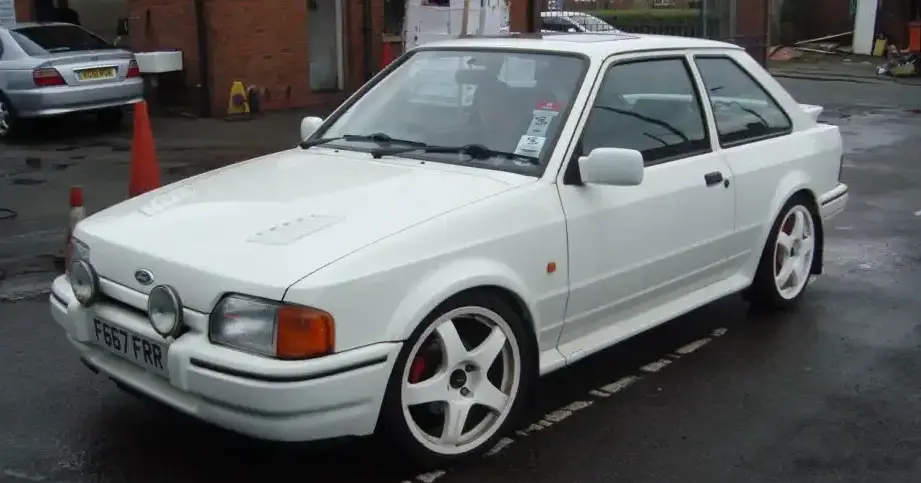
The Ford Escort IV, produced between 1986 and 1990, marked a substantial advancement in Ford’s long-running compact car lineage. Within the Escort IV range – identified by chassis codes GAF, AWF, and ABFT – the 1.6-liter, 90 horsepower variant held a pivotal position as a mainstream, accessible option for buyers. This model aimed to strike a balance between fuel efficiency and sufficient performance for everyday use, functioning as a dependable vehicle for families and commuters. It was positioned as an upgrade from the base 1.3L engine, providing more power without incurring the higher cost associated with the sportier 1.6L CVH or the later 1.8L versions. The Escort IV was a crucial model for Ford in Europe, directly competing with vehicles such as the Opel Astra, Volkswagen Golf, and Peugeot 305.
Powertrain & Engine Architecture
The 1.6-liter engine powering the Escort IV, designated with engine codes L4B and LUC, was a naturally aspirated, inline-four cylinder unit. It employed a single overhead camshaft (SOHC) design, operating two valves per cylinder. Fuel delivery was managed by a Bosch fuel injection system, a significant improvement over the carburetors found in earlier Escort models. This injection system contributed to enhanced fuel economy and reduced emissions. The engine’s bore and stroke measured 80.3mm x 79.5mm, resulting in a displacement of 1597cc. The 90 horsepower output was achieved at 5500 rpm, with peak torque of approximately 137 Nm (101 lb-ft) at 3500 rpm.
The 1.6L engine was commonly paired with a four-speed automatic transmission. While offering convenience, this transmission wasn’t particularly known for its sporty characteristics. It featured a conventional torque converter and prioritized smooth, comfortable operation over rapid acceleration. The automatic transmission’s gear ratios were optimized for fuel efficiency and drivability in typical urban and highway conditions. A five-speed manual transmission was also available on other Escort IV models, providing a more engaging driving experience and slightly improved fuel economy.
Driving Characteristics
The Escort IV 1.6L automatic delivered a comfortable, though not exceptionally thrilling, driving experience. Acceleration from 0 to 60 mph typically took around 12-13 seconds, making it competitive within its class but noticeably slower than the manual transmission or higher-output variants. The automatic transmission’s shift points were programmed for economy, causing the engine to frequently operate at lower rpm, resulting in a relaxed cruising experience. However, this also meant that downshifts could be sluggish and hesitant when attempting to overtake or ascend hills. The steering was light and precise, making the car easy to maneuver in city traffic. The suspension, while adequate, was tuned for comfort rather than handling, leading to some body roll during cornering. Compared to the manual transmission version, the automatic felt less responsive and demanded more foresight when overtaking.
Equipment & Trim Levels
The 1.6L automatic Escort IV generally came equipped with a reasonable array of standard features for its era. These included central locking, electric front windows (on select trims), a basic stereo system, and cloth upholstery. Interior trim levels varied, with higher-specification models boasting upgraded seat fabrics and additional features like a trip computer. Optional extras encompassed a sunroof, alloy wheels, and enhanced sound systems. The dashboard layout was functional and straightforward, with clearly marked controls. The interior space was generous for a car of its size, comfortably accommodating five adults. The trim level was often indicated by badges on the rear of the car, with ‘L’, ‘GL’, and ‘Ghia’ denoting increasing levels of equipment and luxury.
Chassis & Braking
The Escort IV employed a MacPherson strut front suspension and a semi-independent twist beam rear suspension. This configuration provided a good compromise between ride comfort and handling. The front suspension featured coil springs and an anti-roll bar, while the rear suspension relied on leaf springs and shock absorbers. Braking on the 1.6L automatic Escort IV typically consisted of disc brakes on the front wheels and drum brakes on the rear wheels. The braking system was hydraulically assisted and offered sufficient stopping power for everyday driving. Stabilizer bar thickness varied depending on the trim level, with higher-spec models often featuring a thicker front stabilizer bar for improved handling. The car’s weight, typically ranging from 1050-1100 kg (2315-2425 lbs), influenced both braking performance and handling characteristics.
Market Reception & Comparison
The Ford Escort IV 1.6L automatic was generally well-received by automotive critics as a practical and affordable family car. It was lauded for its fuel efficiency, comfortable ride, and spacious interior. However, the automatic transmission frequently drew criticism for its lack of responsiveness and slow shift times. Compared to the manual transmission version, the automatic offered slightly reduced fuel economy and slower acceleration. The 1.6L engine was considered a sensible compromise between performance and economy, delivering more power than the base 1.3L engine without the increased cost of the 1.6L CVH or 1.8L versions. In comparison to competitors like the Opel Astra and Volkswagen Golf, the Escort IV presented a competitive package in terms of price, features, and reliability.
Legacy
The Ford Escort IV 1.6L automatic, while not a performance icon, proved to be a reliable and durable vehicle. The engine and transmission, when properly maintained, were capable of achieving high mileages. Today, these cars are relatively scarce and are increasingly sought after by classic car enthusiasts. The 1.6L engine is recognized for its simplicity and ease of maintenance, making it a popular choice for restoration projects. However, sourcing parts can be challenging, as many components are now discontinued. The automatic transmission, while less desirable than the manual, is generally reliable with regular servicing. The Escort IV 1.6L automatic represents a significant piece of automotive history, embodying the spirit of affordable, practical motoring in the late 1980s.