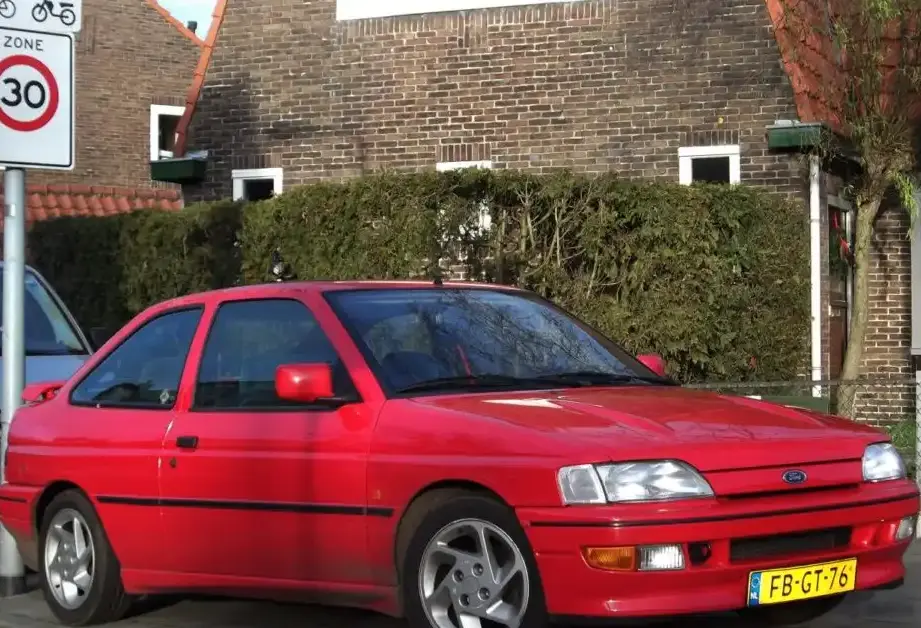
Technical Specifications
| Brand | Ford |
| Model | Escort |
| Generation | Escort V (GAL) |
| Type (Engine) | 1.3 (60 Hp) |
| Start of production | 1990 |
| End of production | 1992 |
| Powertrain Architecture | Internal Combustion engine |
| Body type | Hatchback |
| Fuel Type | Petrol (Gasoline) |
| Power | 60 Hp |
| Engine Model/Code | J4B, J6A |
| Engine aspiration | Naturally aspirated engine |
| Engine oil capacity | 3.25 l / 3.43 US qt / 2.86 UK qt |
| Coolant capacity | 7.1 l / 7.5 US qt / 6.25 UK qt |
The Ford Escort V (GAL) 1.3, produced between 1990 and 1992, represented the entry point into the fifth generation of Ford’s globally successful Escort line. This variant, powered by a modest 1.3-liter engine producing 60 horsepower, was primarily aimed at budget-conscious buyers and those seeking economical transportation. Within the GAL platform, which spanned from 1990 to 1993, the 1.3L model served as the base trim, offering a more affordable alternative to the higher-specification 1.6 and 1.8-liter versions. It was a significant model for Ford Europe, continuing the Escort’s tradition as a practical and reliable family car, though its presence in the North American market was limited.
Powertrain & Engine Architecture
The heart of the Escort V 1.3 was the Ford J4B or J6A engine, a 1297cc (79.1 cubic inches) inline-four cylinder petrol engine. This engine was a continuation of the OHV (Overhead Valve) design, a relatively simple and robust configuration. The J4B and J6A codes denote slight variations in specification, often relating to emissions control equipment and carburetor adjustments depending on the target market. The engine featured a single overhead camshaft operating two valves per cylinder. Fuel delivery was managed by a single-barrel carburetor, a common feature for entry-level models of this era, prioritizing simplicity and cost-effectiveness over performance and efficiency. The engine’s relatively low compression ratio (typically around 8.8:1) contributed to its ability to run on lower octane fuel, further reducing running costs. While a five-speed manual transmission was the most common pairing, a three-speed automatic transmission was also available, though it significantly impacted performance. The automatic transmission was a Ford-sourced unit, designed for smooth, if not particularly rapid, gear changes.
Driving Characteristics
The Escort V 1.3, particularly in automatic guise, was not known for its blistering performance. With only 60 horsepower on tap, acceleration was leisurely, and overtaking required careful planning. The 0-60 mph time was estimated to be around 14-16 seconds, depending on the transmission and vehicle load. The automatic transmission, while offering convenience, further diminished acceleration due to its wider gear ratios and inherent power loss. However, the engine proved to be reasonably torquey at lower RPMs, making it suitable for urban driving and everyday commuting. The steering was light and responsive, making the car easy to maneuver in tight spaces. The suspension, while basic, provided a comfortable ride, absorbing bumps and imperfections in the road surface reasonably well. Compared to the 1.6 and 1.8-liter Escorts, the 1.3 felt noticeably slower, especially when fully loaded with passengers and luggage. The manual transmission version offered a more engaging driving experience and slightly improved performance, but still prioritized fuel economy over outright speed.
Equipment & Trim Levels
The Escort V 1.3 typically came with a fairly basic level of equipment, reflecting its position as the entry-level model. Standard features generally included cloth upholstery, a basic instrument cluster, and manual windows and door locks. Central locking and electric windows were usually optional extras. The interior trim was typically functional and durable, prioritizing practicality over luxury. The dashboard layout was straightforward and easy to use, with clearly labeled controls. Optional extras included a radio/cassette player, upgraded seat fabrics, and a sunroof. The trim level was often denoted by a simple badge on the rear of the car, with the base model typically lacking any specific designation. Higher trim levels, available with the larger engines, offered features such as alloy wheels, upgraded interior trim, and more sophisticated audio systems.
Chassis & Braking
The Escort V 1.3 utilized a MacPherson strut front suspension and a twist-beam rear suspension. This setup provided a good balance between ride comfort and handling. The front brakes were typically disc brakes, while the rear brakes were drum brakes, a cost-saving measure common on base models. The steering was rack and pinion, providing precise and responsive steering feel. The chassis was relatively lightweight, contributing to the car’s fuel efficiency. Stabilizer bars were often omitted on the base model to further reduce costs, resulting in slightly more body roll during cornering. The braking system was adequate for everyday use, but lacked the stopping power of the larger-engined Escorts equipped with disc brakes all around.
Market Reception & Comparison
The Escort V 1.3 was generally well-received as an affordable and reliable family car. Critics praised its fuel economy and ease of driving, but noted its lack of performance. Compared to the 1.6 and 1.8-liter versions, the 1.3 offered significantly lower running costs but at the expense of driving enjoyment. The 1.6-liter model, with its increased power and torque, was often considered a more sensible choice for those who frequently drove on motorways or carried passengers and luggage. The 1.8-liter models, including the sporty XR3i, offered even more performance but came at a higher price point. In terms of reliability, the 1.3-liter engine proved to be exceptionally durable, with many examples exceeding high mileage with minimal maintenance. Fuel economy was a key selling point, with the 1.3 typically achieving around 35-40 mpg in mixed driving conditions.
Legacy
The Ford Escort V 1.3, while not the most exciting variant in the lineup, remains a popular choice among classic car enthusiasts and those seeking a simple, reliable, and affordable vehicle. The 1.3-liter engine is known for its longevity and ease of maintenance, making it a relatively inexpensive car to keep on the road. Parts availability is generally good, although some trim-specific components may be difficult to find. Today, these Escorts are often sought after as project cars or as affordable transportation for younger drivers. The automatic transmission versions, while less desirable to driving enthusiasts, offer a convenient and comfortable driving experience. The Escort V 1.3 represents a significant chapter in Ford’s history, embodying the brand’s commitment to providing practical and affordable transportation to the masses.