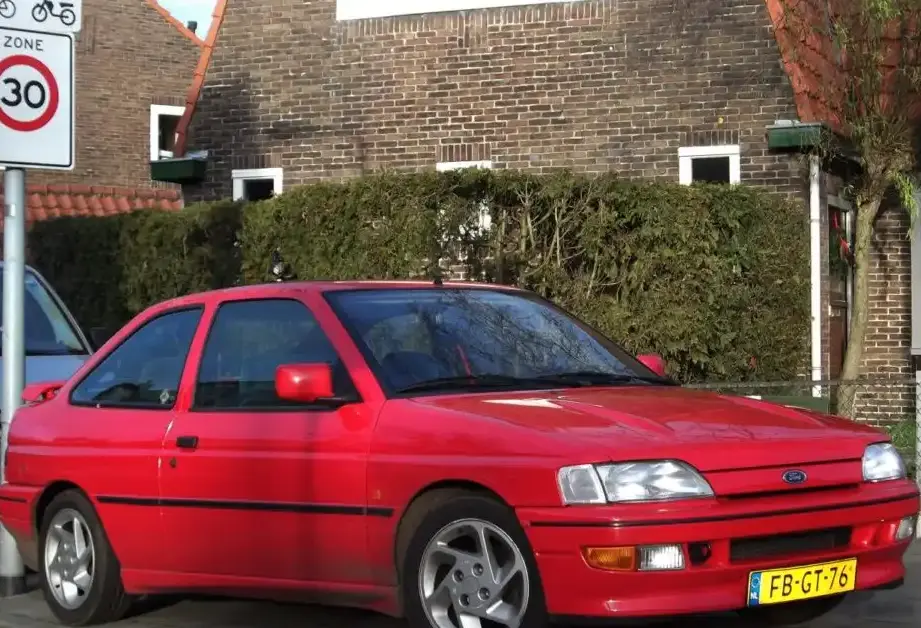
The Ford Escort RS 2000, produced between 1991 and 1992, represented the performance pinnacle of the fifth-generation Escort (GAL). Positioned as the flagship model within the range, it built upon the success of previous RS models, offering a more potent driving experience than the base trims. This variant was primarily marketed in Europe, where the Escort was a dominant force in the compact family car segment. The RS 2000 aimed to deliver a blend of practicality, affordability, and engaging performance, appealing to enthusiasts seeking a sporty hatchback.
Technical Specifications
| Brand | Ford |
| Model | Escort |
| Generation | Escort V (GAL) |
| Type | RS 2000 (150 Hp) |
| Start of production | 1991 |
| End of production | 1992 |
| Powertrain Architecture | Internal Combustion engine |
| Body type | Hatchback |
| Seats | 4 |
| Doors | 3 |
| Fuel consumption (combined) | 8.5 l/100 km |
| Fuel consumption (US mpg) | 27.7 US mpg |
| Fuel consumption (UK mpg) | 33.2 UK mpg |
| Fuel consumption (km/l) | 11.8 km/l |
| Fuel Type | Petrol (Gasoline) |
| Acceleration 0 – 100 km/h | 8.6 sec |
| Acceleration 0 – 62 mph | 8.6 sec |
| Acceleration 0 – 60 mph | 8.2 sec |
| Maximum speed | 208 km/h (129.25 mph) |
| Weight-to-power ratio | 7.5 kg/Hp |
| Weight-to-torque ratio | 5.8 kg/Nm |
| Power | 147 Hp @ 6000 rpm |
| Power per litre | 73.6 Hp/l |
| Torque | 190 Nm @ 4500 rpm (140.14 lb.-ft. @ 4500 rpm) |
| Engine layout | Front, Longitudinal |
| Engine Model/Code | N7A |
| Engine displacement | 1998 cm3 (121.93 cu. in.) |
| Number of cylinders | 4 |
| Engine configuration | Inline |
| Cylinder Bore | 86 mm (3.39 in.) |
| Piston Stroke | 86 mm (3.39 in.) |
| Compression ratio | 10.3:1 |
| Number of valves per cylinder | 4 |
| Fuel injection system | Multi-port manifold injection |
| Engine aspiration | Naturally aspirated engine |
| Valvetrain | OHC |
| Engine oil capacity | 4.5 l (4.76 US qt | 3.96 UK qt) |
| Coolant capacity | 8 l (8.45 US qt | 7.04 UK qt) |
| Kerb Weight | 1096 kg (2416.27 lbs.) |
| Fuel tank capacity | 55 l (14.53 US gal | 12.1 UK gal) |
| Length | 4040 mm (159.06 in.) |
| Width | 1690 mm (66.54 in.) |
| Height | 1340 mm (52.76 in.) |
| Wheelbase | 2520 mm (99.21 in.) |
| Minimum turning circle | 10 m (32.81 ft.) |
| Drivetrain Architecture | Front wheel drive |
| Number of gears | 5 |
| Gearbox type | Manual transmission |
| Front brakes | Ventilated discs |
| Rear brakes | Disc |
| Assisting systems | ABS (Anti-lock braking system) |
| Steering type | Steering rack and pinion |
| Power steering | Hydraulic Steering |
| Tires size | 195/50 VR15 |
Powertrain & Engine Architecture
The heart of the Escort RS 2000 was the 1.998-liter (2.0L) inline-four cylinder engine, designated the N7A. This engine was a naturally aspirated unit featuring multi-port fuel injection and an overhead camshaft (OHC) valvetrain. The N7A engine produced 147 horsepower at 6000 rpm and 190 Nm (140 lb-ft) of torque at 4500 rpm. The engine’s longitudinal mounting allowed for a more balanced weight distribution, contributing to improved handling characteristics. The five-speed manual transmission was the only gearbox option available, providing precise gear changes and enhancing the driver’s connection to the engine. The engine’s design prioritized responsiveness and a broad torque curve, making it suitable for both spirited driving and everyday use.
Driving Characteristics
The RS 2000 offered a noticeably more engaging driving experience compared to the standard Escort models. The combination of the 150 hp engine and the five-speed manual transmission resulted in a 0-60 mph time of approximately 8.2 seconds and a top speed of 129 mph. While not exceptionally quick by modern standards, the RS 2000 felt lively and agile on the road. The gear ratios were well-matched to the engine’s power delivery, providing strong acceleration in each gear. The front-wheel-drive layout, coupled with the relatively lightweight chassis, contributed to good cornering ability. Compared to the lower-powered 1.6L and 1.8L Escort variants, the RS 2000 offered a significant performance upgrade, making it a popular choice for drivers who enjoyed a more dynamic driving experience.
Equipment & Trim Levels
The RS 2000 came reasonably well-equipped for its time. Standard features included power steering, ABS anti-lock brakes, and a sporty interior with supportive bucket seats. The dashboard featured a distinctive instrument cluster with additional gauges, including a voltmeter and oil temperature gauge. Interior trim typically consisted of a combination of cloth and textured materials. Optional extras included a sunroof, central locking, and upgraded audio systems. The exterior styling was also enhanced with a body-colored front spoiler, side skirts, and a rear spoiler, giving the RS 2000 a more aggressive and purposeful appearance.
Chassis & Braking
The Escort RS 2000 utilized a MacPherson strut front suspension and a semi-independent twist beam rear suspension. The suspension was tuned to provide a balance between comfort and handling, offering a firm but not overly harsh ride. The front brakes were ventilated discs, providing ample stopping power, while the rear brakes were solid discs. The ABS system further enhanced braking performance and stability, particularly in adverse conditions. The chassis was reinforced compared to the standard Escort models to handle the increased power and stresses of performance driving. A stabilizer bar was fitted to both the front and rear axles to reduce body roll during cornering.
Market Reception & Comparison
The Escort RS 2000 was generally well-received by automotive critics. It was praised for its engaging driving dynamics, responsive engine, and sporty styling. However, some critics noted that the interior was somewhat basic compared to some of its rivals. Compared to other hot hatches of the era, such as the Volkswagen Golf GTI and the Peugeot 205 GTI, the RS 2000 offered a competitive level of performance and handling at a relatively affordable price point. Fuel economy was reasonable for a performance car of its time, averaging around 27.7 mpg. Reliability was generally good, although regular maintenance was essential to ensure optimal performance.
Legacy
The Ford Escort RS 2000 remains a popular classic car among enthusiasts. The N7A engine is known for its durability and relatively straightforward maintenance requirements. However, as with any older vehicle, regular servicing and attention to potential wear and tear are crucial. Today, well-maintained examples of the RS 2000 are sought after by collectors and enthusiasts, commanding increasingly high prices. The RS 2000 represents a significant chapter in the Escort’s history, embodying the spirit of affordable performance and driving enjoyment that characterized the model for many years. Its legacy continues to inspire Ford’s performance models to this day.