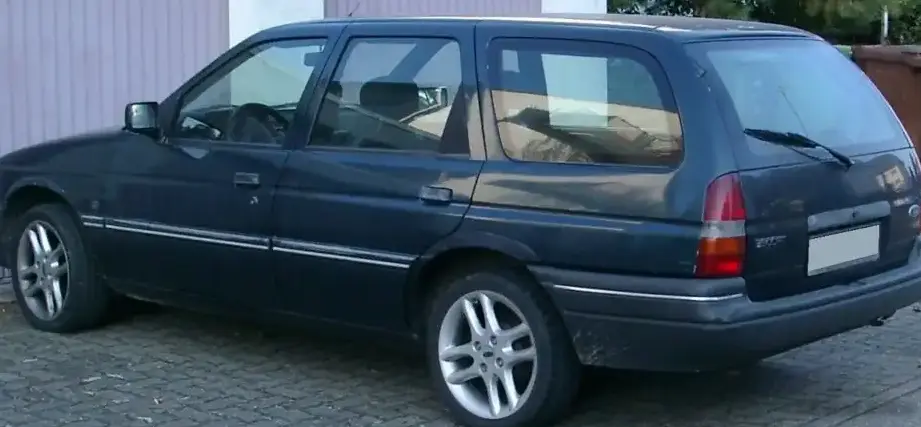
The Ford Escort V Turnier 1.6, produced between 1990 and 1992, represented a practical and affordable option within the fifth generation of the globally successful Escort line. The “Turnier” designation signified the estate (station wagon) body style, offering increased cargo capacity compared to the saloon and hatchback variants. This particular 1.6-liter, 90 horsepower version (typically 88 hp as measured) occupied a mid-range position in the Escort V Turnier lineup, slotting below the more powerful 1.8 and 1.6i models, and above the base 1.3L engine. It was primarily aimed at families and individuals needing a versatile vehicle for everyday use, prioritizing fuel economy and practicality over outright performance.
Technical Specifications
| Brand | Ford |
| Model | Escort |
| Generation | Escort V Turnier (GAL, AVL) |
| Type (Engine) | 1.6 (90 Hp) |
| Start of Production | 1990 |
| End of Production | 1992 |
| Powertrain Architecture | Internal Combustion Engine |
| Body Type | Station Wagon (Estate) |
| Doors | 5 |
| Fuel Type | Petrol (Gasoline) |
| Power | 88 Hp |
| Engine Model/Code | LUJ, LUK |
| Engine Aspiration | Naturally Aspirated |
| Engine Oil Capacity | 3.5 l (3.7 US qt | 3.08 UK qt) |
| Coolant Capacity | 7.9 l (8.35 US qt | 6.95 UK qt) |
| Fuel Tank Capacity | 55 l (14.53 US gal | 12.1 UK gal) |
Powertrain & Engine Architecture
The Escort V Turnier 1.6 utilized Ford’s 1597cc (approximately 97.4 cubic inches) four-cylinder engine, designated with engine codes LUJ or LUK depending on minor variations and market specifications. This engine belonged to the Ford Sigma family, known for its relatively simple and robust design. It featured a cast iron block and an aluminum cylinder head, employing a single overhead camshaft (SOHC) operating two valves per cylinder. Fuel delivery was managed by a Bosch fuel injection system, a significant upgrade from the carburetors used in earlier Escort models. This injection system contributed to improved fuel efficiency and reduced emissions. The engine’s modest power output of 88 horsepower at approximately 5,500 rpm and 138 Nm (102 lb-ft) of torque at 3,500 rpm was delivered to the front wheels through a four-speed automatic transmission. This automatic transmission, while offering convenience, was not known for its particularly quick shifts or sporty feel. It was a fairly conventional hydraulic automatic, prioritizing smooth operation and reliability over performance.
Driving Characteristics
The driving experience in the Escort V Turnier 1.6 Automatic was characterized by its practicality and ease of use. Acceleration was adequate for everyday driving, but not particularly brisk. The 0-60 mph time was estimated to be around 12-13 seconds, making it slower than the manual transmission versions or those equipped with the larger 1.8-liter engine. The automatic transmission’s gear ratios were geared towards fuel economy, resulting in a somewhat leisurely pace. The engine felt relatively strained when attempting to accelerate quickly, and overtaking maneuvers required careful planning. However, for cruising on the highway or navigating city streets, the powertrain provided sufficient power. The steering was light and easy, making the car maneuverable, although lacking in significant feedback. The suspension, tuned for comfort, absorbed bumps reasonably well, but the car could exhibit noticeable body roll during cornering.
Equipment & Trim Levels
The 1.6-liter Escort V Turnier typically came with a reasonable level of standard equipment, though it was less lavishly appointed than the higher-spec models. Standard features generally included central locking, power steering, and a basic stereo system. Interior upholstery was typically cloth, with a durable and practical design. The dashboard layout was functional, with clearly labeled controls. Optional extras available for this trim level included electric front windows, a sunroof, and upgraded stereo systems. Higher trim levels, such as the Ghia, offered more luxurious appointments, including upgraded upholstery, alloy wheels, and additional comfort features. The base trim levels were even more spartan, focusing on affordability.
Chassis & Braking
The Escort V Turnier utilized a MacPherson strut front suspension and a semi-independent twist beam rear suspension. This setup provided a good balance between ride comfort and handling. The front brakes were typically disc brakes, while the rear brakes were often drum brakes, particularly on the lower trim levels. This configuration was common for vehicles in this price range during the early 1990s. Stabilizer bars were fitted to both the front and rear axles to reduce body roll. The steering was a rack and pinion system, providing precise and responsive steering feel. The overall chassis design was relatively lightweight, contributing to the car’s fuel efficiency.
Market Reception & Comparison
The Escort V Turnier 1.6 Automatic was generally well-received by critics as a practical and affordable family car. It was praised for its spacious interior, fuel efficiency, and ease of driving. However, it was also criticized for its lack of performance and the somewhat dated feel of the automatic transmission. Compared to the manual transmission versions, the automatic offered less engaging driving experience and slightly lower fuel economy. The 1.8-liter models provided significantly more power and performance, but at a higher price point. Against competitors such as the Vauxhall/Opel Astra Estate and Volkswagen Golf Estate, the Escort V Turnier offered a competitive package in terms of price, space, and reliability.
Legacy
The Ford Escort V Turnier 1.6 Automatic, while not a performance icon, proved to be a reliable and durable vehicle. The Sigma engine, in its various iterations, was known for its longevity and relatively low maintenance costs. Today, these vehicles are relatively rare, and well-maintained examples are sought after by classic car enthusiasts and those looking for a practical and affordable vintage vehicle. The automatic transmission, while not the most sophisticated, has proven to be reasonably durable over time. Common issues with these vehicles include rust, particularly in areas prone to moisture, and wear and tear on suspension components. However, spare parts are generally readily available, making it relatively easy to keep these cars on the road. The Escort V Turnier 1.6 Automatic remains a testament to Ford’s commitment to building practical and affordable vehicles for the masses.