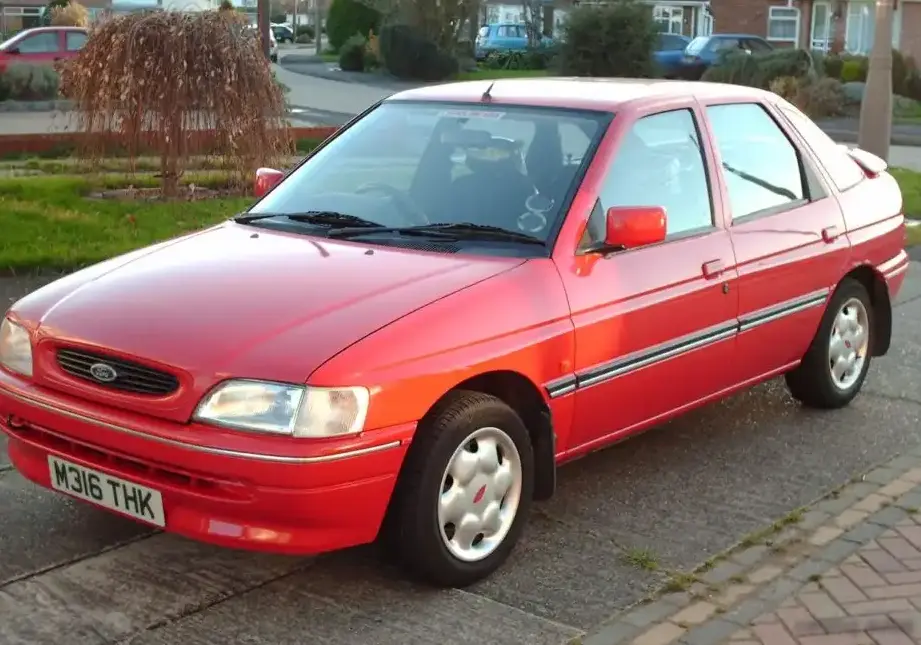
The Ford Escort VI Hatch (GAL) 2.0 i 16V RS 2000 4×4, produced between 1992 and 1995, represented the pinnacle of performance for the sixth-generation Escort. Positioned as the flagship model within the GAL series, it combined a potent 2.0-liter 16-valve engine with a sophisticated all-wheel-drive system. This variant aimed to deliver a sporty and engaging driving experience, appealing to enthusiasts seeking a practical yet capable hatchback. It was a key offering in the European market, where the Escort was a consistently popular choice in the compact segment.
Technical Specifications
| Brand | Ford |
| Model | Escort |
| Generation | Escort VI Hatch (GAL) |
| Type | 2.0 i 16V RS 2000 4×4 (150 Hp) |
| Start of production | 1992 |
| End of production | 1995 |
| Powertrain Architecture | Internal Combustion engine |
| Body type | Hatchback |
| Seats | 5 |
| Doors | 3 |
| Fuel consumption (combined) | 8.8 l/100 km (26.7 US mpg, 32.1 UK mpg, 11.4 km/l) |
| Fuel Type | Petrol (Gasoline) |
| Acceleration 0 – 100 km/h | 9.1 sec |
| Acceleration 0 – 62 mph | 9.1 sec |
| Acceleration 0 – 60 mph | 8.6 sec |
| Maximum speed | 208 km/h (129.25 mph) |
| Weight-to-power ratio | 8.3 kg/Hp, 121 Hp/tonne |
| Weight-to-torque ratio | 6.5 kg/Nm, 153.2 Nm/tonne |
| Power | 150 Hp @ 6000 rpm |
| Power per litre | 75.1 Hp/l |
| Torque | 190 Nm @ 4500 rpm (140.14 lb.-ft. @ 4500 rpm) |
| Engine layout | Front, Transverse |
| Engine Model/Code | N7A |
| Engine displacement | 1998 cm3 (121.93 cu. in.) |
| Number of cylinders | 4 |
| Engine configuration | Inline |
| Cylinder Bore | 86 mm (3.39 in.) |
| Piston Stroke | 86 mm (3.39 in.) |
| Compression ratio | 10.3:1 |
| Number of valves per cylinder | 4 |
| Fuel injection system | Multi-port manifold injection |
| Engine aspiration | Naturally aspirated engine |
| Valvetrain | DOHC |
| Engine oil capacity | 4.5 l (4.76 US qt | 3.96 UK qt) |
| Coolant capacity | 7.5 l (7.93 US qt | 6.6 UK qt) |
| Kerb Weight | 1240 kg (2733.73 lbs.) |
| Max. weight | 1700 kg (3747.86 lbs.) |
| Max load | 460 kg (1014.13 lbs.) |
| Trunk (boot) space – minimum | 380 l (13.42 cu. ft.) |
| Trunk (boot) space – maximum | 735 l (25.96 cu. ft.) |
| Fuel tank capacity | 55 l (14.53 US gal | 12.1 UK gal) |
| Length | 4108 mm (161.73 in.) |
| Width | 1696 mm (66.77 in.) |
| Height | 1391 mm (54.76 in.) |
| Wheelbase | 2525 mm (99.41 in.) |
| Front track | 1443 mm (56.81 in.) |
| Rear track | 1453 mm (57.2 in.) |
| Drive wheel | All wheel drive (4×4) |
| Number of gears and type of gearbox | 5 gears, manual transmission |
| Front suspension | Wishbone |
| Rear suspension | Coil spring |
| Front brakes | Ventilated discs |
| Rear brakes | Disc |
| Assisting systems | ABS (Anti-lock braking system) |
| Steering type | Steering rack and pinion |
| Power steering | Hydraulic Steering |
| Tires size | 195/50 R15 V |
Powertrain & Engine Architecture
The heart of the RS 2000 4×4 was the Ford N7A engine, a 1998cc inline-four cylinder powerplant. This engine featured a 16-valve dual overhead camshaft (DOHC) configuration, enhancing its breathing and contributing to its higher output. It utilized multi-port fuel injection, a common technology for the era, ensuring precise fuel delivery for optimal combustion. The engine’s 10.3:1 compression ratio further aided in maximizing power and efficiency. The 4×4 system employed a viscous coupling to distribute torque between the front and rear axles, providing enhanced traction without the complexity of a fully electronic system. The transmission was a robust five-speed manual, chosen for its durability and driver engagement. This powertrain was a significant step up from the base Escort models, which typically featured smaller displacement engines and front-wheel drive.
Driving Characteristics
The RS 2000 4×4 offered a noticeably more dynamic driving experience than its front-wheel-drive counterparts. The all-wheel-drive system provided excellent grip, particularly on slippery surfaces, and reduced understeer during cornering. While 150 horsepower might not seem substantial by modern standards, it was ample for a vehicle of this weight class in the early 1990s. Acceleration to 60 mph took approximately 8.6 seconds, and it could achieve a top speed of 129.25 mph. The five-speed manual transmission allowed drivers to keep the engine in its optimal power band, delivering responsive acceleration. Compared to the lower-powered Escort variants, the RS 2000 4×4 felt significantly more capable and engaging, though it wasn’t as overtly sporty as some of its rear-wheel-drive rivals.
Equipment & Trim Levels
The RS 2000 4×4 was generally well-equipped for its time. Standard features typically included power steering, ABS anti-lock brakes, and a relatively comfortable interior. Upholstery was usually a sporty cloth material, and the dashboard featured a comprehensive instrument cluster. Optional extras could include a sunroof, alloy wheels (often 15-inch), and upgraded audio systems. The interior design, while functional, was typical of Ford’s offerings in the early 1990s – durable and practical rather than luxurious. The focus was on providing a driver-oriented environment.
Chassis & Braking
The Escort VI’s chassis was a relatively simple but effective design. The RS 2000 4×4 featured a wishbone front suspension and a coil spring rear suspension. The braking system consisted of ventilated discs on the front wheels and solid discs on the rear, providing adequate stopping power for the vehicle’s performance capabilities. The all-wheel-drive system added weight, but the suspension was tuned to handle the increased load and maintain a reasonable level of ride comfort. Stabilizer bars were fitted to both the front and rear axles to reduce body roll during cornering.
Market Reception & Comparison
The RS 2000 4×4 was generally well-received by automotive critics. It was praised for its handling, grip, and overall performance. However, some reviewers noted that the engine, while capable, wasn’t as refined or powerful as some of its competitors. Compared to the standard Escort models, the RS 2000 4×4 represented a significant upgrade in terms of performance and handling. It offered a compelling alternative to other hot hatches of the era, such as the Volkswagen Golf GTI and the Peugeot 205 GTI. Fuel economy was reasonable for a performance-oriented vehicle, averaging around 26.7 US mpg. Reliability was generally good, although the all-wheel-drive system did require more maintenance than a front-wheel-drive setup.
Legacy
The Ford Escort VI RS 2000 4×4 has become a sought-after classic among Ford enthusiasts. The N7A engine, while not known for being exceptionally durable, is generally reliable if properly maintained. The all-wheel-drive system, however, can be prone to issues if not serviced regularly. Today, well-maintained examples command a premium in the used car market. The RS 2000 4×4 represents a high point in the Escort’s history, offering a blend of performance, practicality, and affordability that continues to appeal to enthusiasts today. It remains a testament to Ford’s ability to create engaging and capable vehicles for the everyday driver.