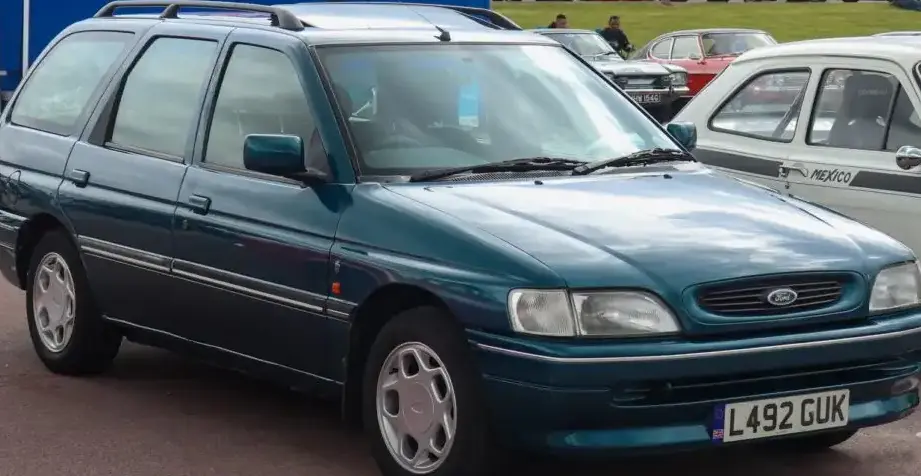
The Ford Escort VI Turnier 1.8 D, produced between 1992 and 1995, represented a practical and economical offering within the broader Escort Mark VI (GAL) range. Positioned as a base-level diesel variant of the Turnier (estate) body style, it catered to buyers prioritizing fuel efficiency and load-carrying capacity over outright performance. This model played a significant role in the European market, where diesel engines were increasingly popular for their economy, particularly for fleet and family use. The Escort VI generation, launched in 1990, was a substantial update over its predecessor, offering improved aerodynamics, safety features, and a more refined driving experience. The 1.8 D Turnier specifically targeted buyers needing a versatile vehicle for both daily commuting and occasional hauling.
Technical Specifications
| Brand | Ford |
| Model | Escort |
| Generation | Escort VI Turnier (GAL) |
| Type (Engine) | 1.8 D (60 Hp) |
| Start of production | 1992 |
| End of production | 1995 |
| Powertrain Architecture | Internal Combustion engine |
| Body type | Station wagon (estate) |
| Seats | 5 |
| Doors | 5 |
| Fuel consumption (combined) | 5.8 l/100 km (40.6 US mpg, 48.7 UK mpg, 17.2 km/l) |
| Fuel Type | Diesel |
| Acceleration 0 – 100 km/h | 18.6 sec |
| Acceleration 0 – 62 mph | 18.6 sec |
| Acceleration 0 – 60 mph | 17.7 sec |
| Maximum speed | 150 km/h (93.21 mph) |
| Weight-to-power ratio | 19.2 kg/Hp, 52.2 Hp/tonne |
| Weight-to-torque ratio | 10.5 kg/Nm, 95.7 Nm/tonne |
| Power | 60 Hp @ 4800 rpm |
| Power per litre | 34.2 Hp/l |
| Torque | 110 Nm @ 2500 rpm (81.13 lb.-ft. @ 2500 rpm) |
| Engine layout | Front, Transverse |
| Engine Model/Code | RTE, RTF, RTH |
| Engine displacement | 1753 cm3 (106.97 cu. in.) |
| Number of cylinders | 4 |
| Engine configuration | Inline |
| Cylinder Bore | 82.5 mm (3.25 in.) |
| Piston Stroke | 82 mm (3.23 in.) |
| Compression ratio | 21.5:1 |
| Number of valves per cylinder | 2 |
| Fuel injection system | Precombustion chamber injection |
| Engine aspiration | Naturally aspirated engine |
| Valvetrain | OHC |
| Engine oil capacity | 5 l (5.28 US qt | 4.4 UK qt) |
| Coolant | 9.3 l (9.83 US qt | 8.18 UK qt) |
| Kerb Weight | 1150 kg (2535.32 lbs.) |
| Max. weight | 1650 kg (3637.63 lbs.) |
| Max load | 500 kg (1102.31 lbs.) |
| Trunk (boot) space – minimum | 460 l (16.24 cu. ft.) |
| Trunk (boot) space – maximum | 860 l (30.37 cu. ft.) |
| Fuel tank capacity | 55 l (14.53 US gal | 12.1 UK gal) |
| Length | 4268 mm (168.03 in.) |
| Width | 1690 mm (66.54 in.) |
| Height | 1410 mm (55.51 in.) |
| Wheelbase | 2525 mm (99.41 in.) |
| Front track | 1440 mm (56.69 in.) |
| Rear (Back) track | 1462 mm (57.56 in.) |
| Drivetrain Architecture | The Internal combustion engine (ICE) drives the front wheels of the vehicle. |
| Drive wheel | Front wheel drive |
| Number of gears and type of gearbox | 5 gears, manual transmission |
| Front suspension | Wishbone |
| Rear suspension | Coil spring |
| Front brakes | Ventilated discs |
| Rear brakes | Drum |
| Assisting systems | ABS (Anti-lock braking system) |
| Steering type | Steering rack and pinion |
| Power steering | Hydraulic Steering |
| Tires size | 175/70 R13 |
Powertrain & Engine Architecture
The Escort VI Turnier 1.8 D was powered by Ford’s 1.8-liter, four-cylinder diesel engine, typically identified by the engine codes RTE, RTF, or RTH. This engine was a naturally aspirated, inline configuration utilizing precombustion chamber injection. This system, common in older diesel engines, involved injecting fuel into a pre-chamber where it partially combusted before being ignited in the main cylinder. This aided in cold starting and reduced engine noise. The engine featured a single overhead camshaft (OHC) operating two valves per cylinder. The 1.8 D produced 60 horsepower at 4800 rpm and 110 Nm (81.13 lb-ft) of torque at 2500 rpm. The engine’s relatively low compression ratio of 21.5:1 was typical for diesel engines of the era. The manual transmission offered was a five-speed unit, chosen for its efficiency and suitability for the engine’s torque characteristics.
Driving Characteristics
The 1.8 D variant of the Escort Turnier was not designed for spirited driving. Its focus was firmly on economy and practicality. Acceleration was slow, with a 0-60 mph time of around 17.7 seconds and a top speed of 93.21 mph. The five-speed manual transmission helped to keep the engine within its optimal torque band, but the limited horsepower meant that overtaking required careful planning. Compared to the gasoline-powered Escort variants, such as the 1.6 or 1.8, the 1.8 D offered significantly less power but substantially better fuel economy. The gear ratios were optimized for maximizing fuel efficiency rather than performance, resulting in a somewhat lethargic feel, especially when fully loaded.
Equipment & Trim Levels
The 1.8 D Turnier typically represented a base trim level within the Escort range. Standard equipment generally included basic cloth upholstery, a simple dashboard layout, and manual windows and door locks. Power steering was often included, but air conditioning and central locking were usually optional extras. The Turnier’s primary appeal lay in its spacious interior and large cargo area, making it a practical choice for families and those needing to transport goods. Optional extras could include a sunroof, upgraded stereo systems, and different wheel trims.
Chassis & Braking
The Escort VI Turnier 1.8 D utilized a front-wheel-drive layout with a wishbone front suspension and a coil spring rear suspension. The front brakes were ventilated discs, providing adequate stopping power for the vehicle’s weight and performance. However, the rear brakes were typically drum brakes, which were less effective than disc brakes. An anti-lock braking system (ABS) was often included as standard or an optional extra, enhancing safety. The chassis was designed to provide a comfortable ride, prioritizing practicality over sporty handling. Stabilizer bars were present, but were relatively modest in size, reflecting the vehicle’s intended use.
Market Reception & Comparison
The Escort VI Turnier 1.8 D was generally well-received as a practical and economical estate car. Critics praised its fuel efficiency and spacious interior, but noted its lack of performance. Compared to other diesel estate cars of the time, such as the Vauxhall/Opel Astra Estate CD, the Escort offered a competitive level of equipment and a reasonable price. The 1.8 D was often seen as a more sensible alternative to the higher-powered gasoline variants, particularly for those covering long distances or frequently carrying heavy loads. Its fuel economy of around 40.6 US mpg was a significant selling point.
Legacy
The Ford Escort VI Turnier 1.8 D, while not a performance icon, has proven to be a relatively reliable and durable vehicle. The 1.8-liter diesel engine, though simple in design, is known for its longevity when properly maintained. Today, these vehicles are relatively rare, but those that remain are often sought after by enthusiasts looking for a classic, economical estate car. Common issues include wear and tear on suspension components and potential problems with the precombustion chamber injection system. However, parts availability is generally good, and the vehicle’s simple mechanical design makes it relatively easy to repair. The Escort VI Turnier 1.8 D represents a practical and honest offering from Ford, embodying the values of economy and versatility that were highly valued in the early 1990s.