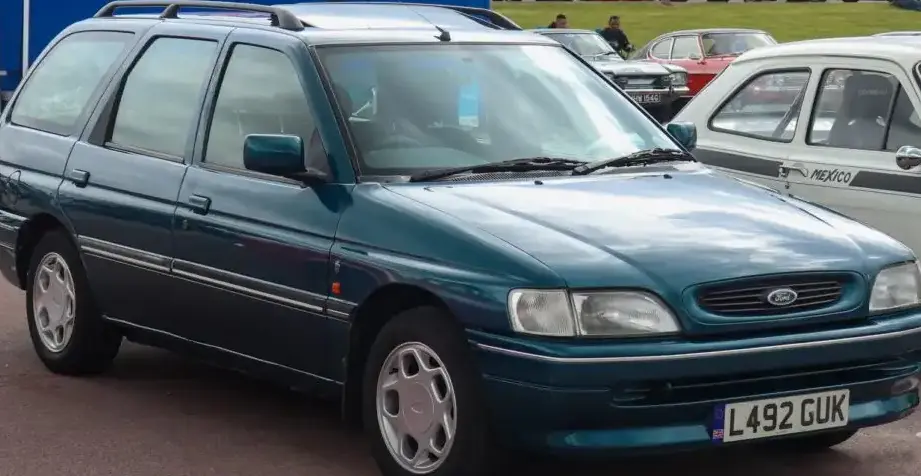
The Ford Escort VI Turnier 1.8 TD, produced between 1993 and 1995, was a station wagon variant within the sixth generation of the popular Ford Escort. Positioned as an economical and practical option, this model combined a turbocharged diesel engine with an automatic transmission, catering to buyers seeking fuel efficiency and ease of driving. It was part of the GAL series, representing the Turnier (estate) body style. This variant occupied a middle ground in the Escort VI lineup, offering a compromise between the base models and the more powerful, gasoline-fueled options.
Technical Specifications
| Brand | Ford |
| Model | Escort |
| Generation | Escort VI Turnier (GAL) |
| Type (Engine) | 1.8 TD (90 Hp) |
| Start of production | 1993 |
| End of production | 1995 |
| Powertrain Architecture | Internal Combustion engine |
| Body type | Station wagon (estate) |
| Seats | 5 |
| Doors | 5 |
| Fuel consumption (combined) | 6.4 l/100 km (36.8 US mpg, 44.1 UK mpg, 15.6 km/l) |
| Fuel Type | Diesel |
| Acceleration 0 – 100 km/h | 11.9 sec |
| Acceleration 0 – 62 mph | 11.9 sec |
| Acceleration 0 – 60 mph | 11.3 sec |
| Maximum speed | 172 km/h (106.88 mph) |
| Weight-to-power ratio | 13.2 kg/Hp, 75.9 Hp/tonne |
| Weight-to-torque ratio | 6.6 kg/Nm, 151.9 Nm/tonne |
| Power | 90 Hp @ 4500 rpm |
| Power per litre | 51.3 Hp/l |
| Torque | 180 Nm @ 2000 rpm (132.76 lb.-ft. @ 2000 rpm) |
| Engine layout | Front, Transverse |
| Engine Model/Code | RFD, RFK, RFS |
| Engine displacement | 1753 cm3 (106.97 cu. in.) |
| Number of cylinders | 4 |
| Engine configuration | Inline |
| Cylinder Bore | 82.5 mm (3.25 in.) |
| Piston Stroke | 82 mm (3.23 in.) |
| Compression ratio | 21.5:1 |
| Number of valves per cylinder | 2 |
| Fuel injection system | Precombustion chamber injection |
| Engine aspiration | Turbocharger |
| Valvetrain | OHC |
| Engine oil capacity | 5.1 l (5.39 US qt | 4.49 UK qt) |
| Coolant | 9.3 l (9.83 US qt | 8.18 UK qt) |
| Kerb Weight | 1185 kg (2612.48 lbs.) |
| Max. weight | 1675 kg (3692.74 lbs.) |
| Max load | 490 kg (1080.27 lbs.) |
| Trunk (boot) space – minimum | 460 l (16.24 cu. ft.) |
| Trunk (boot) space – maximum | 860 l (30.37 cu. ft.) |
| Fuel tank capacity | 55 l (14.53 US gal | 12.1 UK gal) |
| Length | 4268 mm (168.03 in.) |
| Width | 1690 mm (66.54 in.) |
| Height | 1410 mm (55.51 in.) |
| Wheelbase | 2525 mm (99.41 in.) |
| Front track | 1440 mm (56.69 in.) |
| Rear (Back) track | 1462 mm (57.56 in.) |
| Drivetrain Architecture | The Internal combustion engine (ICE) drives the front wheels of the vehicle. |
| Drive wheel | Front wheel drive |
| Number of gears and type of gearbox | 5 gears, manual transmission |
| Front suspension | Wishbone |
| Rear suspension | Coil spring |
| Front brakes | Ventilated discs |
| Rear brakes | Drum |
| Assisting systems | ABS (Anti-lock braking system) |
| Steering type | Steering rack and pinion |
| Power steering | Hydraulic Steering |
| Tires size | 175/70 R13 |
Introduction
The Ford Escort VI Turnier 1.8 TD, launched in 1993, represented a practical and fuel-conscious option within the sixth-generation Escort range. Built on the 1HX0/A3 platform, the Turnier (estate) body style offered increased cargo capacity compared to the hatchback and sedan versions. This particular variant, powered by a 1.8-liter turbocharged diesel engine and paired with an automatic transmission, aimed to provide comfortable and economical transportation for families and individuals alike. It was a key offering in European markets where diesel engines were increasingly popular due to their fuel efficiency and lower running costs.
Powertrain & Engine Architecture
The heart of the Escort VI Turnier 1.8 TD was the Ford RFD (and related RFK, RFS) engine, a 1753cc inline-four cylinder diesel. This engine utilized precombustion chamber injection, a system common in European diesels of the era. This system involved injecting fuel into a precombustion chamber connected to the main cylinder, promoting more complete combustion and reducing noise. The engine was turbocharged, boosting power output to 90 horsepower at 4500 rpm and 180 Nm (132.76 lb-ft) of torque at 2000 rpm. The automatic transmission was typically a four-speed unit, designed to provide smooth shifts and ease of driving. While not known for its blistering acceleration, the powertrain prioritized fuel economy and relaxed cruising.
Driving Characteristics
The 1.8 TD automatic Escort Turnier offered a distinctly different driving experience compared to its gasoline-powered or manual diesel siblings. The automatic transmission, while convenient, did detract from the overall responsiveness. Acceleration from 0-60 mph took around 11.3 seconds, and top speed was approximately 106.88 mph. The turbocharger provided a noticeable boost in power, but the engine lacked the high-revving character of the gasoline engines. Gear ratios were optimized for fuel efficiency rather than performance, resulting in a relaxed and comfortable ride. Compared to the 1.6L gasoline models, the 1.8 TD offered significantly more torque, making it better suited for carrying loads or towing. However, the manual transmission versions of the 1.8 TD provided a more engaging driving experience and slightly better fuel economy.
Equipment & Trim Levels
The Escort VI Turnier 1.8 TD typically came with a reasonable level of standard equipment. Interior features generally included cloth upholstery, a basic dashboard layout, and manual windows and door locks. Power steering was usually standard, enhancing ease of maneuverability. Optional extras included air conditioning, a radio/cassette player, and upgraded interior trim. Trim levels varied depending on the market, but generally, this variant sat in the mid-range of the Escort lineup, offering a balance between affordability and comfort. The Turnier estate body style itself added practicality with its large cargo area and folding rear seats.
Chassis & Braking
The Escort VI Turnier 1.8 TD utilized a relatively simple chassis design. Front suspension consisted of wishbones, while the rear employed a coil spring setup. Braking was typically accomplished with ventilated discs on the front wheels and drum brakes on the rear. ABS (Anti-lock Braking System) was often included as standard equipment, enhancing safety. The suspension was tuned for comfort, providing a reasonably smooth ride, although it wasn’t particularly sporty. Stabilizer bars were present, helping to reduce body roll during cornering. The chassis was designed to handle the added weight of the estate body style and the typical loads carried in the cargo area.
Market Reception & Comparison
The Escort VI Turnier 1.8 TD received generally positive reviews for its fuel efficiency and practicality. Critics praised its comfortable ride and spacious interior. However, the automatic transmission was sometimes criticized for its lack of responsiveness. Compared to the gasoline-powered Escorts, the 1.8 TD offered significantly better fuel economy, making it a popular choice for high-mileage drivers. Against other diesel-powered estates of the time, such as the Vauxhall/Opel Astra Estate CDTi, the Escort offered a competitive combination of performance, economy, and price. Reliability was generally good, although the precombustion chamber injection system could require occasional maintenance.
Legacy
The Ford Escort VI Turnier 1.8 TD has become a relatively affordable and practical classic car. The RFD engine, while not known for its outright power, is generally considered durable and reliable if properly maintained. The automatic transmission, however, can be a potential weak point, requiring careful servicing. Today, these Escorts are often sought after by enthusiasts looking for a fuel-efficient and practical classic estate car. Parts availability is generally good, although some specific components may be becoming increasingly difficult to find. The 1.8 TD automatic represents a unique blend of practicality, economy, and comfort within the broader Escort VI lineup, and remains a testament to Ford’s commitment to providing affordable transportation.