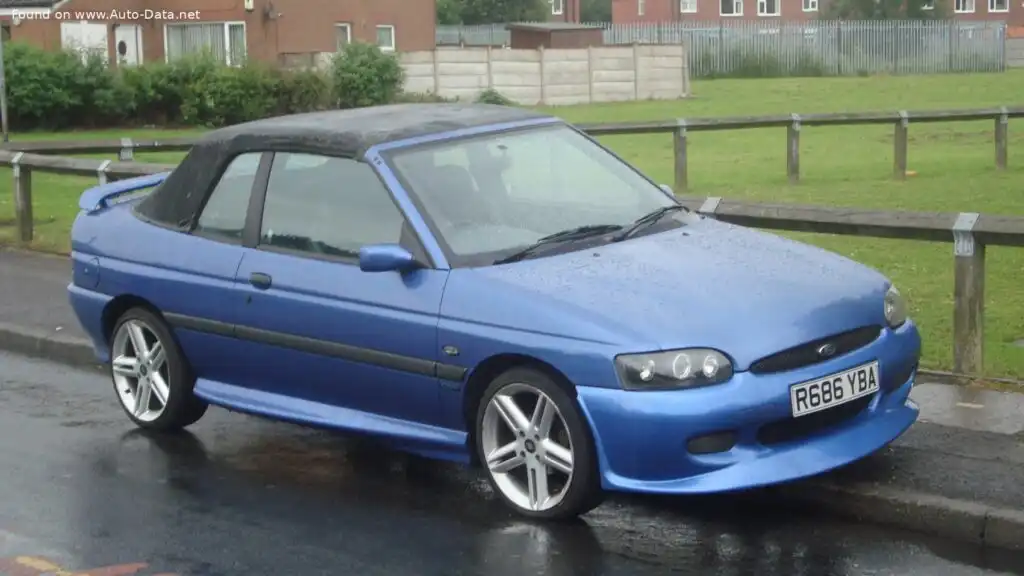
The Ford Escort VII Cabrio 1.6 i 16V (90 hp) was a popular open-top variant of the seventh-generation Ford Escort, produced between 1995 and 2000. Positioned as a more affordable and accessible entry into the convertible market, it offered a blend of style, practicality, and Ford’s established mechanical reliability. This model was primarily sold in Europe, where the demand for compact convertibles was strong. It represented a key offering in Ford’s lineup, providing a more emotional and lifestyle-oriented alternative to the standard Escort saloon and hatchback. The 1.6L engine, paired with a manual transmission, was a common configuration, offering a balance between fuel economy and acceptable performance for everyday driving.
Technical Specifications
| Brand | Ford |
| Model | Escort |
| Generation | Escort VII Cabrio |
| Type (Engine) | 1.6 i 16V (90 Hp) |
| Start of production | 1995 |
| End of production | 2000 |
| Powertrain Architecture | Internal Combustion engine |
| Body type | Cabriolet |
| Seats | 5 |
| Doors | 2 |
| Fuel consumption (combined) | 7.9 l/100 km |
| Fuel consumption (US mpg) | 29.8 US mpg |
| Fuel consumption (UK mpg) | 35.8 UK mpg |
| Fuel consumption (km/l) | 12.7 km/l |
| Fuel Type | Petrol (Gasoline) |
| Acceleration 0 – 100 km/h | 12.7 sec |
| Acceleration 0 – 62 mph | 12.7 sec |
| Acceleration 0 – 60 mph | 12.1 sec |
| Maximum speed | 173 km/h (107.5 mph) |
| Weight-to-power ratio | 12.9 kg/Hp |
| Weight-to-torque ratio | 8.7 kg/Nm |
| Power | 90 Hp @ 5500 rpm |
| Power per litre | 56.4 Hp/l |
| Torque | 134 Nm @ 3000 rpm (98.83 lb.-ft. @ 3000 rpm) |
| Engine layout | Front, Transverse |
| Engine Model/Code | L1E, L1K |
| Engine displacement | 1597 cm3 (97.45 cu. in.) |
| Number of cylinders | 4 |
| Engine configuration | Inline |
| Cylinder Bore | 76 mm (2.99 in.) |
| Piston Stroke | 88 mm (3.46 in.) |
| Compression ratio | 10.3:1 |
| Number of valves per cylinder | 4 |
| Fuel injection system | Multi-port manifold injection |
| Engine aspiration | Naturally aspirated engine |
| Valvetrain | DOHC |
| Engine oil capacity | 4.25 l (4.49 US qt | 3.74 UK qt) |
| Coolant capacity | 7 l (7.4 US qt | 6.16 UK qt) |
| Kerb Weight | 1165 kg (2568.39 lbs.) |
| Max. weight | 1660 kg (3659.67 lbs.) |
| Max load | 495 kg (1091.29 lbs.) |
| Trunk (boot) space – minimum | 322 l (11.37 cu. ft.) |
| Fuel tank capacity | 55 l (14.53 US gal | 12.1 UK gal) |
| Length | 4136 mm (162.83 in.) |
| Width | 1700 mm (66.93 in.) |
| Height | 1381 mm (54.37 in.) |
| Wheelbase | 2525 mm (99.41 in.) |
| Front track | 1440 mm (56.69 in.) |
| Rear track | 1454 mm (57.24 in.) |
| Drivetrain Architecture | Front wheel drive |
| Number of gears | 5 gears, manual transmission |
| Front suspension | Wishbone |
| Rear suspension | Coil spring |
| Front brakes | Ventilated discs |
| Rear brakes | Drum |
| Assisting systems | ABS (Anti-lock braking system) |
| Steering type | Steering rack and pinion |
| Power steering | Hydraulic Steering |
| Tires size | 175/65 R14 H |
Powertrain & Engine Architecture
The Escort VII Cabrio 1.6 i 16V utilized the Ford L1E or L1K engine, a 1.6-liter inline-four cylinder gasoline engine. This engine was a mainstay in the Escort range, known for its relative simplicity and durability. The ‘16V’ designation indicates a four-valve-per-cylinder configuration, enhancing breathing and contributing to improved power output compared to earlier two-valve designs. Fuel delivery was managed by a multi-port fuel injection system, providing precise fuel metering for optimal combustion. The engine featured a double overhead camshaft (DOHC) valvetrain, further optimizing valve timing and airflow. The five-speed manual transmission was the standard offering, providing drivers with good control over the engine’s power band. The transmission was a conventional design, prioritizing reliability and ease of maintenance.
Driving Characteristics
The 90 hp output of the 1.6L engine, coupled with the five-speed manual transmission, provided adequate, though not exhilarating, performance. Acceleration from 0-60 mph took approximately 12.1 seconds, and the top speed was around 107.5 mph. The engine’s torque peak of 134 Nm (98.83 lb-ft) at 3000 rpm provided reasonable pulling power for everyday driving situations, such as overtaking and climbing hills. Compared to the higher-performance Escort variants, such as those equipped with the 1.8L Zetec engine, the 1.6L felt less responsive. However, it offered a more economical driving experience. The gear ratios in the five-speed manual were well-spaced, allowing drivers to keep the engine within its optimal power band. The convertible top, while adding to the enjoyment, did slightly impact the car’s structural rigidity, which could be felt during spirited driving.
Equipment & Trim Levels
The 1.6 i 16V Cabrio typically came with a reasonable level of standard equipment. This included power steering, central locking, electric front windows, and an AM/FM radio. Interior upholstery was typically cloth, with a relatively simple dashboard layout. Optional extras included alloy wheels, a sunroof (in addition to the convertible top), upgraded audio systems, and air conditioning. Trim levels varied slightly depending on the market, but generally, the 1.6L Cabrio was positioned as the entry-level or mid-range offering in the convertible Escort lineup. Higher trim levels often featured more luxurious interior appointments and additional convenience features.
Chassis & Braking
The Escort VII Cabrio utilized a front-wheel-drive chassis with independent wishbone suspension at the front and a coil spring rear suspension. The front suspension provided good handling characteristics, while the rear suspension offered a comfortable ride. Braking was handled by ventilated discs at the front and drum brakes at the rear. Anti-lock Braking System (ABS) was standard, enhancing safety by preventing wheel lockup during hard braking. The chassis was reinforced to compensate for the lack of a fixed roof, but still exhibited some degree of flex compared to the hardtop Escort models. Stabilizer bars were fitted to both the front and rear axles to reduce body roll during cornering.
Market Reception & Comparison
The Ford Escort VII Cabrio 1.6 i 16V was generally well-received by critics as an affordable and stylish convertible. It was praised for its practicality, ease of driving, and relatively low running costs. However, some reviewers noted that the performance was somewhat underwhelming compared to other convertibles in its class. Compared to the higher-powered Escort variants, the 1.6L offered better fuel economy. Against competitors like the Peugeot 205 Cabriolet and the Renault 5 Cabriolet, the Escort offered a more spacious interior and a more modern design. Reliability was generally good, with the 1.6L engine proving to be a durable unit.
Legacy
The Ford Escort VII Cabrio 1.6 i 16V remains a popular choice among classic car enthusiasts and those seeking an affordable entry into the world of open-top motoring. The 1.6L engine is known for its reliability and relatively low maintenance costs. Parts availability is generally good, although some components may be becoming increasingly difficult to find. Today, these cars are often sought after as weekend cruisers and nostalgic reminders of the 1990s. While not a high-performance machine, the Escort VII Cabrio 1.6 i 16V offers a charming and enjoyable driving experience, making it a worthwhile addition to any classic car collection.