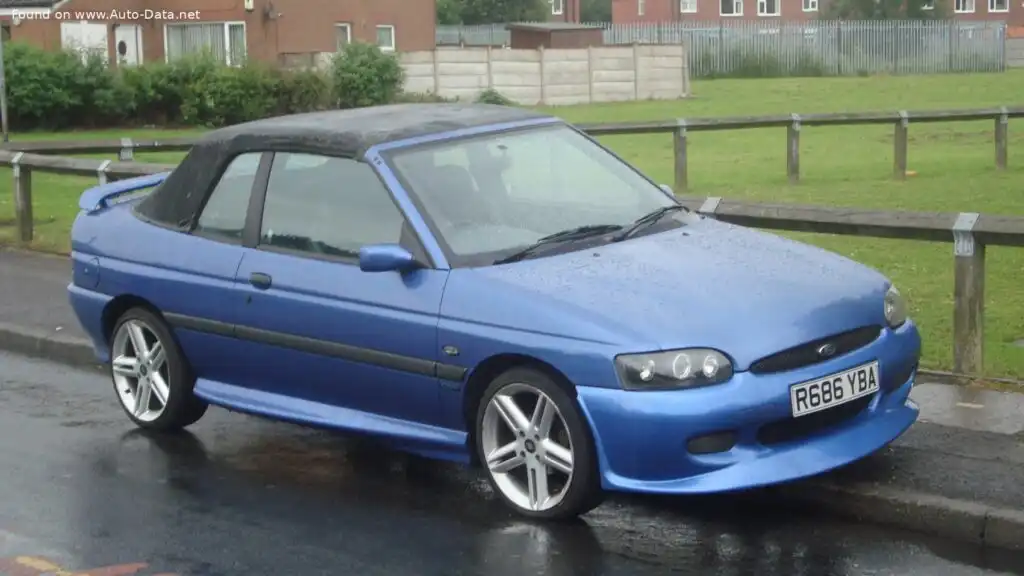
The Ford Escort VII Cabrio 1.8 i 16V XR3i was a sporty variant of the seventh-generation Ford Escort, produced between 1995 and 1998. Positioned as a premium offering within the Escort Cabriolet range, the XR3i combined a relatively powerful 1.8-liter engine with a focus on driver engagement. It represented Ford’s attempt to cater to buyers seeking an open-top car with a degree of performance and style. The Escort VII, launched in 1990, was a significant update to the popular Escort line, sharing its platform (the B3 platform) with other Ford and Mazda models. The Cabriolet version, introduced later, added a desirable open-air experience to the Escort’s practicality.
Technical Specifications
| Brand | Ford |
| Model | Escort |
| Generation | Escort VII Cabrio |
| Type (Engine) | 1.8 i 16V XR3i (115 Hp) |
| Start of production | 1995 |
| End of production | 1998 |
| Powertrain Architecture | Internal Combustion engine |
| Body type | Cabriolet |
| Seats | 5 |
| Doors | 2 |
| Fuel consumption (combined) | 7.6 l/100 km |
| Fuel consumption (US mpg) | 30.9 US mpg |
| Fuel consumption (UK mpg) | 37.2 UK mpg |
| Fuel consumption (km/l) | 13.2 km/l |
| Fuel Type | Petrol (Gasoline) |
| Acceleration 0 – 100 km/h | 10.7 sec |
| Acceleration 0 – 62 mph | 10.7 sec |
| Acceleration 0 – 60 mph | 10.2 sec |
| Maximum speed | 193 km/h (119.92 mph) |
| Weight-to-power ratio | 10.3 kg/Hp |
| Power per tonne | 96.6 Hp/tonne |
| Weight-to-torque ratio | 7.4 kg/Nm |
| Torque per tonne | 134.5 Nm/tonne |
| Power | 115 Hp @ 5750 rpm |
| Power per litre | 64 Hp/l |
| Torque | 160 Nm @ 4500 rpm (118.01 lb.-ft. @ 4500 rpm) |
| Engine layout | Front, Transverse |
| Engine Model/Code | RKC |
| Engine displacement | 1796 cm3 (109.6 cu. in.) |
| Number of cylinders | 4 |
| Engine configuration | Inline |
| Cylinder Bore | 80.6 mm (3.17 in.) |
| Piston Stroke | 88 mm (3.46 in.) |
| Compression ratio | 9.8:1 |
| Number of valves per cylinder | 4 |
| Fuel injection system | Multi-port manifold injection |
| Engine aspiration | Naturally aspirated |
| Valvetrain | DOHC |
| Engine oil capacity | 4.25 l (4.49 US qt | 3.74 UK qt) |
| Coolant capacity | 7 l (7.4 US qt | 6.16 UK qt) |
| Kerb Weight | 1190 kg (2623.5 lbs.) |
| Max. weight | 1700 kg (3747.86 lbs.) |
| Max load | 510 kg (1124.36 lbs.) |
| Trunk (boot) space – minimum | 322 l (11.37 cu. ft.) |
| Fuel tank capacity | 55 l (14.53 US gal | 12.1 UK gal) |
| Length | 4136 mm (162.83 in.) |
| Width | 1700 mm (66.93 in.) |
| Height | 1381 mm (54.37 in.) |
| Wheelbase | 2525 mm (99.41 in.) |
| Front track | 1440 mm (56.69 in.) |
| Rear (Back) track | 1454 mm (57.24 in.) |
| Drivetrain Architecture | Front wheel drive |
| Number of gears | 5 gears, manual transmission |
| Front suspension | Wishbone |
| Rear suspension | Coil spring |
| Front brakes | Ventilated discs |
| Rear brakes | Disc |
| Assisting systems | ABS (Anti-lock braking system) |
| Steering type | Steering rack and pinion |
| Power steering | Hydraulic Steering |
| Tires size | 195/50 R15 V |
Powertrain & Engine Architecture
The XR3i Cabriolet was powered by Ford’s 1.8-liter Zetec-E engine, designated as the RKC code. This engine was a 16-valve, naturally aspirated inline-four cylinder unit. The Zetec-E was a modern design for its time, featuring multi-point fuel injection, a double overhead camshaft (DOHC) valvetrain, and a relatively high compression ratio of 9.8:1. These features contributed to its respectable power output of 115 horsepower at 5750 rpm and 160 Nm (118 lb-ft) of torque at 4500 rpm. The engine’s design prioritized smooth power delivery and reasonable fuel efficiency. The five-speed manual transmission was the standard offering, providing drivers with good control over the engine’s power band. The transmission was known for its relatively light shift action and precise engagement.
Driving Characteristics
The 1.8-liter XR3i Cabriolet offered a balanced driving experience. While not a high-performance sports car, it provided sufficient power for enjoyable open-top motoring. Acceleration from 0-60 mph took around 10.2 seconds, and it had a top speed of approximately 119.92 mph. The engine felt responsive in the mid-range, making it suitable for everyday driving and overtaking maneuvers. Compared to the base Escort Cabriolet models with smaller engines, the XR3i offered a noticeable performance improvement. However, it didn’t possess the outright speed of the later Escort Cosworth or even some of the more powerful versions of the Escort RS2000. The manual transmission allowed for precise gear selection, and the relatively short gearing helped to maximize acceleration. The suspension, while tuned for comfort, provided adequate body control, minimizing roll during cornering.
Equipment & Trim Levels
The XR3i trim level was well-equipped for its time. Standard features typically included power steering, ABS anti-lock brakes, alloy wheels, and a sporty interior with bolstered seats. The interior often featured a unique dashboard trim and XR3i badging. Optional extras could include a sunroof (in addition to the convertible top), upgraded audio systems, and leather upholstery. The XR3i was positioned as a step above the more basic Escort Cabriolet models, offering a more premium feel and a higher level of equipment.
Chassis & Braking
The Escort VII Cabriolet utilized a front-wheel-drive layout with independent wishbone suspension at the front and a coil spring rear suspension. The braking system consisted of ventilated discs at the front and solid discs at the rear, providing adequate stopping power for the vehicle’s weight and performance. The ABS system enhanced braking performance, particularly on slippery surfaces. The chassis was reinforced to compensate for the lack of a fixed roof, ensuring structural rigidity and minimizing body flex. Stabilizer bars were fitted to both the front and rear axles to reduce body roll during cornering.
Market Reception & Comparison
The Escort VII Cabrio 1.8 i 16V XR3i was generally well-received by automotive critics. It was praised for its stylish design, enjoyable driving experience, and relatively affordable price. However, some critics noted that it wasn’t as sporty or refined as some of its competitors, such as the Volkswagen Golf Cabriolet or the Peugeot 205 Convertible. In terms of fuel economy, the XR3i offered a reasonable compromise between performance and efficiency, achieving around 30.9 US mpg on combined cycles. Reliability was generally good, although some owners reported minor issues with the electrical system. Compared to the lower-powered Escort Cabriolet models, the XR3i offered a significant performance upgrade, making it a more appealing option for drivers who prioritized driving enjoyment.
Legacy
The Ford Escort VII Cabrio 1.8 i 16V XR3i remains a popular choice among classic car enthusiasts. The Zetec-E engine is known for its durability and relatively simple maintenance requirements. Parts availability is generally good, although some trim-specific components may be more difficult to find. Today, these cars are often sought after as affordable and enjoyable classic convertibles. The XR3i’s combination of style, performance, and practicality has ensured its enduring appeal in the used car market. While not a rare vehicle, well-maintained examples in original condition are becoming increasingly collectible.