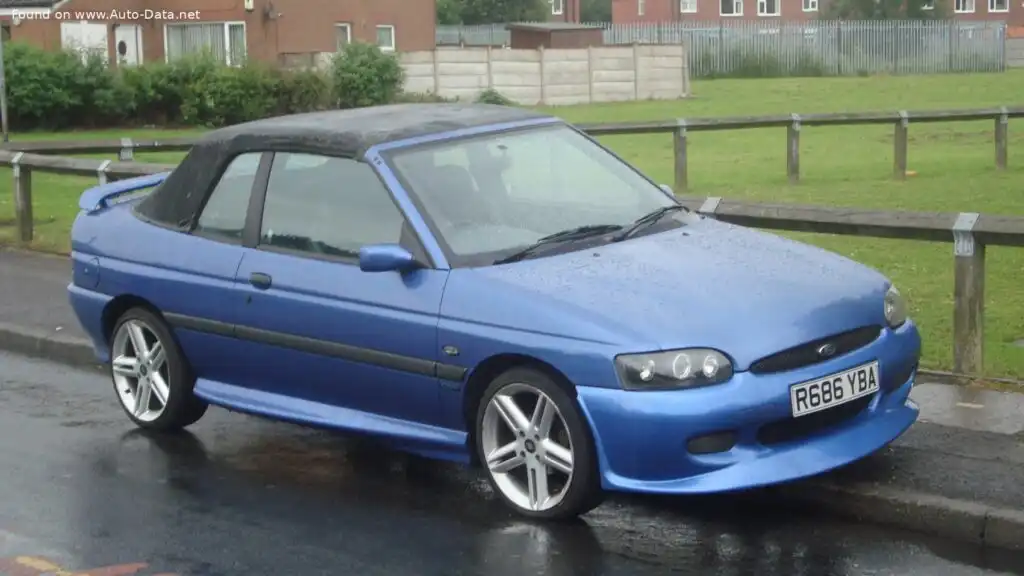
The Ford Escort VII Cabrio 1.8 TD, produced between 1995 and 2000, represented a unique offering within the seventh generation (Mk VII) Escort range. Positioned as a more economical and torque-focused alternative to the petrol-powered Cabriolets, it aimed to appeal to buyers seeking open-top motoring with lower running costs. This variant utilized a turbocharged diesel engine, a relatively uncommon choice for a convertible in the European market, and was primarily sold in Europe where diesel fuel was more prevalent and affordable. It was built on the shared B-platform with the Ford Focus, known internally as the 1HX0/A3 platform.
Technical Specifications
| Brand | Ford |
| Model | Escort |
| Generation | Escort VII Cabrio |
| Type (Engine) | 1.8 TD (90 Hp) |
| Start of production | 1995 |
| End of production | 2000 |
| Powertrain Architecture | Internal Combustion engine |
| Body type | Cabriolet |
| Seats | 5 |
| Doors | 2 |
| Fuel consumption (combined) | 6.4 l/100 km (36.8 US mpg, 44.1 UK mpg, 15.6 km/l) |
| Fuel Type | Diesel |
| Acceleration 0 – 100 km/h | 11.5 sec |
| Acceleration 0 – 62 mph | 11.5 sec |
| Acceleration 0 – 60 mph | 10.9 sec |
| Maximum speed | 170 km/h (105.63 mph) |
| Weight-to-power ratio | 13.9 kg/Hp, 72 Hp/tonne |
| Weight-to-torque ratio | 6.9 kg/Nm, 144 Nm/tonne |
| Power | 90 Hp @ 4500 rpm |
| Power per litre | 51.3 Hp/l |
| Torque | 180 Nm @ 2000 rpm (132.76 lb.-ft. @ 2000 rpm) |
| Engine layout | Front, Transverse |
| Engine Model/Code | RFD, RFK, RFS |
| Engine displacement | 1753 cm3 (106.97 cu. in.) |
| Number of cylinders | 4 |
| Engine configuration | Inline |
| Cylinder Bore | 82.5 mm (3.25 in.) |
| Piston Stroke | 82 mm (3.23 in.) |
| Compression ratio | 21.5:1 |
| Number of valves per cylinder | 2 |
| Fuel injection system | Precombustion chamber injection |
| Engine aspiration | Turbocharger |
| Valvetrain | OHC |
| Engine oil capacity | 5.1 l (5.39 US qt | 4.49 UK qt) |
| Coolant | 9.3 l (9.83 US qt | 8.18 UK qt) |
| Kerb Weight | 1250 kg (2755.78 lbs.) |
| Max. weight | 1685 kg (3714.79 lbs.) |
| Max load | 435 kg (959.01 lbs.) |
| Trunk (boot) space – minimum | 322 l (11.37 cu. ft.) |
| Fuel tank capacity | 55 l (14.53 US gal | 12.1 UK gal) |
| Length | 4136 mm (162.83 in.) |
| Width | 1700 mm (66.93 in.) |
| Height | 1381 mm (54.37 in.) |
| Wheelbase | 2525 mm (99.41 in.) |
| Front track | 1440 mm (56.69 in.) |
| Rear (Back) track | 1462 mm (57.56 in.) |
| Drivetrain Architecture | The Internal combustion engine (ICE) drives the front wheels of the vehicle. |
| Drive wheel | Front wheel drive |
| Number of gears and type of gearbox | 5 gears, manual transmission |
| Front suspension | Wishbone |
| Rear suspension | Coil spring |
| Front brakes | Ventilated discs |
| Rear brakes | Drum |
| Assisting systems | ABS (Anti-lock braking system) |
| Steering type | Steering rack and pinion |
| Power steering | Hydraulic Steering |
| Tires size | 175/65 R14 H |
Powertrain & Engine Architecture
The heart of the Escort VII Cabrio 1.8 TD was the RFD (and related RFK, RFS) engine, a 1.8-liter inline-four cylinder diesel. This engine utilized a precombustion chamber injection system, a common design for diesel engines of the era. This system involved injecting fuel into a precombustion chamber connected to the main cylinder, promoting more complete combustion and reducing noise. The addition of a turbocharger significantly boosted power output to 90 horsepower at 4500 rpm and 180 Nm (132.76 lb-ft) of torque at 2000 rpm. The engine featured an overhead camshaft (OHC) valvetrain with two valves per cylinder. The 5-speed manual transmission was the only gearbox option available with this engine, prioritizing fuel efficiency over outright performance.
Driving Characteristics
The 1.8 TD Cabrio offered a distinctly different driving experience compared to the petrol-powered Escort convertibles. While lacking the brisk acceleration of the 1.6 or 1.8 petrol engines, it provided a substantial amount of low-end torque. This made it surprisingly capable in everyday driving situations, particularly for overtaking and navigating hilly terrain. The turbocharger provided a noticeable boost in power, but the engine did exhibit some turbo lag. The 5-speed manual transmission was well-matched to the engine’s characteristics, allowing drivers to keep the engine in its optimal torque band. However, the overall experience was geared towards relaxed cruising rather than sporty driving.
Equipment & Trim Levels
The 1.8 TD Cabrio typically came with a reasonably well-equipped specification, though it generally sat in the mid-range of the Escort Cabrio lineup. Standard features included power steering, central locking, and an AM/FM radio. Interior upholstery was typically cloth, with options for upgraded materials. Optional extras included alloy wheels, a sunroof (in addition to the convertible top), and upgraded audio systems. The dashboard layout was typical of the Mk VII Escort, featuring a functional but somewhat dated design.
Chassis & Braking
The Escort VII Cabrio chassis featured independent front suspension with wishbones and a coil spring rear suspension. The front brakes were ventilated discs, providing adequate stopping power, while the rear brakes were drums. This configuration was typical for vehicles in this weight class during the mid-1990s. Anti-lock braking system (ABS) was available as an option, enhancing safety. The steering was a rack and pinion system with hydraulic assistance, providing a reasonably precise and responsive feel.
Market Reception & Comparison
The Escort VII Cabrio 1.8 TD received mixed reviews. Critics praised its fuel economy and low-speed torque, making it an attractive option for drivers covering long distances. However, it was often criticized for its lack of outright performance compared to the petrol versions. Compared to the 1.6 or 1.8 petrol Cabriolets, the 1.8 TD offered significantly better fuel economy (around 37 mpg combined) but slower acceleration. The diesel engine also tended to be noisier and less refined than its petrol counterparts. Reliability was generally good, although diesel engines of this era could be susceptible to issues with the fuel injection system and turbocharger.
Legacy
Today, the Ford Escort VII Cabrio 1.8 TD is a relatively rare sight on the roads. While not as sought-after as some of the higher-performance petrol versions, it has gained a following among enthusiasts who appreciate its unique character and fuel efficiency. The RFD engine, while not known for its high output, is generally considered to be a robust and reliable unit when properly maintained. Finding well-maintained examples can be challenging, as many have succumbed to age and corrosion. However, for those seeking a classic convertible with a focus on practicality and economy, the Escort VII Cabrio 1.8 TD offers a compelling and affordable option.