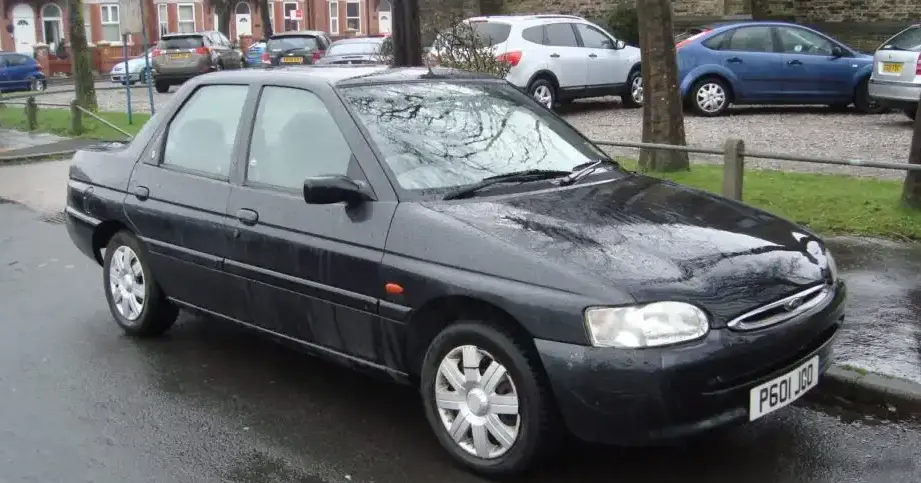
The Ford Escort VII, produced between 1995 and 1996, represented a significant evolution of Ford’s long-running Escort line. Within the seventh generation (chassis codes GAL, AAL, and ABL), the 1.3 i variant, producing 60 horsepower, served as the entry point into the range. This model was primarily aimed at budget-conscious buyers in European markets, offering basic transportation with Ford’s established reliability. It occupied the lowest rung of the Escort VII ladder, positioned below the 1.6L and 1.8L models, and significantly below the performance-oriented versions. The 1.3 i was designed to provide economical motoring, prioritizing fuel efficiency over outright performance.
Technical Specifications
| Brand | Ford |
| Model | Escort |
| Generation | Escort VII (GAL, AAL, ABL) |
| Type (Engine) | 1.3 i (60 Hp) |
| Start of production | 1995 |
| End of production | 1996 |
| Powertrain Architecture | Internal Combustion engine |
| Body type | Sedan |
| Seats | 5 |
| Doors | 4 |
| Fuel consumption (combined) | 6.6 l/100 km (35.6 US mpg, 42.8 UK mpg, 15.2 km/l) |
| Fuel Type | Petrol (Gasoline) |
| Acceleration 0 – 100 km/h | 17.1 sec |
| Acceleration 0 – 62 mph | 17.1 sec |
| Acceleration 0 – 60 mph | 16.2 sec |
| Maximum speed | 154 km/h (95.69 mph) |
| Weight-to-power ratio | 17.2 kg/Hp, 58.3 Hp/tonne |
| Weight-to-torque ratio | 10 kg/Nm, 100 Nm/tonne |
| Power | 60 Hp @ 5000 rpm |
| Power per litre | 46.2 Hp/l |
| Torque | 103 Nm @ 2500 rpm (75.97 lb.-ft. @ 2500 rpm) |
| Engine layout | Front, Transverse |
| Engine Model/Code | J4B, J6A |
| Engine displacement | 1299 cm3 (79.27 cu. in.) |
| Number of cylinders | 4 |
| Engine configuration | Inline |
| Cylinder Bore | 74 mm (2.91 in.) |
| Piston Stroke | 75.5 mm (2.97 in.) |
| Compression ratio | 9.5:1 |
| Number of valves per cylinder | 2 |
| Fuel injection system | Multi-port manifold injection |
| Engine aspiration | Naturally aspirated engine |
| Valvetrain | OHC |
| Engine oil capacity | 3.25 l (3.43 US qt | 2.86 UK qt) |
| Coolant capacity | 7.1 l (7.5 US qt | 6.25 UK qt) |
| Kerb Weight | 1030 kg (2270.76 lbs.) |
| Max. weight | 1540 kg (3395.12 lbs.) |
| Max load | 510 kg (1124.36 lbs.) |
| Trunk (boot) space – minimum | 250 l (8.83 cu. ft.) |
| Trunk (boot) space – maximum | 625 l (22.07 cu. ft.) |
| Fuel tank capacity | 55 l (14.53 US gal | 12.1 UK gal) |
| Length | 4293 mm (169.02 in.) |
| Width | 1700 mm (66.93 in.) |
| Height | 1394 mm (54.88 in.) |
| Wheelbase | 2525 mm (99.41 in.) |
| Front track | 1440 mm (56.69 in.) |
| Rear (Back) track | 1462 mm (57.56 in.) |
| Drivetrain Architecture | The Internal combustion engine (ICE) drives the front wheels of the vehicle. |
| Drive wheel | Front wheel drive |
| Number of gears and type of gearbox | 5 gears, manual transmission |
| Front suspension | Wishbone |
| Rear suspension | Coil spring |
| Front brakes | Ventilated discs |
| Rear brakes | Drum |
| Assisting systems | ABS (Anti-lock braking system) |
| Steering type | Steering rack and pinion |
| Tires size | 175/70 R13 T |
Powertrain & Engine Architecture
The heart of the Escort VII 1.3 i was the Ford J4B or J6A engine, a 1.3-liter inline-four cylinder unit. This engine was a relatively simple design, featuring a single overhead camshaft (OHC) operating two valves per cylinder. Fuel delivery was handled by a multi-port fuel injection system, a step up from the carburetors used in earlier Escort models. The J4B/J6A engine was known for its durability, though it wasn’t particularly powerful. The 60 horsepower output was achieved at 5000 rpm, while peak torque of 103 Nm (75.97 lb-ft) arrived at 2500 rpm. The engine’s modest output was paired with a five-speed manual transmission, optimized for fuel economy rather than spirited driving. The transmission’s gear ratios were relatively tall, further emphasizing the engine’s efficiency.
Driving Characteristics
The driving experience in the 1.3 i Escort was decidedly uninspiring, but practical. Acceleration was slow, taking over 17 seconds to reach 60 mph. The engine felt strained when pushed hard, and overtaking required careful planning. However, around town, the engine proved adequate for everyday driving. The tall gearing meant that the car was relatively quiet on the highway, although maintaining speed on inclines required downshifting. Compared to the 1.6L and 1.8L Escorts, the 1.3 i felt significantly underpowered. The manual transmission, while not sporty, was light and easy to use. The suspension, tuned for comfort, provided a reasonably smooth ride, but handling was unremarkable.
Equipment & Trim Levels
The 1.3 i Escort was typically offered in a base trim level, focusing on essential features. Standard equipment generally included power steering, central locking, and a basic stereo system. Interior upholstery was typically cloth, with a simple dashboard layout. Optional extras included electric front windows, a sunroof, and upgraded audio systems. The interior plastics were durable but lacked the refinement found in higher-spec Escorts. Safety features were limited, typically consisting of a driver’s airbag and ABS (Anti-lock Braking System) as standard equipment.
Chassis & Braking
The Escort VII utilized a front-wheel-drive layout with independent wishbone suspension at the front and a coil spring rear suspension. The braking system consisted of ventilated discs at the front and drum brakes at the rear. The drum brakes on the rear were a cost-saving measure typical of entry-level models. The suspension was tuned for comfort, prioritizing ride quality over sharp handling. Stabilizer bars were present, but relatively thin compared to those found on higher-performance Escort variants.
Market Reception & Comparison
The 1.3 i Escort was generally viewed as a sensible and economical choice. Critics acknowledged its affordability and fuel efficiency, but criticized its lack of performance. Compared to the 1.6L and 1.8L Escorts, the 1.3 i offered significantly less power and refinement. However, it was more fuel-efficient and cheaper to insure. The 1.3 i appealed to buyers who prioritized practicality and low running costs over driving excitement. Its reliability was generally good, making it a popular choice for first-time drivers and those on a tight budget.
Legacy
The Ford Escort VII 1.3 i, while not a particularly exciting vehicle, proved to be a reliable and affordable option for many European drivers. The J4B/J6A engine, despite its modest output, was known for its durability. Today, these Escorts are relatively rare, and well-maintained examples are sought after by enthusiasts and collectors. The 1.3 i powertrain is generally considered to be robust and relatively easy to maintain, although finding replacement parts can sometimes be challenging. Its simplicity and affordability continue to make it an appealing option for those seeking a classic Ford at a reasonable price.