
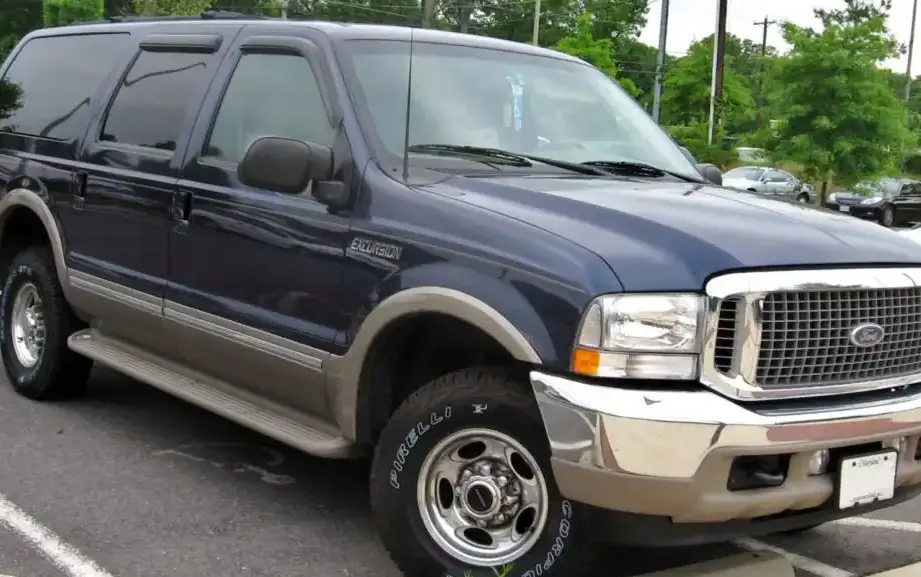
The Ford Excursion 5.4, produced from 2000 to 2005, represented Ford’s entry into the full-size SUV segment, aiming to provide maximum space and towing capacity. Built on a heavily modified Ford Super Duty truck chassis, the Excursion was the largest SUV ever produced by Ford, and one of the largest ever produced in the United States. The 5.4-liter V8 engine, paired with a four-speed automatic transmission and four-wheel drive, was the base engine option for the Excursion, positioning it as the more accessible, though still substantial, variant within the lineup. It served as a workhorse vehicle for families needing to tow large trailers, haul numerous passengers, or simply desiring a commanding presence on the road.
Technical Specifications
| Brand | Ford |
| Model | Excursion |
| Generation | Excursion |
| Type (Engine) | 5.4 (258 Hp) 4WD Automatic |
| Start of production | 2000 year |
| End of production | 2005 year |
| Powertrain Architecture | Internal Combustion engine |
| Body type | SUV |
| Seats | 8-9 |
| Doors | 5 |
| Fuel Type | Petrol (Gasoline) |
| Weight-to-power ratio | 12.9 kg/Hp, 77.6 Hp/tonne |
| Weight-to-torque ratio | 7 kg/Nm, 142.6 Nm/tonne |
| Power | 258 Hp @ 4500 rpm |
| Power per litre | 47.8 Hp/l |
| Torque | 474 Nm @ 2500 rpm, 349.6 lb.-ft. @ 2500 rpm |
| Engine layout | Front, Longitudinal |
| Engine displacement | 5398 cm3, 329.41 cu. in. |
| Number of cylinders | 8 |
| Engine configuration | V-engine |
| Cylinder Bore | 90.2 mm, 3.55 in. |
| Piston Stroke | 105.7 mm, 4.16 in. |
| Compression ratio | 9:1 |
| Number of valves per cylinder | 2 |
| Fuel injection system | Multi-port manifold injection |
| Engine aspiration | Naturally aspirated engine |
| Valvetrain | OHC |
| Engine oil capacity | 5.7 l, 6.02 US qt | 5.02 UK qt |
| Coolant | 25 l, 26.42 US qt | 22 UK qt |
| Kerb Weight | 3325 kg, 7330.37 lbs |
| Max. weight | 4037 kg, 8900.06 lbs |
| Max load | 712 kg, 1569.69 lbs |
| Trunk (boot) space – minimum | 1359 l, 47.99 cu. ft. |
| Trunk (boot) space – maximum | 4145 l, 146.38 cu. ft. |
| Fuel tank capacity | 167 l, 44.12 US gal | 36.73 UK gal |
| Length | 5758 mm, 226.69 in. |
| Width | 2032 mm, 80 in. |
| Height | 2024 mm, 79.69 in. |
| Wheelbase | 3480 mm, 137.01 in. |
| Front track | 1737 mm, 68.39 in. |
| Rear (Back) track | 1730 mm, 68.11 in. |
| Drive wheel | All wheel drive (4×4) |
| Number of gears and type of gearbox | 4 gears, automatic transmission |
| Front suspension | Leaf spring |
| Rear suspension | Leaf spring |
| Front brakes | Ventilated discs |
| Rear brakes | Ventilated discs |
| Assisting systems | ABS (Anti-lock braking system) |
| Steering type | Worm-reduction unit |
| Power steering | Hydraulic Steering |
| Tires size | 265/75 R16 |
Powertrain & Engine Architecture
The heart of the Excursion 5.4 was the 5.4-liter Triton V8 engine, a member of Ford’s modular engine family. This engine, designated as the 5.4L SOHC, featured a single overhead camshaft design, two valves per cylinder, and multi-port fuel injection. The engine’s architecture prioritized low-end torque, making it suitable for towing and hauling. The 9:1 compression ratio was a compromise between performance and durability, allowing the engine to run on regular unleaded gasoline. The four-speed 4R70W automatic transmission was chosen for its robustness and ability to handle the engine’s torque output. While not the most technologically advanced transmission available at the time, it was known for its reliability when properly maintained. The transmission featured electronic control for smoother shifting and improved fuel efficiency, though fuel economy remained a significant drawback for the Excursion.
Driving Characteristics
The Excursion 5.4, while capable, wasn’t known for its blistering acceleration. With 258 horsepower and 349 lb-ft of torque, it took approximately 9-10 seconds to reach 60 mph. The four-speed automatic transmission, while reliable, had relatively wide gear ratios, which contributed to a less refined driving experience compared to the higher-output V10 or diesel-powered Excursions. The 5.4L engine delivered adequate power for everyday driving and moderate towing, but struggled when fully loaded or tackling steep inclines. The large size and weight of the Excursion were always noticeable, requiring careful maneuvering and a wider turning radius than most SUVs. Compared to the V10, the 5.4L offered a more economical option, but at the cost of significant performance. The 5.4L was also noticeably quieter and smoother than the diesel options.
Equipment & Trim Levels
The Excursion 5.4 was typically offered in XLT and Limited trim levels. The XLT trim included standard features such as air conditioning, power windows and locks, a CD player, and cloth upholstery. The Limited trim added leather upholstery, heated front seats, a premium sound system, and alloy wheels. Optional extras included a DVD entertainment system, a sunroof, and upgraded towing packages. The interior of the Excursion was spacious, offering seating for up to nine passengers depending on the configuration. The third-row seats were relatively comfortable, making the Excursion a viable option for large families. The dashboard layout was functional but lacked the modern aesthetics found in some competing SUVs.
Chassis & Braking
The Excursion’s chassis was based on the Ford Super Duty truck platform, featuring a heavy-duty frame and robust suspension components. Both the front and rear suspension utilized leaf springs, designed to handle heavy loads and provide a stable ride. The rear brakes were ventilated discs, a notable upgrade over the drums found on some earlier Super Duty models. The front brakes were also ventilated discs. Anti-lock brakes (ABS) were standard equipment. Due to the vehicle’s substantial weight, braking performance was adequate but not exceptional. The steering system utilized a worm-reduction unit with hydraulic power assist, providing a firm but somewhat imprecise steering feel.
Market Reception & Comparison
The Ford Excursion received mixed reviews from automotive critics. While praised for its spacious interior and impressive towing capacity, it was often criticized for its poor fuel economy, cumbersome handling, and large size. The 5.4-liter engine was considered adequate for most tasks, but many reviewers recommended the V10 engine for those who frequently towed heavy loads. Compared to the V10, the 5.4L offered better fuel economy (though still relatively poor), but significantly less power. The 5.4L was also more affordable than the V10 and diesel options, making it an attractive choice for budget-conscious buyers. Reliability was generally good, although the 5.4L engine was known to be susceptible to spark plug issues if maintenance was neglected.
Legacy
The Ford Excursion, despite its short production run, left a lasting impression on the SUV market. It remains a popular choice among enthusiasts who need a large, capable vehicle for towing and hauling. The 5.4-liter engine, while not the most powerful option, has proven to be relatively reliable when properly maintained. Today, used Excursions are often sought after for their spacious interiors and rugged construction. However, potential buyers should be aware of the vehicle’s poor fuel economy and the potential for spark plug issues. The Excursion represents a unique chapter in Ford’s history, a time when size and capability were prioritized above all else. It’s a vehicle that continues to command attention and serve as a testament to American automotive excess.
