
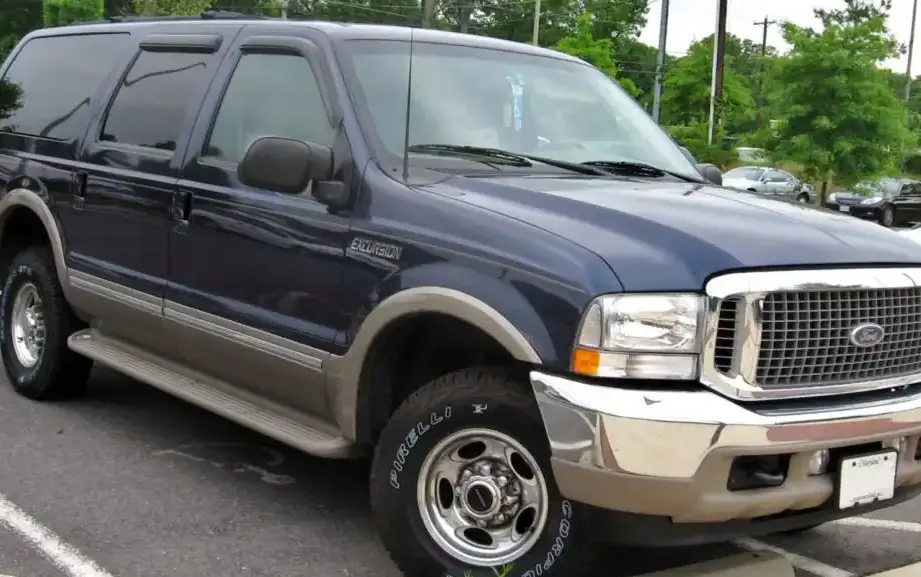
The Ford Excursion 6.8, produced from 2000 to 2005, represented Ford’s entry into the full-size SUV segment, aiming to provide maximum space and towing capacity. Built on a heavily modified Ford Super Duty truck chassis, the Excursion was the largest SUV ever mass-produced by an American manufacturer. The 6.8-liter V10 engine paired with a four-speed automatic transmission was a key configuration, positioned as the premium powertrain option within the Excursion lineup, appealing to buyers needing substantial power for work or recreation. It was a direct competitor to the Chevrolet Suburban and GMC Yukon XL, offering a larger alternative to the more common, truck-based SUVs.
Technical Specifications
| Brand | Ford |
| Model | Excursion |
| Generation | Excursion |
| Type (Engine) | 6.8 (314 Hp) Automatic |
| Start of production | 2000 year |
| End of production | 2005 year |
| Powertrain Architecture | Internal Combustion engine |
| Body type | SUV |
| Seats | 8-9 |
| Doors | 5 |
| Fuel Type | Petrol (Gasoline) |
| Maximum speed | 153 km/h (95.07 mph) |
| Weight-to-power ratio | 10.1 kg/Hp, 99.4 Hp/tonne |
| Weight-to-torque ratio | 5.5 kg/Nm, 182.3 Nm/tonne |
| Power | 314 Hp @ 4250 rpm |
| Power per litre | 46.5 Hp/l |
| Torque | 576 Nm @ 3250 rpm (424.84 lb.-ft. @ 3250 rpm) |
| Engine layout | Front, Longitudinal |
| Engine displacement | 6748 cm3 (411.79 cu. in.) |
| Number of cylinders | 10 |
| Engine configuration | Inline |
| Cylinder Bore | 90.2 mm (3.55 in.) |
| Piston Stroke | 105.7 mm (4.16 in.) |
| Compression ratio | 9:1 |
| Number of valves per cylinder | 2 |
| Fuel injection system | Multi-port manifold injection |
| Engine aspiration | Naturally aspirated engine |
| Valvetrain | OHC |
| Engine oil capacity | 5.7 l (6.02 US qt | 5.02 UK qt) |
| Coolant | 27 l (28.53 US qt | 23.76 UK qt) |
| Kerb Weight | 3160 kg (6966.61 lbs.) |
| Max. weight | 3900 kg (8598.03 lbs.) |
| Max load | 740 kg (1631.42 lbs.) |
| Trunk (boot) space – minimum | 1359 l (47.99 cu. ft.) |
| Trunk (boot) space – maximum | 4145 l (146.38 cu. ft.) |
| Fuel tank capacity | 167 l (44.12 US gal | 36.73 UK gal) |
| Length | 5758 mm (226.69 in.) |
| Width | 2032 mm (80 in.) |
| Height | 1948 mm (76.69 in.) |
| Wheelbase | 3480 mm (137.01 in.) |
| Front track | 1737 mm (68.39 in.) |
| Rear (Back) track | 1730 mm (68.11 in.) |
| Drive wheel | All wheel drive (4×4) |
| Number of gears and type of gearbox | 4 gears, automatic transmission |
| Front suspension | Coil spring |
| Rear suspension | Leaf spring |
| Front brakes | Ventilated discs |
| Rear brakes | Ventilated discs |
| Assisting systems | ABS (Anti-lock braking system) |
| Steering type | Worm-reduction unit |
| Power steering | Hydraulic Steering |
| Tires size | 265/75 R16 |
Powertrain & Engine Architecture
The heart of the Excursion 6.8 was the 6.8-liter (411.79 cubic inches) Triton V10 engine. This engine, part of Ford’s modular engine family, featured an overhead camshaft (OHC) design with two valves per cylinder. The engine utilized a multi-port fuel injection system, delivering fuel directly to each intake port. The 9:1 compression ratio was a compromise between power and durability, suitable for the demands of a heavy-duty vehicle. The engine’s V configuration contributed to its smooth operation and relatively compact size for its displacement. Paired with the V10 was a four-speed automatic transmission (4R100), chosen for its robustness and ability to handle the engine’s substantial torque output. This transmission was a workhorse unit, commonly found in Ford’s heavy-duty trucks and known for its reliability when properly maintained. The 4R100 featured a torque converter lock-up clutch to improve fuel efficiency at highway speeds, and its gear ratios were optimized for both towing and comfortable cruising.
Driving Characteristics
The Excursion 6.8 Automatic offered a unique driving experience. While its sheer size made maneuvering in tight spaces challenging, the V10 engine provided ample power for accelerating and towing. The four-speed automatic transmission, while not as sophisticated as modern transmissions with more gears, offered smooth shifts and a reasonable balance between performance and fuel economy. Compared to the Excursion’s available diesel engines (7.3L Power Stroke and later the 6.0L Power Stroke), the V10 offered a different character. The diesel engines prioritized torque for heavy hauling, while the V10 focused on providing a more responsive and refined driving experience. The V10’s power delivery was linear, with peak torque available at 3250 rpm, making it well-suited for highway cruising and occasional towing. However, the V10 was notably less fuel-efficient than the diesel options. The transmission’s shift points were calibrated to maximize engine power and minimize hunting, providing a predictable and controllable driving experience even when heavily loaded.
Equipment & Trim Levels
The Excursion 6.8 typically came standard with features expected of a premium SUV, including air conditioning, power windows and locks, and a basic audio system. Higher trim levels, such as the Limited, added leather upholstery, heated seats, a premium sound system, and automatic climate control. Optional extras included a DVD entertainment system, a sunroof, and various towing packages. The interior design was functional and spacious, prioritizing comfort and utility over luxury. The third-row seating could be configured as a bench seat or captain’s chairs, offering flexibility for passenger and cargo needs. The XLT trim, a mid-level option, often included features like alloy wheels and upgraded interior trim, bridging the gap between the base model and the luxurious Limited.
Chassis & Braking
The Excursion’s chassis was based on the Ford Super Duty truck platform, featuring a robust frame and heavy-duty suspension components. The front suspension utilized coil springs, while the rear suspension employed leaf springs, designed to handle heavy loads. Braking duties were handled by ventilated discs on all four wheels, coupled with an Anti-lock Braking System (ABS) for enhanced safety. Given the vehicle’s weight, braking performance was adequate but not exceptional. The steering system utilized a worm-reduction unit with hydraulic power assist, providing a stable and predictable steering feel. The heavy-duty suspension was tuned to provide a comfortable ride even when the vehicle was fully loaded, and the leaf springs in the rear were designed to minimize sag when towing.
Market Reception & Comparison
The Ford Excursion received mixed reviews upon its release. Critics praised its spacious interior, powerful engine options, and impressive towing capacity. However, it was also criticized for its large size, poor fuel economy, and cumbersome handling. The 6.8-liter V10 engine was generally well-regarded for its power and smoothness, but its fuel consumption was a significant drawback. Compared to the diesel-powered Excursions, the V10 offered a lower initial cost but higher long-term operating expenses due to fuel costs. The Excursion’s primary competitors, the Chevrolet Suburban and GMC Yukon XL, offered similar capabilities but were generally considered to be more refined and easier to drive. The Excursion’s sheer size also made it difficult to maneuver in urban environments, a disadvantage compared to its competitors.
Legacy
The Ford Excursion was discontinued after the 2005 model year, largely due to declining sales and increasing fuel prices. However, it has gained a cult following among enthusiasts who appreciate its unique combination of size, power, and capability. The 6.8-liter V10 engine, while not known for exceptional longevity, proved to be reasonably reliable when properly maintained. Common issues included oil leaks and occasional spark plug failures. Today, well-maintained Excursions 6.8 are sought after by collectors and those needing a large, capable SUV for work or recreation. The Excursion remains a symbol of a bygone era of American automotive excess, representing a time when bigger was often considered better. Its robust construction and powerful engine continue to appeal to those who value capability and durability above all else.
