
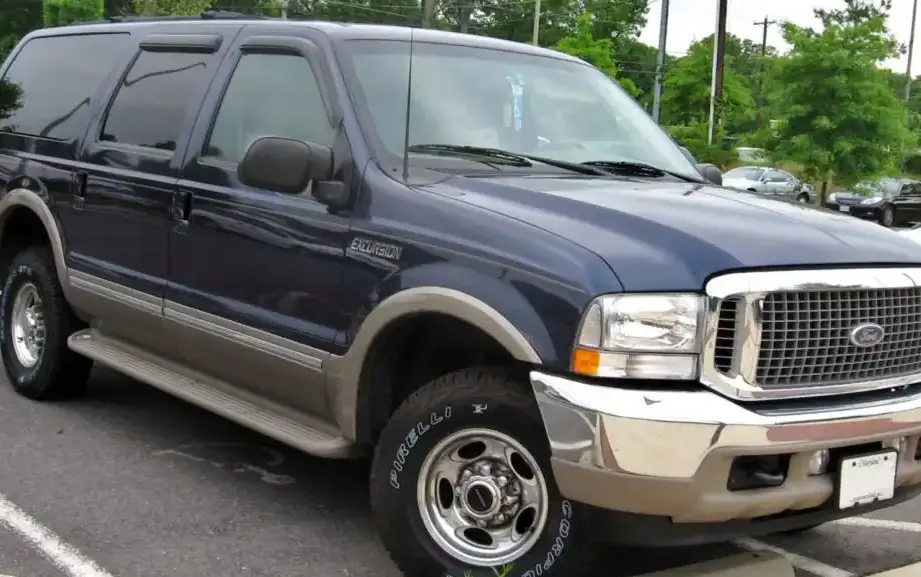
The Ford Excursion 7.3L Turbo Diesel, produced from 2000 to 2005, represents Ford’s entry into the full-size, heavy-duty SUV segment, aiming to compete with offerings like the Chevrolet Suburban and GMC Yukon XL. Built on a heavily modified Ford Super Duty truck chassis, the Excursion was notable for its immense size and capability. The 7.3-liter Power Stroke diesel engine paired with an automatic transmission was a popular configuration, offering a balance of power and usability for those needing substantial towing and hauling capacity. This variant occupied the mid-to-upper range of the Excursion lineup, appealing to buyers who prioritized diesel performance over the base gasoline engines.
Technical Specifications
| Brand | Ford |
| Model | Excursion |
| Generation | Excursion |
| Type (Engine) | 7.3 TD (253 Hp) Automatic |
| Start of production | 2000 year |
| End of production | 2005 year |
| Powertrain Architecture | Internal Combustion engine |
| Body type | SUV |
| Seats | 8-9 |
| Doors | 5 |
| Fuel Type | Diesel |
| Maximum speed | 153 km/h (95.07 mph) |
| Weight-to-power ratio | 16 kg/Hp, 62.7 Hp/tonne |
| Weight-to-torque ratio | 6 kg/Nm, 167.9 Nm/tonne |
| Power | 253 Hp @ 2700 rpm |
| Power per litre | 34.8 Hp/l |
| Torque | 678 Nm @ 1600 rpm (500.07 lb.-ft. @ 1600 rpm) |
| Engine layout | Front, Longitudinal |
| Engine displacement | 7270 cm3 (443.64 cu. in.) |
| Number of cylinders | 8 |
| Engine configuration | V-engine |
| Cylinder Bore | 104.4 mm (4.11 in.) |
| Piston Stroke | 106.2 mm (4.18 in.) |
| Compression ratio | 17:1 |
| Number of valves per cylinder | 2 |
| Fuel injection system | Diesel Commonrail |
| Engine aspiration | Turbocharger |
| Valvetrain | OHC |
| Engine oil capacity | 14.2 l (15 US qt | 12.49 UK qt) |
| Coolant | 31 l (32.76 US qt | 27.28 UK qt) |
| Kerb Weight | 4037 kg (8900.06 lbs.) |
| Max. weight | 4536 kg (10000.17 lbs.) |
| Max load | 499 kg (1100.11 lbs.) |
| Trunk (boot) space – minimum | 1359 l (47.99 cu. ft.) |
| Trunk (boot) space – maximum | 4145 l (146.38 cu. ft.) |
| Fuel tank capacity | 167 l (44.12 US gal | 36.73 UK gal) |
| Length | 5758 mm (226.69 in.) |
| Width | 2032 mm (80 in.) |
| Height | 1948 mm (76.69 in.) |
| Wheelbase | 3480 mm (137.01 in.) |
| Front track | 1737 mm (68.39 in.) |
| Rear (Back) track | 1730 mm (68.11 in.) |
| Drive wheel | All wheel drive (4×4) |
| Number of gears and type of gearbox | 4 gears, automatic transmission |
| Front suspension | Coil spring |
| Rear suspension | Leaf spring |
| Front brakes | Ventilated discs |
| Rear brakes | Ventilated discs |
| Assisting systems | ABS (Anti-lock braking system) |
| Steering type | Worm-reduction unit |
| Power steering | Hydraulic Steering |
| Tires size | 265/75 R16 |
Powertrain & Engine Architecture
The heart of the Excursion 7.3L is the Ford Power Stroke diesel engine, specifically the 7.3-liter OHV (Overhead Valve) V8. This engine, designated with codes like E4OD, was a robust and relatively simple design for its time, eschewing more complex technologies like unit injectors found in later Power Stroke engines. It utilized a HEUI (Hydraulic Electronic Unit Injection) system, which uses high-pressure oil to actuate the fuel injectors. This system offered a good balance of performance and reliability. The engine’s 17:1 compression ratio and turbocharger contributed to its substantial torque output. The four-speed automatic transmission (4R100) was specifically designed to handle the high torque loads of the diesel engine and the Excursion’s considerable weight. It featured a heavy-duty torque converter and reinforced internal components.
Driving Characteristics
The 7.3L diesel-powered Excursion with the automatic transmission delivered a driving experience focused on capability rather than outright speed. Acceleration was adequate, but not brisk, due to the vehicle’s weight. The automatic transmission’s gear ratios were optimized for towing and hauling, prioritizing low-end torque over quick shifts. Compared to the gasoline-powered Excursions, the diesel offered significantly more torque, making it far more capable when towing large trailers or navigating challenging terrain. The 7.3L diesel was noticeably slower than the V10 gasoline engine, but offered superior fuel economy when towing. The automatic transmission, while robust, could feel somewhat dated compared to more modern transmissions, lacking the smoothness and responsiveness of newer designs.
Equipment & Trim Levels
The Excursion was offered in several trim levels, including XL, XLT, and Limited. The 7.3L diesel engine was available on all trims. The base XL trim typically included features like air conditioning, AM/FM radio, and basic cloth upholstery. The XLT trim added features such as power windows and locks, keyless entry, and upgraded interior trim. The Limited trim, the most luxurious option, included leather upholstery, woodgrain interior accents, and premium sound systems. Optional extras included a DVD entertainment system, sunroof, and various towing packages. The automatic transmission was standard with the 7.3L diesel, and a floor shifter was the typical configuration.
Chassis & Braking
The Excursion’s chassis was based on the Ford Super Duty truck platform, featuring a robust frame and heavy-duty suspension components. The front suspension utilized coil springs, while the rear suspension employed leaf springs, designed to handle heavy loads. Braking duties were handled by ventilated disc brakes on all four wheels, providing adequate stopping power for the vehicle’s weight. An Anti-lock Braking System (ABS) was standard. Due to the Excursion’s size and weight, the steering system utilized a hydraulic power steering system to assist with maneuverability. The rear axle ratios varied depending on the intended use, with lower ratios (e.g., 3.73:1) being more common for highway driving and higher ratios (e.g., 4.10:1) being preferred for towing.
Market Reception & Comparison
The Ford Excursion received mixed reviews upon its release. Critics praised its spacious interior, powerful diesel engine, and impressive towing capacity. However, it was also criticized for its immense size, poor fuel economy (though better than comparable gasoline models when towing), and cumbersome handling. Compared to the gasoline-powered Excursion models, the 7.3L diesel offered significantly better fuel economy when towing and superior torque. Compared to competitors like the Chevrolet Suburban and GMC Yukon XL, the Excursion offered a more robust diesel engine option, but was often perceived as being less refined in terms of ride quality and interior appointments. The 7.3L diesel’s reliability was generally considered good, but maintenance costs could be higher due to the complexity of the fuel injection system.
Legacy
The Ford Excursion 7.3L Turbo Diesel has developed a strong following among enthusiasts and those who require a heavy-duty SUV. The 7.3L Power Stroke engine is renowned for its durability and relatively simple design, making it a popular choice for modifications and upgrades. Today, well-maintained Excursions with the 7.3L diesel command a premium in the used car market. While fuel economy remains a concern, the Excursion’s capability and spaciousness continue to appeal to buyers who need a vehicle that can handle demanding tasks. The 7.3L Power Stroke engine, when properly maintained, is known to exceed 200,000 miles, and many examples are still in service today, a testament to its robust design and build quality.
