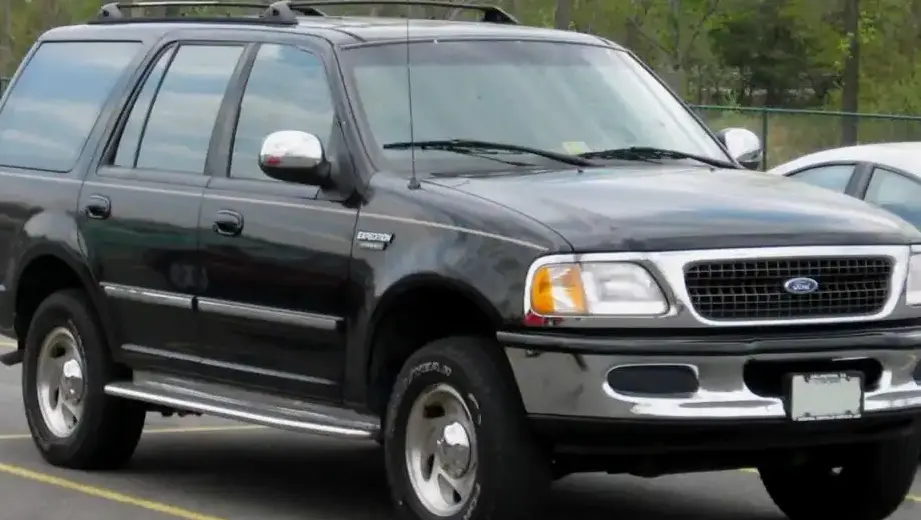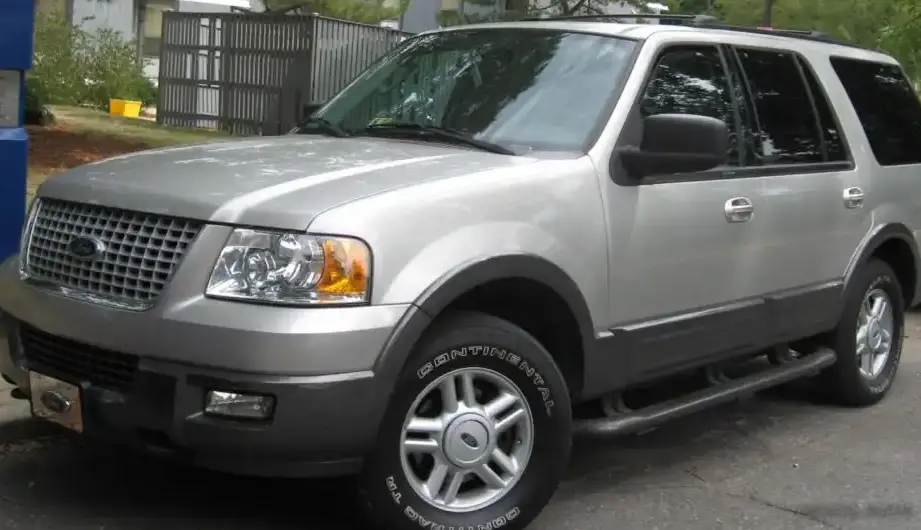
The Ford Expedition II 5.4i V8 4WD, produced for the 2003 and 2004 model years, represented a significant iteration of Ford’s full-size SUV. Positioned as a robust, family-oriented vehicle, the Expedition II (the second generation of the Expedition) aimed to provide ample space and towing capacity for American families. This particular variant, equipped with the 5.4-liter V8 engine and a four-speed automatic transmission, occupied a mid-to-upper range within the Expedition lineup, offering a balance between power, comfort, and capability. It was a key player in the competitive full-size SUV segment, facing rivals like the Chevrolet Tahoe and GMC Yukon.
Technical Specifications
| Brand | Ford |
| Model | Expedition |
| Generation | Expedition II |
| Type (Engine) | 5.4 i V8 16 L 4WD (263 Hp) |
| Start of production | 2003 |
| End of production | 2004 |
| Powertrain Architecture | Internal Combustion engine |
| Body type | SUV |
| Seats | 8 |
| Doors | 5 |
| Fuel consumption (urban) | 18.1 l/100 km (13 US mpg) |
| Fuel consumption (extra urban) | 13.9 l/100 km (16.9 US mpg) |
| Fuel Type | Petrol (Gasoline) |
| Maximum speed | 170 km/h (105.63 mph) |
| Weight-to-power ratio | 10.1 kg/Hp |
| Weight-to-torque ratio | 5.6 kg/Nm |
| Power | 263 Hp @ 4500 rpm |
| Power per litre | 48.7 Hp/l |
| Torque | 474 Nm @ 2500 rpm (349.6 lb.-ft. @ 2500 rpm) |
| Engine layout | Front, Longitudinal |
| Engine displacement | 5398 cm3 (329.41 cu. in.) |
| Number of cylinders | 8 |
| Engine configuration | V-engine |
| Cylinder Bore | 90.2 mm (3.55 in.) |
| Piston Stroke | 105.7 mm (4.16 in.) |
| Compression ratio | 9:1 |
| Number of valves per cylinder | 2 |
| Fuel injection system | Multi-port manifold injection |
| Engine aspiration | Naturally aspirated engine |
| Valvetrain | OHC |
| Engine oil capacity | 5.7 l (6.02 US qt | 5.02 UK qt) |
| Coolant | 18.4 l (19.44 US qt | 16.19 UK qt) |
| Kerb Weight | 2645 kg (5831.23 lbs.) |
| Max. weight | 3310 kg (7297.3 lbs.) |
| Max load | 665 kg (1466.07 lbs.) |
| Trunk (boot) space – minimum | 571 l (20.16 cu. ft.) |
| Trunk (boot) space – maximum | 1723 l (60.85 cu. ft.) |
| Fuel tank capacity | 106 l (28 US gal | 23.32 UK gal) |
| Length | 5228 mm (205.83 in.) |
| Width | 2000 mm (78.74 in.) |
| Height | 1971 mm (77.6 in.) |
| Wheelbase | 3023 mm (119.02 in.) |
| Front track | 1702 mm (67.01 in.) |
| Rear (Back) track | 1709 mm (67.28 in.) |
| Drive wheel | All wheel drive (4×4) |
| Number of gears and type of gearbox | 4 gears, automatic transmission |
| Front suspension | Double wishbone |
| Rear suspension | Double wishbone |
| Front brakes | Ventilated discs |
| Rear brakes | Ventilated discs |
| Assisting systems | ABS (Anti-lock braking system) |
| Steering type | Steering rack and pinion |
| Tires size | 265/70 R17 |
Powertrain & Engine Architecture
The heart of the Expedition II 5.4i was Ford’s 5.4-liter Triton V8 engine. This engine, designated with various codes depending on the specific year and calibration, was a three-valve-per-cylinder design, offering a good balance of power and efficiency for its size. The engine utilized a sequential multi-port fuel injection system, delivering fuel directly to each intake port. The 9:1 compression ratio was typical for a truck-based SUV of this era, prioritizing durability and torque over outright high-revving performance. The four-speed 4R70W automatic transmission was the standard pairing for this engine. This transmission, known for its robustness, featured electronic control for smoother shifting and improved fuel economy. While not the most technologically advanced transmission available at the time, it was well-suited to the demands of towing and hauling.
Driving Characteristics
The 5.4-liter V8, producing 263 horsepower and 349 lb-ft of torque, provided adequate power for the Expedition II, even with a full load of passengers and cargo. Acceleration was respectable, though not particularly brisk. The four-speed automatic transmission, while reliable, had relatively wide gear ratios. This meant that the engine often operated at lower RPMs during cruising, contributing to fuel efficiency, but could feel somewhat strained when accelerating quickly or climbing hills. Compared to the smaller 4.6-liter V8 offered in lower trims, the 5.4-liter provided a noticeable increase in towing capacity and overall performance. It didn’t offer the same sporty feel as some of the lighter SUVs on the market, but it excelled in providing a comfortable and capable driving experience.
Equipment & Trim Levels
The Expedition II 5.4i typically came standard with features like air conditioning, power windows and locks, a CD player, and cloth upholstery. Higher trim levels, such as the Eddie Bauer and Limited editions, added features like leather upholstery, heated seats, a premium sound system, and automatic climate control. Optional extras included a DVD entertainment system, a power-operated sunroof, and upgraded wheels. The interior design was functional and spacious, prioritizing practicality over luxury. The third-row seating was a key selling point, offering seating for up to eight passengers.
Chassis & Braking
The Expedition II utilized a body-on-frame construction, providing a robust and durable platform. The suspension consisted of independent double wishbones at both the front and rear, offering a comfortable ride quality. Ventilated disc brakes were standard on all four wheels, providing adequate stopping power for the vehicle’s weight. Anti-lock brakes (ABS) were also standard, enhancing safety. The rear axle featured a limited-slip differential, improving traction in slippery conditions. The 4WD system was typically a part-time system, allowing the driver to switch between two-wheel drive and four-wheel drive as needed.
Market Reception & Comparison
The Expedition II 5.4i was generally well-received by critics and consumers alike. It was praised for its spacious interior, comfortable ride, and strong towing capacity. However, fuel economy was a common criticism, as the large V8 engine and heavy weight resulted in relatively low MPG figures. Compared to the 4.6-liter V8 version, the 5.4-liter offered a significant performance advantage, but at the cost of slightly lower fuel economy. Reliability was generally good, although some owners reported issues with the spark plugs breaking during removal, a common problem with the Triton V8 engine.
Legacy
The Ford Expedition II 5.4i remains a popular choice in the used car market, particularly among those seeking a large, capable SUV for family transportation or towing. The 5.4-liter Triton V8 engine, while known for the spark plug issue, is generally considered a durable and reliable powerplant when properly maintained. Parts availability is good, and the vehicle’s relatively simple mechanical design makes it relatively easy to repair. While newer SUVs offer more advanced technology and better fuel economy, the Expedition II 5.4i continues to offer a compelling combination of space, capability, and affordability.