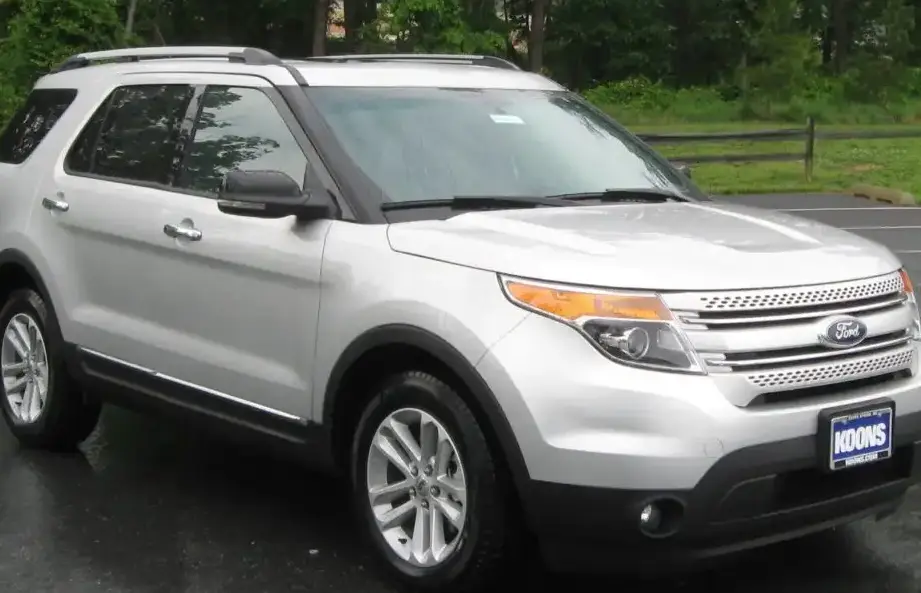
The Ford Explorer V 3.5 Ti-VCT V6 Automatic, produced from 2011 to 2016, represents the fifth generation of Ford’s popular SUV. This iteration of the Explorer marked a significant shift from the body-on-frame construction of previous generations to a more modern, car-like unibody platform, shared with the Ford Taurus and Lincoln MKS. The 3.5 Ti-VCT V6 Automatic trim occupied a central position in the Explorer lineup, offering a balance of power, space, and features aimed at families and those needing a versatile vehicle. It served as a key offering in the North American market, where large SUVs remained highly sought after.
Technical Specifications
| Brand | Ford |
| Model | Explorer |
| Generation | Explorer V |
| Type (Engine) | 3.5 Ti-VCT V6 (290 Hp) Automatic |
| Start of production | 2011 |
| End of production | 2016 |
| Powertrain Architecture | Internal Combustion engine |
| Body type | SUV |
| Seats | 7 |
| Doors | 5 |
| Fuel consumption (urban) | 13.8 l/100 km (17 US mpg, 20.5 UK mpg, 7.2 km/l) |
| Fuel consumption (extra urban) | 9.4 l/100 km (25 US mpg, 30.1 UK mpg, 10.6 km/l) |
| Fuel consumption (combined) | 11.8 l/100 km (19.9 US mpg, 23.9 UK mpg, 8.5 km/l) |
| Fuel Type | Petrol (Gasoline) |
| Power | 290 Hp @ 6500 rpm |
| Power per litre | 83.1 Hp/l |
| Torque | 346 Nm @ 4000 rpm (255.2 lb.-ft. @ 4000 rpm) |
| Engine layout | Front, Transverse |
| Engine displacement | 3490 cm3 (212.97 cu. in.) |
| Number of cylinders | 6 |
| Engine configuration | V-engine |
| Cylinder Bore | 92.5 mm (3.64 in.) |
| Piston Stroke | 86.7 mm (3.41 in.) |
| Compression ratio | 10.8:1 |
| Number of valves per cylinder | 4 |
| Fuel injection system | Multi-port manifold injection |
| Engine aspiration | Naturally aspirated engine |
| Valvetrain | DOHC |
| Engine oil capacity | 5.7 l (6.02 US qt | 5.02 UK qt) |
| Coolant capacity | 11.5 l (12.15 US qt | 10.12 UK qt) |
| Trunk (boot) space – minimum | 595 l (21.01 cu. ft.) |
| Trunk (boot) space – maximum | 2285 l (80.69 cu. ft.) |
| Fuel tank capacity | 70 l (18.49 US gal | 15.4 UK gal) |
| Permitted trailer load with brakes (12%) | 2268 kg (5000.08 lbs.) |
| Length | 5006 mm (197.09 in.) |
| Width | 2004 mm (78.9 in.) |
| Width with mirrors folded | 2096 mm (82.52 in.) |
| Width including mirrors | 2291 mm (90.2 in.) |
| Height | 1788 mm (70.39 in.) |
| Wheelbase | 2860 mm (112.6 in.) |
| Front track | 1702 mm (67.01 in.) |
| Rear track | 1702 mm (67.01 in.) |
| Front overhang | 965 mm (37.99 in.) |
| Rear overhang | 1181 mm (46.5 in.) |
| Ride height (ground clearance) | 193 mm (7.6 in.) |
| Approach angle | 21.7° |
| Departure angle | 21.4° |
| Ramp-over angle | 16.5° |
| Drivetrain Architecture | Front wheel drive |
| Number of gears | 6 |
| Gearbox type | Automatic transmission |
| Front suspension | Independent type McPherson |
| Rear suspension | Independent multi-link suspension |
| Front brakes | Ventilated discs |
| Rear brakes | Disc |
| Steering type | Steering rack and pinion |
| Power steering | Electric Steering |
| Tires size | 245/65 R17; 245/60 R18; 255/50 R20 |
| Wheel rims size | 7.5J x 17; 8J x 18; 8.5J x 20 |
Powertrain & Engine Architecture
The heart of the Explorer V 3.5 Ti-VCT was the 3.5-liter Duratec 35 V6 engine. This engine, designated with the engine code 928F, featured twin independent variable camshaft timing (Ti-VCT), which optimized valve timing for improved performance and fuel efficiency. The engine utilized multi-port fuel injection and a naturally aspirated design, delivering a respectable 290 horsepower and 255 lb-ft of torque. The six-speed automatic transmission (6F55) was the sole transmission option for this variant. This transmission was known for its smooth shifting characteristics, but wasn’t particularly sporty. It was tuned for comfort and fuel economy rather than aggressive acceleration.
Driving Characteristics
The 3.5L V6 and 6-speed automatic combination provided adequate, but not exhilarating, performance. Acceleration from 0 to 60 mph typically took around 7.5-8.5 seconds. The automatic transmission’s gear ratios were geared towards cruising comfort and fuel efficiency, meaning it wasn’t as responsive as some competitors with more aggressively tuned transmissions. Compared to the base 3.5L engine without Ti-VCT, the 290 hp version offered a noticeable improvement in power, particularly during highway merging and overtaking. However, it didn’t match the performance of the optional 3.5L EcoBoost V6, which offered significantly more horsepower and torque. The front-wheel-drive configuration contributed to decent fuel economy, but limited traction in adverse weather conditions.
Equipment & Trim Levels
The 3.5 Ti-VCT Automatic Explorer typically came standard with features like tri-zone automatic climate control, a six-speaker audio system, Bluetooth connectivity, and a rearview camera. Higher trim levels, such as the Limited, added features like leather upholstery, heated front seats, a power liftgate, and a navigation system. Optional extras included a panoramic sunroof, a premium sound system, and advanced safety features like blind-spot monitoring and rear cross-traffic alert. Interior upholstery was typically cloth on base models, with leather available on higher trims. The dashboard layout was functional and user-friendly, with a focus on ease of use.
Chassis & Braking
The Explorer V utilized an independent front suspension with McPherson struts and an independent multi-link rear suspension. This setup provided a comfortable ride quality, although handling wasn’t particularly sporty. Front disc brakes were ventilated, while rear brakes were solid discs. Anti-lock braking system (ABS) was standard. The Explorer’s chassis was designed to prioritize passenger comfort and space, rather than sharp handling. Stabilizer bars were included both front and rear, but were relatively modest in size compared to sportier SUVs.
Market Reception & Comparison
The Explorer V 3.5 Ti-VCT Automatic was generally well-received by critics as a practical and comfortable family SUV. Fuel economy was considered average for its class, with combined ratings around 19.9 US mpg. Reliability was generally good, although some owners reported minor issues with the transmission and electrical systems. Compared to the base 3.5L Explorer, the Ti-VCT version offered a worthwhile performance upgrade. However, the EcoBoost V6 offered a more substantial performance boost, albeit at a higher price point. The Explorer competed with other mid-size SUVs like the Honda Pilot, Toyota Highlander, and Chevrolet Traverse.
Legacy
The Ford Explorer V 3.5 Ti-VCT Automatic remains a relatively common sight on the used car market. The 3.5L Duratec V6 engine is known for its durability, although regular maintenance is crucial to prevent issues. The 6F55 automatic transmission can be prone to failure if not properly maintained. Overall, this Explorer variant offers a good value proposition for buyers seeking a spacious, comfortable, and reliable SUV. Its unibody construction and modern features represent a significant step forward from previous Explorer generations, solidifying its place as a popular choice for families.