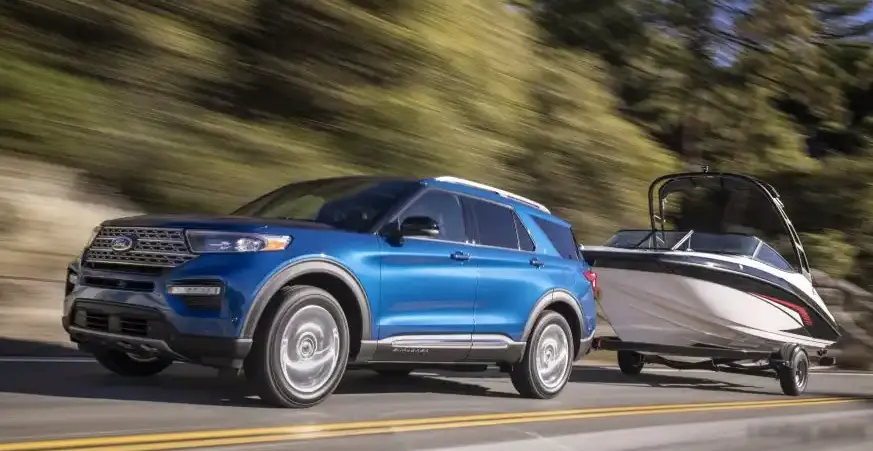
The Ford Explorer VI 2.3 EcoBoost AWD Automatic, produced from May 2019 to February 2024, represents a significant iteration in Ford’s long-running Explorer SUV lineage. This variant occupied a key position in the sixth generation (2020-2024) Explorer lineup, offering a balance between performance, fuel efficiency, and capability for families and active individuals. It was positioned as a mid-range offering, slotting between the base 2.3L non-turbo engine and the more powerful 3.0L EcoBoost V6 models. The Explorer VI moved to a rear-wheel-drive based platform, a departure from previous generations, enhancing its driving dynamics and towing capacity.
Technical Specifications
| Brand | Ford |
| Model | Explorer |
| Generation | Explorer VI |
| Type (Engine) | 2.3 EcoBoost (300 Hp) AWD Automatic |
| Start of production | May, 2019 |
| End of production | February, 2024 |
| Powertrain Architecture | Internal Combustion engine |
| Body type | SUV |
| Seats | 6-7 |
| Doors | 5 |
| Fuel consumption (urban) | 11.8 l/100 km (19.9 US mpg) |
| Fuel consumption (extra urban) | 8.7 l/100 km (27 US mpg) |
| Fuel consumption (combined) | 10.2 l/100 km (23.1 US mpg) |
| Fuel Type | Petrol (Gasoline) |
| Power | 300 Hp @ 5500 rpm |
| Torque | 420 Nm @ 3500 rpm (309.78 lb.-ft. @ 3500 rpm) |
| Engine displacement | 2261 cm3 (137.97 cu. in.) |
| Number of cylinders | 4 |
| Engine configuration | Inline |
| Cylinder Bore | 87.55 mm (3.45 in.) |
| Piston Stroke | 94 mm (3.7 in.) |
| Compression ratio | 10:1 |
| Number of valves per cylinder | 4 |
| Fuel injection system | Direct injection |
| Engine aspiration | Turbocharger, Intercooler |
| Valvetrain | DOHC |
| Engine oil capacity | 4.9 l (5.18 US qt | 4.31 UK qt) |
| Coolant | 13.3 l (14.05 US qt | 11.7 UK qt) |
| Trunk (boot) space – minimum | 515 l (18.19 cu. ft.) |
| Trunk (boot) space – maximum | 2485 l (87.76 cu. ft.) |
| Fuel tank capacity | 68 l (17.96 US gal | 14.96 UK gal) |
| Permitted trailer load with brakes (12%) | 2400 kg (5291.09 lbs.) |
| Length | 5049 mm (198.78 in.) |
| Width | 2004 mm (78.9 in.) |
| Width with mirrors folded | 2100 mm (82.68 in.) |
| Width including mirrors | 2268 mm (89.29 in.) |
| Height | 1775 mm (69.88 in.) |
| Wheelbase | 3025 mm (119.09 in.) |
| Front track | 1699 mm (66.89 in.) |
| Rear (Back) track | 1699 mm (66.89 in.) |
| Front overhang | 856 mm (33.7 in.) |
| Rear overhang | 1168 mm (45.98 in.) |
| Ride height (ground clearance) | 200 mm (7.87 in.) |
| Approach angle | 21° |
| Departure angle | 22° |
| Ramp-over (brakeover) angle | 17.1° |
| Drive wheel | All wheel drive (4×4) |
| Number of gears and type of gearbox | 10 gears, automatic transmission SelectShift |
| Front suspension | Independent, type McPherson with coil spring and anti-roll bar |
| Rear suspension | Independent multi-link spring suspension with stabilizer |
| Front brakes | Disc |
| Rear brakes | Disc |
| Assisting systems | ABS (Anti-lock braking system) |
| Steering type | Steering rack and pinion |
| Power steering | Electric Steering |
| Tires size | 255/65 R18; 255/55 R20; 275/45 R21 |
| Wheel rims size | 18; 20; 21 |
Powertrain & Engine Architecture
The heart of the Explorer VI 2.3 EcoBoost is Ford’s 2.3-liter turbocharged inline-four cylinder engine, internally designated as the EcoBoost. This engine utilizes direct fuel injection, a twin-scroll turbocharger, and a double overhead camshaft (DOHC) valvetrain with four valves per cylinder. The engine’s design prioritizes both power and efficiency. The turbocharger provides increased air intake, boosting horsepower and torque, while direct injection ensures precise fuel delivery. The 10-speed SelectShift automatic transmission, co-developed with General Motors, is a key component of this powertrain. This transmission offers a wide range of gear ratios, optimizing both acceleration and fuel economy. The transmission’s sophisticated control system adapts to driving conditions and driver input, providing smooth and responsive shifts.
Driving Characteristics
The 2.3L EcoBoost engine delivers a respectable 300 horsepower and 310 lb-ft of torque, providing adequate performance for everyday driving and light towing. While not as quick as the 3.0L EcoBoost V6, the 2.3L offers a more balanced driving experience. The 10-speed automatic transmission contributes to smooth acceleration and efficient cruising. The rear-wheel-drive bias, inherent in the Explorer VI’s platform, enhances handling and provides a more engaging driving experience compared to previous front-wheel-drive based Explorers. The all-wheel-drive system provides enhanced traction in inclement weather conditions. Compared to manual transmission options (not available with this engine), the automatic prioritizes convenience and ease of use, but may slightly reduce responsiveness.
Equipment & Trim Levels
The 2.3 EcoBoost trim typically included standard features such as Ford’s SYNC 3 infotainment system with an 8-inch touchscreen, Apple CarPlay and Android Auto compatibility, and a suite of driver-assistance technologies including automatic emergency braking, lane-keeping assist, and blind-spot monitoring. Interior upholstery was typically cloth, with available upgrades to leather. Higher trim levels offered features like heated and ventilated front seats, a panoramic sunroof, and a premium sound system. Optional extras included a navigation system, adaptive cruise control, and a rear-seat entertainment system.
Chassis & Braking
The Explorer VI utilizes an independent front suspension with McPherson struts and a multi-link independent rear suspension. This suspension setup provides a comfortable ride and good handling characteristics. The 2.3 EcoBoost models typically featured disc brakes on all four wheels, providing adequate stopping power. Anti-lock braking system (ABS) was standard. Stabilizer bars were included on both the front and rear axles to reduce body roll during cornering. The suspension tuning was generally geared towards comfort, but offered a reasonable level of control for an SUV of its size.
Market Reception & Comparison
The Explorer VI 2.3 EcoBoost AWD Automatic was generally well-received by automotive critics. It was praised for its comfortable ride, spacious interior, and user-friendly technology. Fuel economy was considered competitive for its class, averaging around 23 mpg combined. Compared to the 3.0L EcoBoost V6, the 2.3L offered a more affordable entry point into the Explorer lineup, but with a noticeable reduction in performance. Compared to the base 2.3L non-turbo engine, the EcoBoost version provided a significant power boost. Reliability reports have been mixed, with some owners reporting issues with the 10-speed automatic transmission, while others have experienced no major problems.
Legacy
The Ford Explorer VI 2.3 EcoBoost AWD Automatic represents a transitional point in the Explorer’s history, moving to a more modern platform and powertrain. While the 10-speed automatic transmission has been the subject of some criticism, the 2.3L EcoBoost engine has proven to be a relatively reliable and efficient powerplant. On the used car market, these Explorers offer a good value proposition for families seeking a spacious and capable SUV. Maintenance costs are generally reasonable, and parts availability is good. The Explorer VI 2.3 EcoBoost remains a popular choice for those seeking a well-rounded and versatile SUV.